Some mornings feel washed clean. The rain has passed in the night, the leaves outside the window look newly rinsed, and the air smells of wet soil and cut grass. Nothing on the day ahead is urgent.
Green obsidian fits mornings like that: a deep green glassy stone that catches the light and throws it back as a fresh, cool green, like the first leaves of spring held up to the sun. It is dark enough to feel solid, yet its green keeps it lively.
This guide looks closely at green obsidian: what the stone is and how much of what is sold is really natural, how to judge a piece before you buy it, how it differs from the other obsidians here, and how to arrange it on a tray with a glass of water close by. It is something to look at and to hold, and nothing more; it cannot heal the body or change a day.
Key Takeaways
- Green obsidian is a deep green volcanic glass, fresh and cool in colour.
- Much green obsidian sold today is man-made glass, so ask the seller plainly.
- Its fresh green suits calm days, slow mornings and unhurried hours.
- Green obsidian is for looking at and holding only; it heals nothing and cures nothing.
- The stone sits on the dry side of the tray, with the glass kept apart.
What Green Obsidian Is
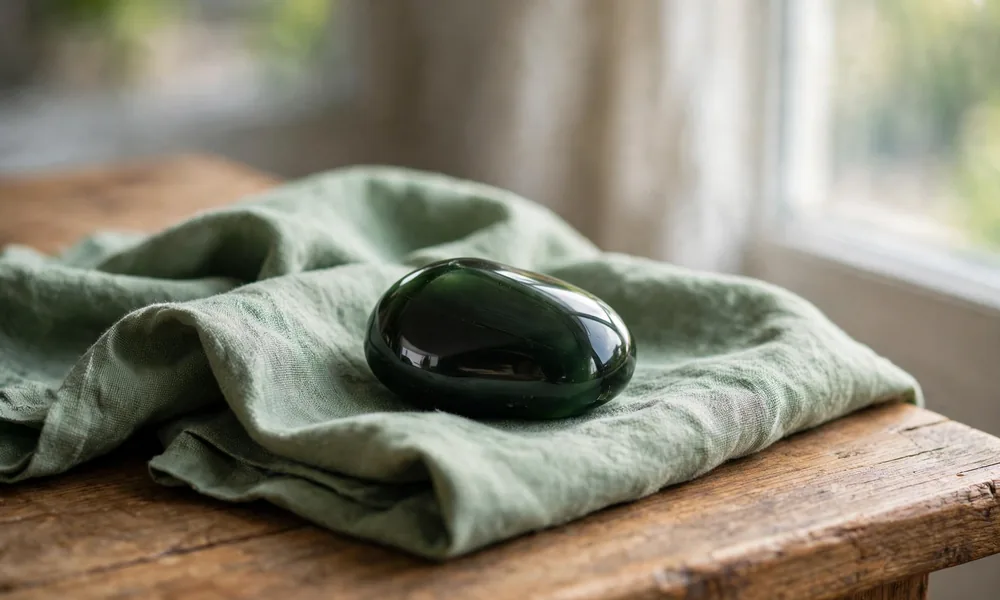
Green obsidian is obsidian in its green form: a volcanic glass made when lava cools so fast that no crystals have time to grow. The result is a smooth, glassy stone, dark green all through, with a soft shine rather than a hard glitter.
Here is the honest part, and it matters. True natural green obsidian is rare, and most pieces sold under this name are man-made glass, coloured green in a furnace and polished to look like the real thing. A seller who says plainly whether a piece is natural or furnace-made is a seller worth trusting, and one who will not answer should be left alone.
A polished piece feels cool when you first close your fingers round it, then warms slowly, with a smooth face and a gentle glow rather than a sharp sparkle. Tilt it under a lamp and the green shifts, darker at one edge and brighter at the other.
Why Fresh Green Fits Calm Days
Green is the colour of things that grow without hurrying: a lawn after rain, a hedge in June, a pot of mint on the sill. A calm day works the same way, made from small repeated jobs and long pauses between them.
A stone that flashes and sparkles would sit badly with that mood, and a very dark one would feel too grave for an ordinary Tuesday. Fresh green sits between the two, quiet and lively at once.
Picking a Green Obsidian Piece
Take the stone to a window and turn it slowly in the daylight. A good piece shows its green clearly from every side, without milky patches, grey streaks or a chipped edge. Set it on a table and check that it rests flat instead of wobbling.
Ask the seller directly whether the piece formed in a volcano or was coloured in a furnace. Leave behind any green that looks brushed onto the outside, any price far above what an ordinary stone should fetch, and any seller who promises better health or good fortune.
A Calm Day with Green Obsidian
Put a small wooden board by the window, with the green obsidian on the left and a tall glass of drinking water on the right, and a stretch of bare wood in the middle. Sip the water slowly and let your gaze rest on the green while the morning finds its rhythm.
Nothing here needs finishing. The board, the glass and the stone are the entire plan, and the rest of the morning can be spent reading.
Green Obsidian Beside Water
Green obsidian and water look pleasant side by side, yet the two should never meet. Put the glass at one end of the board and the stone at the far end, with plain wood in between, so the drink stays clean and the glass stays dry. The board is a place to show the stone, not a place to wash it.
Once the stone is in place, wash your hands with soap before lifting the glass to drink. The stone must never be dropped into a glass, a jug or a bath, and water must never be poured across it.
Green Obsidian at a Glance
| Fresh green glass | Tray, shelf, desk | Display only |
|---|---|---|
| Even, cool tone | Soft light, still air | Keep it dry |
| Smooth, solid, heavy | Slow days, plain hours | Wash hands after |
| Palm-sized piece | Water kept apart | Never in a drink |

Green Obsidian and Silver Sheen Obsidian
Silver sheen obsidian for quiet days is the cool cousin of this stone: black volcanic glass whose pale silver-grey glow drifts across the face as the piece is turned, soft and moonlit. Where that stone cools a room with grey light, green obsidian fills it with the colour of leaves.
The two stones suit different hours of the day. Silver sheen belongs in dim, quiet light, where nothing is hurrying. Green obsidian belongs where the light is fresh and the day is open, on a sill with a plant beside it.
Green Obsidian and the Other Obsidians
The rest of the obsidian family holds more colours still, and none of them is the fresh green of this guide. Gold sheen obsidian for bold days is a black volcanic glass with a warm golden shine that moves across its surface, made for days that ask for brightness and nerve. Rainbow obsidian for bold days is a dark black glass with a rainbow shine that flashes in the light. Mahogany obsidian is a warm brown volcanic glass with soft reddish-brown swirls, like polished wood caught in stone. Black obsidian is a smooth black volcanic glass, dark and glossy, kept as a quiet marker for busy weeks. Snowflake obsidian is black volcanic glass marked with soft white spots, kept as a calm reminder for a new routine.
Green obsidian stands apart by being simply fresh green, with no silver, no gold, no rainbow flash and no white spots inside it.
Green Obsidian and Its Batch 81 Siblings
Two more obsidians are queued in this same batch, and neither is live on this site yet. Blue obsidian, topic 800, is the blue member of the family, and peanut obsidian, topic 804, is the speckled brown member with pale peanut-coloured marks. Both will have their own guides.
Green obsidian keeps its own place among them: a deep green glass for calm days, while blue will speak in cooler tones and peanut in warmer ones.

Where Green Obsidian Lives at Home
The best home for green obsidian is somewhere your eyes land every day: a bookshelf top, a dresser corner, or a stair ledge, provided the stone is simple to see and difficult to knock off. It looks its best in morning light.
Choose a place far from sinks and showers, where steam and splashes never reach, and high enough that small children cannot grab it. A stone kept in sight gets noticed.
Looking After Green Obsidian
Because it is glass, green obsidian can survive ordinary handling yet still chip if it falls. Wipe it with a dry cloth during the weekly tidy. Soap, polish and household cleaners are not needed, and they can take the brightness off the surface.
Between displays, store the stone in a soft pouch of its own, away from keys, coins and harder pieces. Treat a chipped edge with care, since glass can cut, and do not let the stone drop onto tiles or stone floors.
Stones That Must Stay Away from Water
Water is not kind to every stone. Amber is hardened tree resin, not rock, and soaking it for hours can cloud it and soften its face. Pyrite loses its shine in damp air and can rust, leaving brown marks on the shelf below. Angelite is a soft stone, and water slowly rubs its surface down.
A few stones also carry metals and minerals that have no place in a drink. Malachite is rich in copper and must never be placed in water. Lepidolite contains lithium, so it stays out of soaks and elixirs too. Apatite is far too soft to soak, hematite will rust when left damp, and amber never belongs in drinking water. Green obsidian follows the same habit as all of them: it stays on the dry part of the tray, well away from the glass.
Your Calm Days Checklist
- Lay the green obsidian on a dry board, with a full glass set apart.
- Sip the water slowly as the morning light grows stronger.
- Wash your hands once the stone is back in its place.
- Ask the seller outright whether the piece is natural or furnace-made.
- Store it dry and cool, out of reach of little hands.
- If a health worry lingers, ask a doctor; stones treat nothing.

Frequently Asked Questions
What is green obsidian?
Green obsidian is a deep green volcanic glass, formed when lava cools so quickly that crystals never get the chance to grow. It polishes smoothly, shines softly, and feels cool and firm when held.
Is green obsidian natural or man-made?
True natural green obsidian is rare, and much of what is sold as green obsidian is glass coloured green in a furnace. Ask the seller plainly.
How is green obsidian different from silver sheen obsidian?
Silver sheen obsidian is dark glass whose pale silver-grey glow drifts across the face as you turn it. Green obsidian is a deep green glass with no silver glow inside it.
How is green obsidian different from rainbow obsidian?
Rainbow obsidian is a dark black glass with a rainbow shine that flashes in the light. Green obsidian is a deep green glass with an even green colour and no rainbow flash.
Is green obsidian safe to hold?
For most people, holding it for a short while is fine. Put it back afterwards, wash your hands with soap, and keep it away from children and from food.
Where should I keep green obsidian at home?
Choose a dry, quiet spot, a shelf, a sill or a ledge, with the glass standing apart from it, and the stone protected from knocks and damp.
The Bottom Line
Green obsidian gives calm days a fresh companion: one deep green glassy stone resting in soft light, on a wooden board with a glass of water close by.
A Note for Calm Days
Keep the day plain and the stone dry. One green obsidian, one glass of water, and a few unhurried hours to enjoy them.