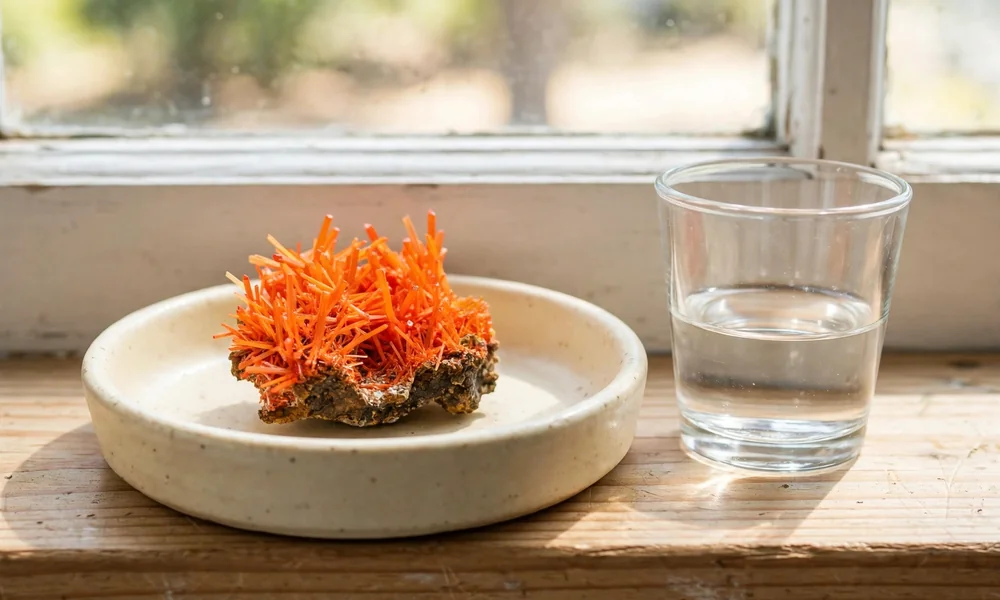
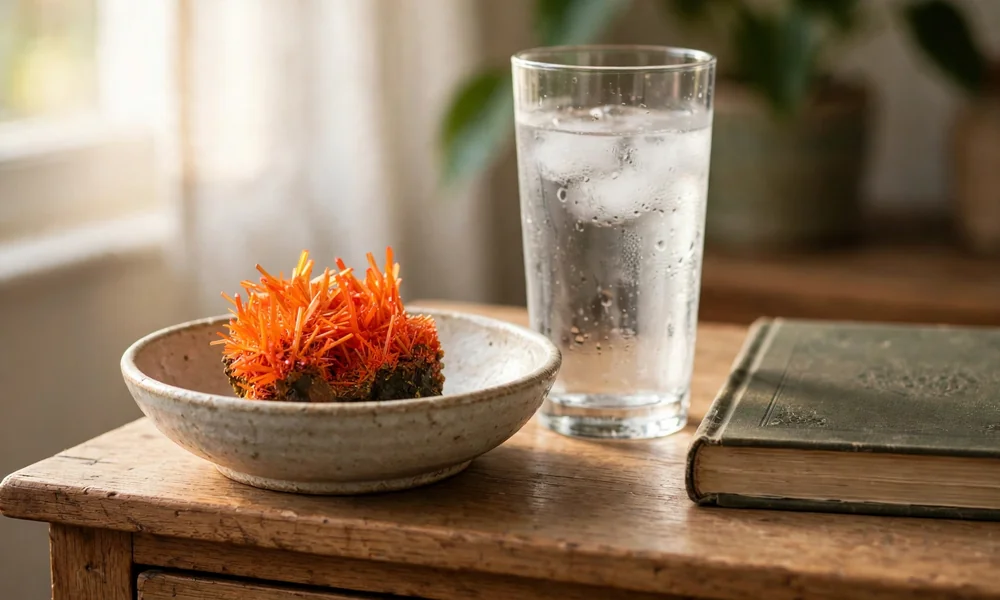
Few minerals look as if they were lit from inside. Crocoite does: a spray of slender orange-red needles rising from dark rock, each one catching the sun and throwing it back in a sharp, fiery line.
A bright day is the right setting for such a stone. When the sky is clear and the rooms are full of light, a small vivid object on a tray can lift the whole corner where it sits. It asks for very little in return: a dry place, a little space, and a firm rule about water.
That firm rule comes first in this guide, and it shapes everything that follows. Crocoite is lead chromate, a mineral that holds lead, so it is a piece for the eyes only: it is admired on its tray, it never goes near a drink, and hands are washed after it is touched. With that understood, the rest is pleasure: what the mineral is, how it differs from the other warm stones, how to pick a sound piece, and where it sits best at home.
Key Takeaways
- Crocoite is a vivid orange-red lead chromate, grown as long slender needles.
- Its fiery colour suits bright days, clear light and open windows.
- Crocoite holds lead: it is for display only, never in water or near food.
- Wash your hands after touching it, and keep it out of reach of children and pets.
- The stone sits dry beside its glass, never inside it, on a plain tray.
What Crocoite Is
Crocoite is lead chromate, a mineral built from lead, chromium and oxygen, and it grows in long, thin crystals, often no thicker than a matchstick, that shoot out from the matrix like frozen sparks. The colour runs from a clear bright orange to a deep orange-red, and a fine piece glows in sunlight the way a coal glows in a grate.
The finest specimens come from Tasmania, from the old lead workings around Dundas, where miners first pulled the bright needles from the ground. Good pieces are scarce and fragile, so a specimen is usually kept in a box or under a cover.
Why Warm Orange Suits Bright Days
Orange sits exactly where a bright day needs it, between the softness of yellow and the urgency of red, so it warms a room without hurrying it. Crocoite holds its own against the sunshine because its colour is as strong as the light itself.
Crocoite and Wulfenite: Needles Beside Plates
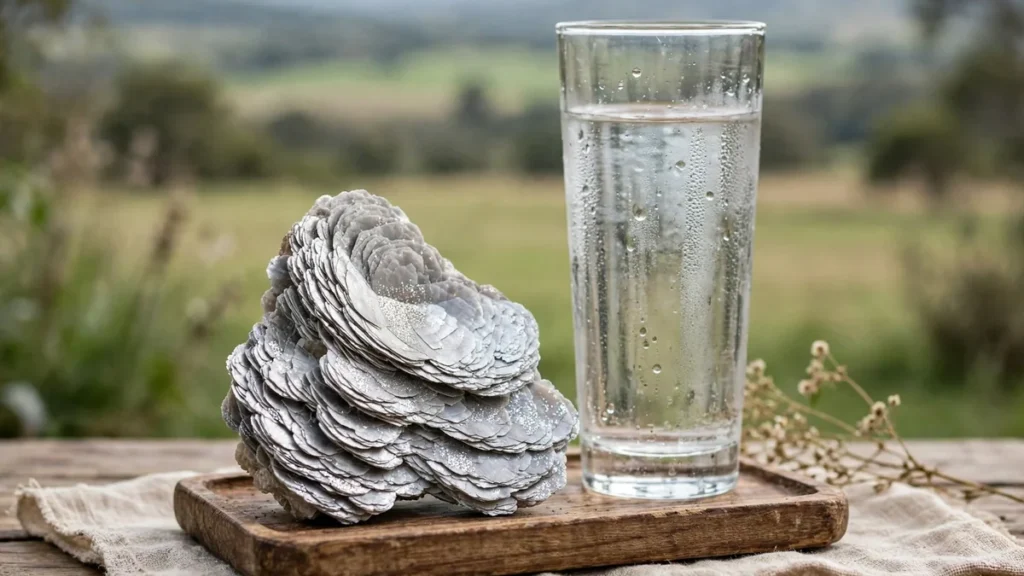
Wulfenite warm orange for bright days follows a lead mineral that spreads across dark rock in thin square plates, marigold-orange and flat, overlapping like the tiles of a tiny roof. Its orange is broad and even, and a cluster looks like a little tiled roof left out in the sun.
Where wulfenite lies flat, crocoite shoots upward in needles; where wulfenite spreads, crocoite bristles. The chemistry differs too: wulfenite is a lead molybdate, crocoite a lead chromate, — wulfenite from the desert mines of Arizona and Mexico, crocoite from the old workings of Tasmania. Both hold lead, so both are display pieces with the same hand-washing rule, yet on the tray they could hardly look more different: one a tiled roof, the other a burst of sparks.
Choosing a Crocoite Piece
Look at crocoite in plain daylight, away from shop lamps. A good piece shows needles of one even, fiery colour, with sharp points and a glassy shine, and no dull brown patches where the surface has faded. The matrix beneath should be firm and dark, holding the needles upright without wobbling.
Pick a piece about the size of a plum, and check the needles with your eyes, not your fingers — they are brittle, and a careless touch snaps them. Ask the seller where the piece was found, and walk away from any seller who claims the stone can improve health. A plain answer about the mine is worth far more than any grand promise.
A Bright Morning with Crocoite
Begin the morning by giving the stone its place before the day fills up. Spread a folded beige cloth over the side table, place the crocoite where its brightest needles face the window, and stand a tall glass of water at the opposite end.
Once the glass is drained and the cloth put away, the little bright rite is finished, and the stone may rest there till evening.
Crocoite Beside Water
A glass of water and a crocoite piece can share a tray, provided each keeps strictly to its own side. Put the glass at one end and the stone at the other, leaving bare wood or cloth between them, so no drop ever reaches the needles. It must stay clear of all water vessels — no glass, no jug, no bath — and never pass beneath a tap, because crocoite holds lead. Once a week, blow the dust gently from the needles; that is all the cleaning it will ever need.

Crocoite at a Glance
| Vivid orange-red needles | Tray, shelf, desk | Dry hands only |
|---|---|---|
| Lead chromate, Tasmania | Bright days, clear light | Glass kept apart |
| Fragile, brittle crystals | One small cluster | Wash hands after |
| Plum-sized piece | Wood, cloth, sunlight | Keep it dry |
Crocoite and Vanadinite: Orange Needles, Red Clusters
Vanadinite warm red for bold days follows a deep warm red crystal that grows in sharp hexagonal points, gathered into bright clusters on a rocky brown base. Its crystals are short and blocky, with flat tops and clean edges.
Crocoite could hardly grow more differently: its crystals are long and thin where vanadinite's are short and stout, and its colour is orange-red where vanadinite's is a deeper red. Vanadinite is a lead vanadate, crocoite a lead chromate. What the two share is the rule that governs them both — each holds lead, each is for display only, each stays far from water and food, and each asks for washed hands after handling.
Crocoite and Mimetite: Sparks Beside Grapes
Mimetite warm yellow for bright days follows a warm yellow mineral that grows in two shapes at once: slim hexagonal prisms with flat ends, and soft rounded lumps like a bunch of tiny yellow grapes.
Crocoite shares the bright-day mood but little else. Its needles are longer and sharper than anything mimetite grows, and its orange-red sits a full step warmer than mimetite's yellow. Mimetite holds lead and arsenic together, crocoite holds lead with chromium, so both are strictly display pieces, yet mimetite's arsenic adds a second reason never to let it near food or drink.
Crocoite Among the Other Stones in This Batch
This batch holds four more minerals beside crocoite, each wearing a colour far from orange-red. Ammonite is warm brown and coiled, an ancient shell turned to stone. Chalcopyrite is warm gold, brassy and metallic. Lazurite is deep blue, the cool opposite of crocoite's fire, and poudretteite is soft pink, gentle where crocoite is fierce.
The nearest water article is water and a clay bowl, a beginner's guide to a simple vessel. Crocoite holds the bright orange corner of the batch, the one vivid note among browns, golds, blues and pinks.
Where Crocoite Rests at Home
Pick a shelf the household walks past often but rarely knocks — the far end of a worktop, a high ledge, or a cupboard top — and keep it away from taps, kettles, steam, small hands and pets.
Once a week, pick it up by its base and check whether any needle has loosened. To carry it anywhere, wrap it in tissue inside its own padded box, away from anything hard enough to snap the needles.
Stones That Must Stay Away from Water
Some minerals need a sterner warning than most. Malachite's green bands carry copper, which has no place near a mouth, so that stone stays well clear of every jug and tumbler. Hematite can rust when it sits wet, so it stays out of drinking water as well.
Apatite crumbles when it is soaked, and angelite turns cloudy after a wetting, so both belong on a dry shelf. Because lepidolite's flakes hold lithium, keep cups and glasses well away from it. Amber is old hardened tree resin, and soaking turns it cloudy, never clear. Pyrite can tarnish and stain when it stays damp, so it also stays dry. Treat crocoite with the same care, and more: a dry tray, a glass standing apart, and hands washed after every touch.
Your Bright Days Checklist
- Set the crocoite down on a dry cloth, keeping the glass a hand-span away.
- Sip the water slowly, one small mouthful after another, in the morning light.
- Look at the needles from two angles and watch how the colour shifts.
- Set the piece down on its tray again, then go and wash your hands.
- Buy only from a seller who can name the mine in plain words.
- If a health worry stays with you, ask a doctor — no orange stone can answer it.
Tray, glass, cloth and one small fiery cluster — nothing else is needed.
Frequently Asked Questions
What is crocoite, in plain words?
Crocoite is a vivid orange-red lead chromate mineral, grown as long slender needles on dark rock, first found in the old lead workings of Tasmania.
Why is crocoite kept out of water?
Crocoite holds lead, which is harmful if swallowed, so the stone must never touch drinking water, a soak or a bath, and any glass it ever fell into should be emptied and washed well.
How can I tell crocoite from wulfenite?
Wulfenite grows in flat square orange plates, like tiny tiles, while crocoite grows in long thin needles, like frozen sparks, so the shape alone tells them apart at a glance.
How do I pick a good crocoite piece?
Look for needles of one even fiery orange-red in daylight, with sharp points and no dull patches, on a firm dark base.
Is it all right to hold crocoite for a short while?
Most adults can lift a small dry piece briefly by its base for a closer look, then set it back and wash their hands with soap.
Where should crocoite live at home?
Give it a dry place in bright light, such as a high shelf, far from water, steam, small hands and pets.

The Bottom Line
One vivid orange cluster kept dry, and water that stays in its glass: that is all a bright day asks of crocoite.
A Note for Bright Days
A fiery stone resting dry, a glass of water standing clear, and the sun moving slowly across the room — that is the whole of it.