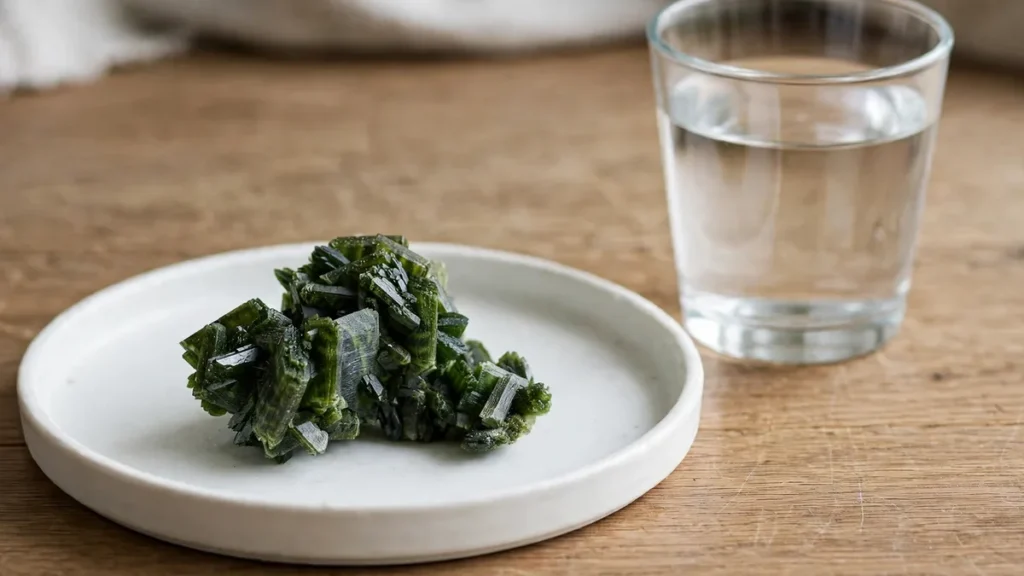
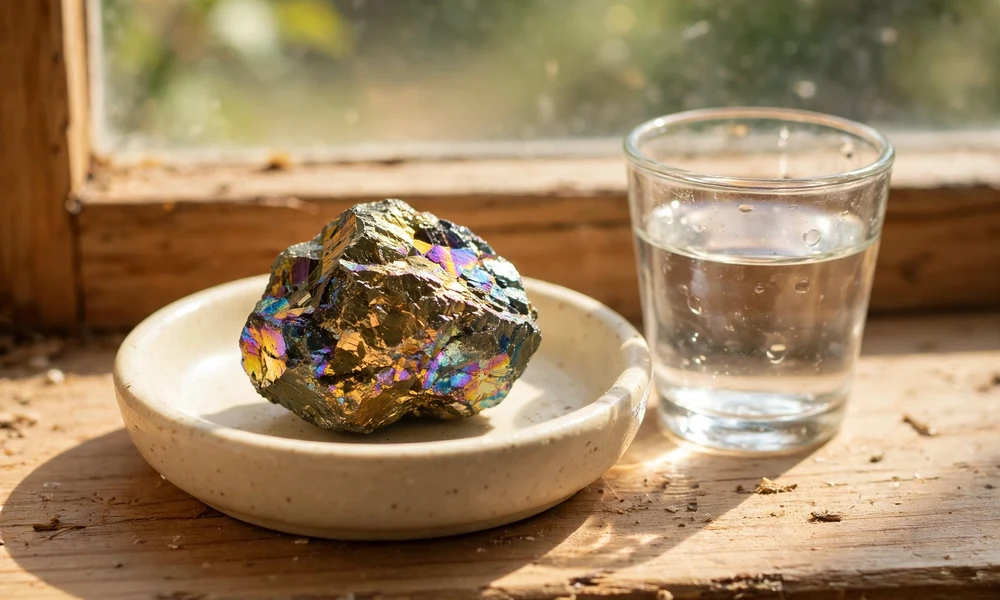
Hold a piece of chalcopyrite under a lamp and the first thing you notice is the gold. It is not the pale yellow of a lemon or the glitter of a sequin; it is a deep brassy gold, the colour of an old brass kettle. Then, as you turn the piece, flashes of purple, blue and green slide across its faces, like oil on a puddle after rain.
That play of colour is what earns chalcopyrite a place on a shelf. It is the main ore from which the world gets its copper, so most of it ends up in wires and pipes, and only a few fine pieces reach a collector's tray. A small one is enough: it catches lamplight from across a room and warms a plain corner.
This guide explains chalcopyrite in plain words: what the mineral is, how to tell it apart from pyrite, how to pick a good piece, and where it sits at home next to a glass of water. It is an ornament to look at, nothing more, and it stays dry always.
Key Takeaways
- Chalcopyrite is copper iron sulfide, a brassy gold mineral and the world's main copper ore.
- Its gold deepens with flashes of purple, blue and green where the surface has tarnished.
- Chalcopyrite is not pyrite: it holds copper and is much softer.
- The stone is for display only; it never goes into water and never near a drink.
- One small piece on a plain tray is enough.
What Chalcopyrite Is
Chalcopyrite is a sulfide mineral built from copper, iron and sulfur, and its formula is written CuFeS2. It grows in the tetragonal pattern, forming chunky masses and rough crystals that are seldom neat or tidy. Fresh faces shine a rich brassy yellow, while older faces darken toward bronze and pick up the rainbow tarnish that collectors love.
Miners have dug it for centuries because it carries more of the world's copper than any other mineral. Good specimens come from many countries, and dealers sell them by weight and by the brightness of their gold. A piece the size of a walnut can sit happily on a desk for years without losing its colour, as long as it is kept dry.
Why Warm Gold Catches the Eye
Gold has a pull that few colours can match. A brass lamp, a gilt frame, a copper pan hanging in a kitchen: each one draws the glance without asking for it. A golden stone fits that bright mood better than any pale or grey one.
Chalcopyrite brings that warmth in a wilder form than polished metal. Its faces are uneven, its gold is broken by dark patches and rainbow flashes, and it looks like something dug from the ground rather than made in a factory. That roughness is the charm.
Chalcopyrite and Pyrite: Cousins, Not Twins
Pyrite shine bold beauty with warm metal tones describes iron sulfide, a mineral that grows in neat cubes and takes a bright polish. Pyrite is hard, pale brassy gold, and often worn in rings and pendants because it holds its shine and its edges.
Chalcopyrite is a different mineral, even though the two are often mixed up in shops. It carries copper as well as iron, so its gold runs deeper and yellower, and its crystals grow rough and massive rather than cubic. It is also much softer, so it scratches easily and suits a tray far better than a ring. The rainbow tarnish is the clearest sign you hold the copper ore.
Choosing a Chalcopyrite Piece
Look at chalcopyrite in daylight, away from the yellow lamps of a shop, where its gold can be judged fairly. A good piece shows a strong brassy yellow across most of its faces, with some purple or blue tarnish at the edges, and no crumbling corners or grey powdery patches. It should feel solid and heavy for its size, with no loose grains coming away in your hand.
Pick a piece about the size of a walnut or a little larger, one that sits flat without rocking. Ask the seller where the piece was dug and whether it has been coated or treated, and walk away from any seller who claims the stone can heal illness or change your health. A plain answer about where it came from is worth far more than any grand promise.
A Bright Morning with Chalcopyrite
Give the stone a sunny corner soon after waking. Spread a beige cloth, folded twice, across the side table; place the chalcopyrite where the light lands first, its brightest face turned to the window, and set a tall glass of water at the opposite edge.
Let the light move across the gold while you drink the water slowly. When the glass is empty, the morning's small pleasure is done.
Chalcopyrite Beside Water
Water and chalcopyrite can share one tray if each keeps its own place. Put the drinking glass down first, then the stone a hand's width away, with bare wood or folded cloth in between, so nothing splashes across. Keep the mineral out of every glass, jug and bath, and away from running taps: wetness dulls its gold, and the copper and iron sulfide inside belong nowhere near a drink. For cleaning, a weekly wipe with a dry, soft cloth is plenty.

Chalcopyrite at a Glance
| Brassy gold sulfide | Tray, shelf, desk | Dry hands only |
|---|---|---|
| Tetragonal gold crystals | Bright days, slow hours | Glass kept apart |
| Copper ore, worldwide | One small accent | Keep it dry |
| Palm-sized piece | Wood, cloth, lamplight | Wipe dry weekly |
Chalcopyrite and Golden Moonstone: Ore Gold, Gentle Gold
Golden moonstone warm gold for bright days follows a feldspar that glows a soft golden colour, smooth and milky, with a gentle shimmer that moves as the stone turns. It is a calm, polished gem, often cut for jewellery and kept close to the skin.
Chalcopyrite is the rougher half of the pair. Its gold is metallic and brassy, its surface is uneven and crusted with crystals, and it flashes purple and green where moonstone only glows. The two share a warm gold, and little else.
Chalcopyrite and Smoky Citrine: Metal Gold, Glassy Brown
Smoky citrine warm brown for steady days describes a quartz coloured brown by iron, its gold deepened to the shade of brewed tea and weathered wood. It sits in almost every crystal shop, its colour glowing through clear glassy stone that light passes through.
Chalcopyrite stands at the far end from that quartz. It is a sulfide ore, not a quartz at all, and its gold is metallic from face to face, with no glassy depth anywhere. It also asks for dry care the quartz never needs, and it belongs on a shelf rather than on a finger. One is a stone for everyday wear; the other is a specimen to admire from a short distance.
Chalcopyrite Among the Other Stones in This Batch
Five stones share this batch with chalcopyrite, and each one wears a colour far from its brassy gold. Crocoite is warm orange, bright and fiery, where chalcopyrite keeps a deeper, yellower gold. Ammonite is a warm brown fossil, spiral and earthy, the quiet neighbour on the tray. Lazurite is deep blue and calm, almost the opposite of gold, and poudretteite is a soft pink stone, tender and pale beside the metallic shine.
Chalcopyrite holds the warm gold corner of the batch, the one metallic note among oranges, browns, blues and pinks.
Where Chalcopyrite Rests at Home
Set it on a shelf the household passes each day but seldom knocks: the far end of a sideboard, a high mantel, or the top of a bookcase. Keep the spot clear of sinks, kettles and steamy air, and well out of reach of small children.
Each week, brush it lightly with a dry soft cloth. For a journey, wrap it in its own soft pouch, apart from keys, coins and anything harder that could scratch its soft faces.
Stones That Must Stay Away from Water
Chalcopyrite is not the only mineral that needs keeping dry, and a few others need even firmer care. Malachite wears green bands rich in copper, which must stay far from any mouth, so that stone never sits near a jug or a tumbler. Hematite left wet can rust and mark skin and cloth, so it stays out of drinking water as well.
Apatite breaks down in a soak, angelite clouds over once wet, and both belong on a dry shelf. Lepidolite's pale flakes hold lithium, so drinks stay well away from that stone too. Amber goes milky in a soak. Give chalcopyrite the same handling: a dry tray, a glass standing nearby, and nothing the stone has touched ever reaching a plate or a cup.
Your Bright Days Checklist
- Put the chalcopyrite down on a dry cloth, the glass a good span away.
- Take the water in slow sips, a small mouthful at a time.
- Raise the stone and turn its brightest faces to the morning light.
- Rest the piece on its tray again, then wash your hands with soap.
- Choose a seller who names plainly where the stone was dug.
- For any health worry, speak to a doctor — no gold stone can settle it.
A tray, a glass, a cloth and one small golden stone — that is the whole of it.

Frequently Asked Questions
What is chalcopyrite, in simple terms?
Chalcopyrite is a brassy gold sulfide of copper, iron and sulfur, and most of the world's copper is won from it.
How do I tell chalcopyrite from pyrite?
Pyrite grows in neat cubes and shines a paler gold, while chalcopyrite is softer, deeper gold, rough in shape, and often tarnished purple, blue and green.
Can chalcopyrite go into drinking water?
No. Chalcopyrite stays beside the glass and never inside it, because water dulls its gold and its copper and iron sulfide must never reach a drink.
How do I pick a good chalcopyrite piece?
Look for strong brassy yellow in daylight, rainbow tarnish at the edges, no crumbling corners, and a seller who names where it was found.
May I hold chalcopyrite for a short while?
Most adults can lift a small dry piece for a minute, then wash their hands with soap.
Where should chalcopyrite sit at home?
Give it a dry place in gentle light, far from water, steam and small hands.

The Bottom Line
One small golden ore, dry on its tray, and water that stays in its own glass: that is all a bright day asks of chalcopyrite.
A Note for Bright Days
A golden stone resting dry, a glass of water standing clear, and sunlight moving across the tray — that is the whole of it.