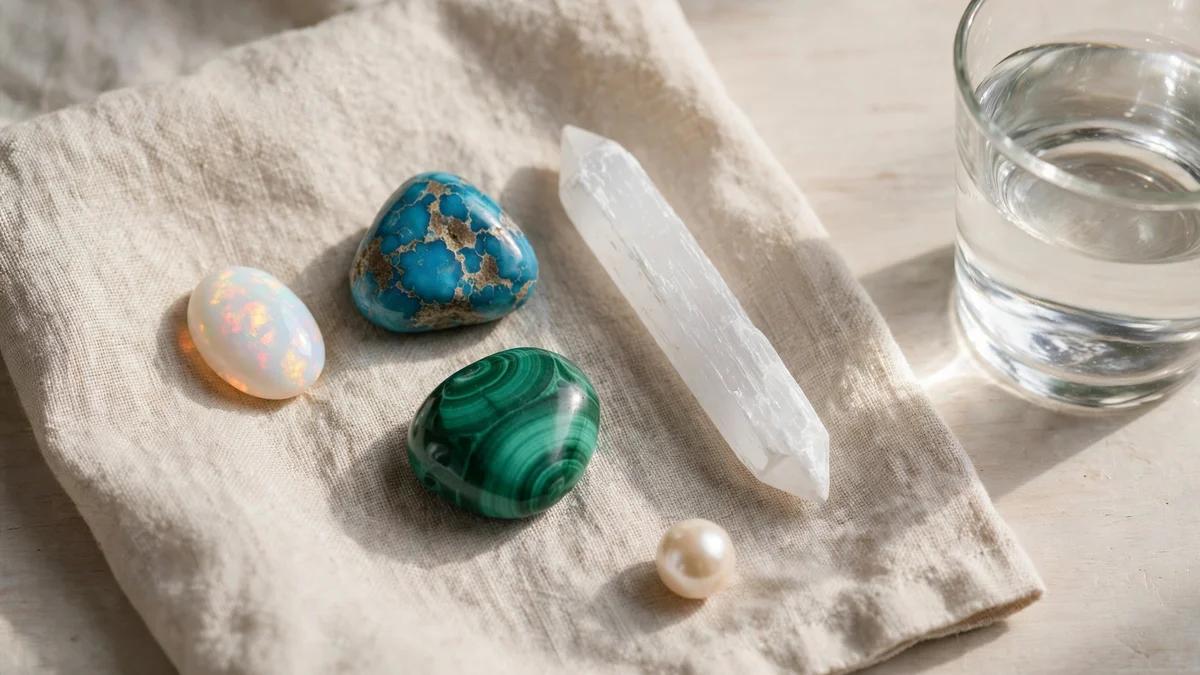
A delicate stone worn every day is a small act of trust. Delicate stones ask for a little more attention than hard ones: they scratch easily, dislike water, and are dulled by perfumes and creams. That does not mean keeping them in a drawer — it means knowing their rules.
The delicate group is small: opal, turquoise, malachite, selenite, amber, and pearl. Each has its own weakness — opal holds water inside itself, turquoise is porous, malachite dust must never be inhaled, selenite dissolves in water, amber is soft resin, and pearl is a thin layer of nacre. One shared habit: keep them dry, clean, and away from chemicals.
This article is a daily-wear care guide for delicate stones: how to tell one from a hard stone, how to clean without water, how to store and wear them, and how to spot wear early.
Key Takeaways
- Delicate stones — opal, turquoise, malachite, selenite, amber and pearl — are soft, porous, or water-sensitive.
- Never soak a delicate stone in water, and never put any stone in drinking water.
- Clean them by wiping with a soft, dry cloth; no soap, no soaking, no ultrasonic cleaner.
- Put delicate jewellery on last, after perfume, hairspray and creams, and take it off first.
- Malachite dust must never be inhaled: buy only polished, sealed pieces, and never cut or break malachite at home.
What Makes a Stone Delicate
A stone's toughness is measured on the Mohs scale, from 1 (talc) to 10 (diamond). It measures scratch resistance: a harder mineral scratches a softer one. Quartz sits at 7 and shrugs off daily knocks; delicate stones sit much lower, which is why everyday wear marks them.
Hardness is only part of the story. Turquoise is full of tiny pores that absorb oils, perfume and water, which can stain it. Opal holds between about 3 and 21 percent water inside its structure, and if that water dries out, the stone can craze. Selenite is gypsum, which dissolves slowly in water. Amber is fossilised tree resin, soft and warm. Pearl is layers of nacre laid over a bead.
| Stone | Mohs hardness | Main weakness |
|---|---|---|
| Opal | 5.5–6.5 | Dries out and crazes; heat and dryness |
| Turquoise | 5–6 | Porous; absorbs oils, perfume and water |
| Malachite | 3.5–4 | Soft; dust is toxic if inhaled |
| Selenite | 2 | Dissolves in water; scratches very easily |
| Amber | 2–2.5 | Soft resin; scratches and melts with heat |
| Pearl | 2.5–4.5 | Thin nacre; acids, perfume and abrasion |
A delicate stone is one that water, chemicals, or a knock can change. Treat it as something to protect, and it will stay beautiful for years.
Opal, Turquoise and the Water Rule
Water feels like the obvious way to clean a stone, and for hard stones a quick rinse is often fine. For delicate stones, water is the fastest way to damage them: selenite dissolves in it, turquoise absorbs it and can change colour, and opal can craze if its inner water is soaked out or dried with heat.
Never soak a delicate stone in water — not under a tap, in a glass, a bath, a pool, or the sea. Salt water is worse still. If a stone gets wet by accident, pat it dry at once and leave it somewhere dry and cool.
One rule comes first: never put stones in drinking water. Stones belong beside water, on a shelf or in a dish, never in it. How to cleanse crystals with water safely explains which hard stones tolerate a brief rinse and which soft ones do not.
Cleaning Without Water
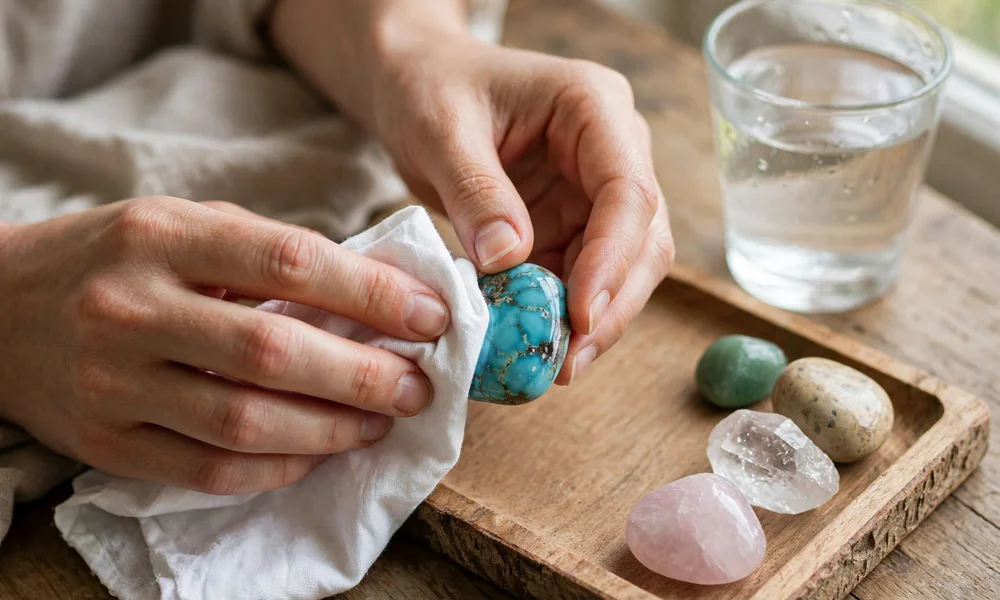
Cleaning without water is still simple: wipe the stone with a soft, dry cloth — microfibre or soft cotton. Hold it gently, wipe in one direction, and let the cloth lift dust and skin oils away. For jewellery, wipe stone and metal separately, so grit on the metal does not drag across the stone.
Do not use soap: it leaves a film on porous stones that dulls the colour. Do not use vinegar, lemon juice, or any acid — pearl nacre dissolves in acid, and mild acids can mark opal and malachite. Do not use an ultrasonic or steam cleaner: vibration and heat can crack opal and loosen settings. Do not use a brush, even a soft one, on selenite or amber.
For pearls, the cloth is enough after each wear: a quick wipe keeps the nacre bright. For opal, a wipe and a rest in a cool place is the whole routine. Clean rarely, gently, and dry.
Perfume, Chemicals and the Last-On Rule
The most common damage to delicate stones does not come from knocks but from perfume, hairspray, creams, and household cleaners. Perfume is the worst: its alcohol and oils can stain turquoise, dull pearl nacre, and mark opal. Hairspray leaves a sticky film that traps dust.
The fix is a habit: put delicate jewellery on last. Do perfume, hairspray, makeup, and creams first, wait a minute for everything to dry, and only then put on the necklace, ring, or earrings. Take jewellery off first when you come home. Last on, first off.
Keep stones away from the bathroom shelf where sprays live, and never clean one with a household cleaner. If a stone has touched perfume or cream, wipe it at once with a dry cloth; if the mark stays, ask a jeweller.
Storing Delicate Stones Well
How you store a delicate stone matters as much as how you wear it. Stones stored loose scratch each other: a hard stone marks a soft one, and two soft stones can scuff each other. Give each piece its own compartment, soft pouch, or slot in a lined box.
Keep them cool, dry, and dark. Heat dries opal out, sunlight fades turquoise and can soften amber, and damp air clouds selenite. A bedroom drawer beats a bathroom shelf, which swings between hot steam and cool damp.
Pearls like a little air, so store them in a soft cloth pouch or a lined compartment, not sealed plastic. Opal prefers a stable home — not too dry, not too damp. For the whole collection, how to store crystals beautifully has more ideas for keeping stones safe and lovely.

Wearing Them Every Day
Delicate stones are made to be worn, and daily wear is fine when the habits are right. Take rings off before washing hands, cooking, gardening, or exercise, and necklaces off before swimming or showering. A stone that never meets water, soap, or sweat lasts far longer.
Watch the setting as well as the stone: claws loosen over months of wear, and a loose stone is a lost stone. Once a month, hold the piece up to the light; if a claw has moved or the stone wobbles, take it to a jeweller. Pearls on silk thread need restringing every year or two, knotted between each pearl.
Choose the right stone for the right day: a hard stone suits a busy day, a delicate stone a calm one. If you are choosing your first stone, how to choose your first healing stone is a gentle place to start.
Malachite: A Special Note
Malachite deserves its own warning. It is a copper carbonate mineral, and its dust is toxic if inhaled or swallowed. That does not make a polished stone dangerous to wear — a sealed, polished piece is safe against the skin. It makes raw, broken, or powdered malachite dangerous to work with.
Buy only polished, sealed pieces, and never cut, grind, sand, drill, or break malachite at home. Never buy malachite dust or raw chunks, and never put malachite in water. If a piece chips or cracks, stop wearing it, wrap it in a cloth, and ask a jeweller whether it can be resealed or retired. Wash your hands after handling a damaged piece.
The same care applies to any stone that breaks at home: do not breathe the dust, do not sweep it dry, and wipe the area with a damp cloth.

Spotting Wear Before It Spreads
Small wear caught early is a repair; ignored, it is a loss. Once a month, take five minutes with your delicate pieces in good daylight, cloth in hand.
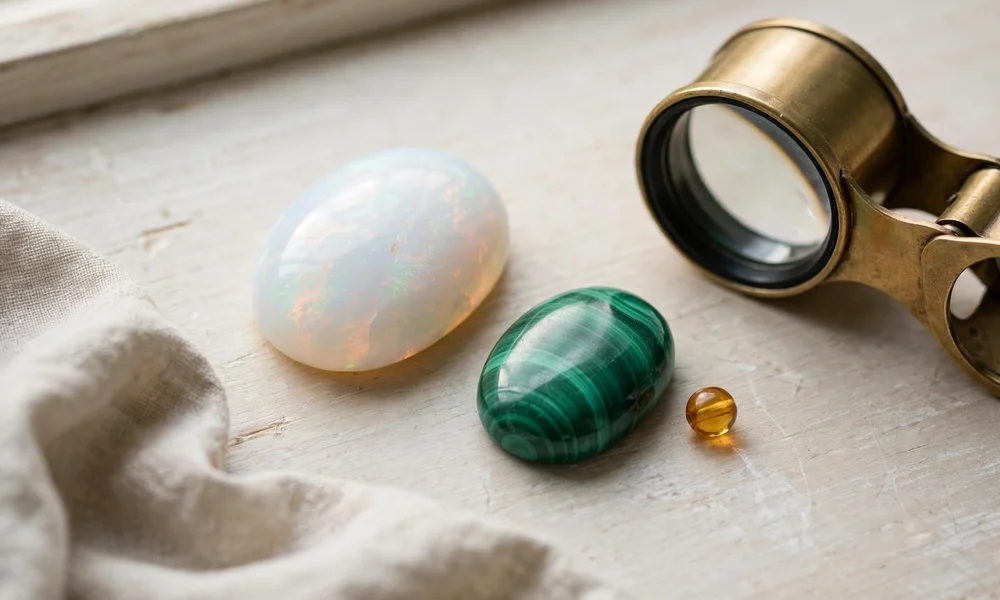
Look for cloudiness on opal (drying out), fading or dark patches on turquoise (absorbed oils or perfume), white edges on selenite (met water), fine scratches on amber, and a dull or peeling look on pearl nacre. Check settings too: loose claws, a bent prong, a tired pearl thread.
If you find something, do not try to fix it with water, soap, or polish. Wipe the piece dry, put it away, and take it to a jeweller. Most early wear is simple to put right — a reseal, a restring, a tightened claw.
Your Delicate Stone Checklist
- Never soak a delicate stone in water, and never put any stone in drinking water.
- Wipe stones with a soft, dry cloth after wearing; no soap, no acids, no ultrasonic cleaner.
- Put delicate jewellery on last, after perfume, hairspray and creams, and take it off first.
- Store each piece separately in a cool, dry, lined box.
- Buy malachite only as polished, sealed pieces; never cut or break it at home.
- Check settings and surfaces once a month, and see a jeweller early.
Frequently Asked Questions
Can I wear opal every day? Yes, if the day is kind to it. Put it on last, keep it dry, wipe it after wearing, and store it somewhere cool. Take it off before water, cleaning, or heavy work.
Why can't I soak turquoise in water? Turquoise is porous, so it absorbs water, oils and perfume. Repeated wetting can change its colour and dull its surface. A soft, dry cloth is the right way to clean it.
Is it safe to wear malachite? Yes, as a polished, sealed piece. The danger is malachite dust, which must never be inhaled or swallowed. Never cut, grind, or break malachite at home, and retire a chipped piece.
Can I clean delicate stones with soap and water? No. Soap leaves a film on porous stones, and water can dissolve selenite, cloud opal, and stain turquoise. Wipe with a soft, dry cloth instead.
How should I store pearls? Separately, in a soft cloth pouch or a lined compartment, somewhere cool and dry. Pearls like a little air, so avoid sealed plastic bags.
Can I put a crystal in my drinking water? No. Stones never belong in drinking water. Keep them beside water, never in it.
The Bottom Line
Caring for delicate stones comes down to three habits: keep them dry, keep them clean with a soft cloth, and keep them away from perfume and chemicals. Put them on last and take them off first.
Begin tomorrow with one habit: wipe your stone after wearing it, and put it away dry.
A Note for Everyday Wear
Keep them dry, keep them gentle, keep them yours. Delicate stones ask for very little: a soft cloth, a cool drawer, and a moment of care at the end of the day. Stay curious. Stay clear.



