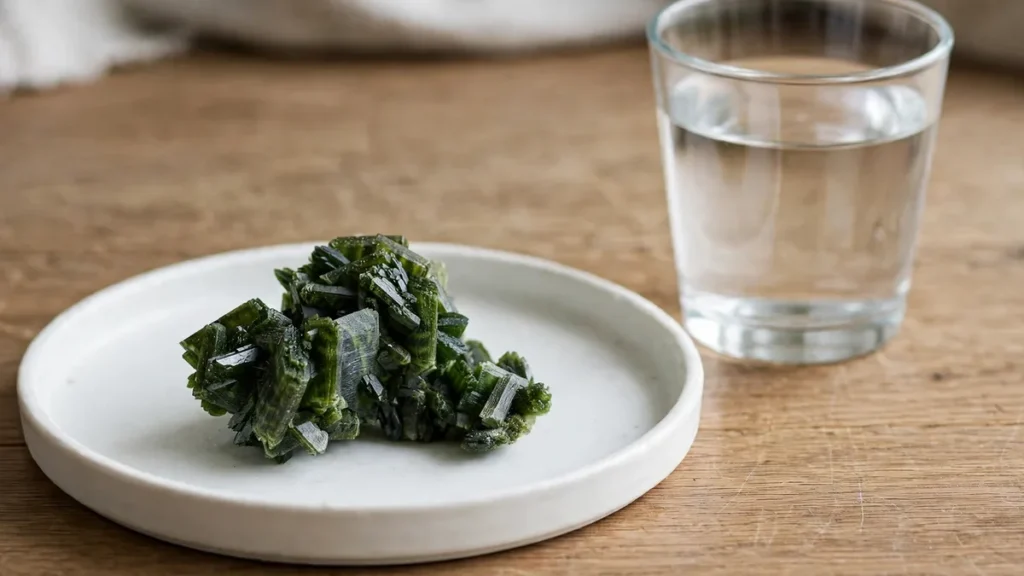
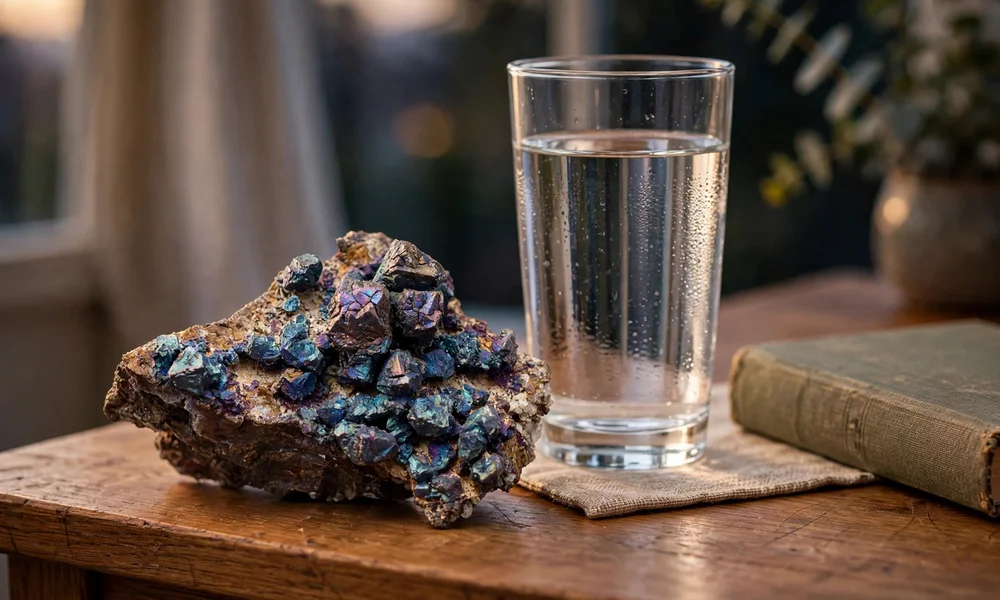
Turn a lump of bornite slowly in your hand and the colours move. Purple slides into blue, blue into green, and a flash of brassy gold appears where the light catches an untarnished patch. No two turns look quite the same, which is why collectors call it peacock ore.
The stone earns its place on a shelf by that shifting surface alone. It is a copper mineral, soft and heavy for its size, and it asks for gentle handling and a dry home.
This guide covers bornite in plain words: what the mineral is, why its colours shift, how it differs from its brassy cousin chalcopyrite and from pyrite, how to choose a sound piece, and where it sits best at home beside a glass of water that it never touches.
Key Takeaways
- Bornite is a copper iron sulfide, known as peacock ore for its purple, blue and green tarnish.
- Its colours shift as the stone turns, so it looks different from every angle.
- Bornite is soft, only about hardness 3, and scratches easily if handled roughly.
- The stone is for display only and stays dry, beside its glass, never inside it.
- One small piece on a plain wooden tray is enough for a bright corner.
What Bornite Is
Bornite is a sulfide mineral built from copper, iron and sulfur, written by chemists as Cu5FeS4. Freshly broken faces are a reddish bronze, but the surface soon tarnishes in air, and that tarnish is the whole show: purples, blues and greens spread across the stone like oil on a puddle.
It grows in chunky masses and rough crystals rather than neat points, and it feels heavy in the hand because copper is dense. Dealers usually sell fine pieces by weight and by the brightness of the tarnish.
Why Bornite Shifts Colour
The shifting colour is not paint and not dye; it is a thin tarnish layer on the surface, and light bounces inside that layer in different ways as the angle changes. Turn the stone a little and the purple deepens; turn it again and green takes over.
That is why bornite suits a bright day. In flat lamplight the colours sit still and dull, but in daylight from a window they keep moving, and the stone looks alive. A piece kept in a dark drawer loses its charm entirely, because the shift needs light to happen at all.
Bornite and Chalcopyrite: Peacock Beside Brass
Chalcopyrite warm gold explained describes a brassy gold mineral that is the world's main source of copper, dug in huge amounts and sold by weight. Its gold is deep and warm, broken here and there by rainbow flashes where the surface has tarnished.
Bornite shares the same family — both are copper iron sulfides — yet the balance is different. Chalcopyrite is CuFeS2 and mostly gold; bornite is Cu5FeS4, richer in copper, and mostly purple, blue and green. Chalcopyrite is harder and more common; bornite is softer and its coat fades faster when handled. Put them side by side and the difference is plain: one is a brass kettle, the other a peacock's tail.
Bornite and Pyrite: Soft Flash, Hard Glint
Pyrite shine with warm metal tones describes iron sulfide, a hard, pale-gold mineral that grows in sharp cubes and keeps its shine for years. It is the stone people mistake for gold, and its glitter is steady, not shifting.
Bornite could hardly be more different in the hand. It is much softer, so a fingernail can mark it where pyrite would laugh at a knife, and its colours slide across the surface while pyrite's gold stays put. Pyrite holds iron alone; bornite holds copper and iron together, which is why its tarnish runs purple and green instead of staying gold.
Choosing a Bornite Piece
Hold bornite to a bright window, never under shop lamps, and rotate it gently in your palm. A good piece shows strong purple and blue across most of its faces, with a little bronze showing through, and the colours should shift as it moves.
Pick a piece about the size of a walnut, and check that it feels solid, with no crumbling edges or loose grains. A seller should be able to say, in ordinary words, where the piece came from; if the answer is vague, or the seller starts promising health benefits, leave the piece where it is. Plain facts about the mine matter more than any grand claim.
A Bright Morning with Bornite
Start the day with the stone already in place. Spread a folded beige cloth across the side table, put the bornite where the window light falls on its brightest face, and set a tall glass of water at the opposite end of the cloth.
Sip the water unhurriedly while the sun climbs and the purple on the stone deepens. When the glass is empty, fold the cloth away and leave the stone to rest there until the evening.
Bornite Beside Water
Water and bornite can sit on one tray, but they must never meet. Put the glass well away from the stone, with bare wood or cloth filling the gap between them, so that not a single splash lands on the tarnish. The stone belongs nowhere near a tap, a jug, a bath or any drink, since moisture takes the shine off its colours and may leave marks behind. Dust it once a week with a soft breath of air; it needs no washing at all.

Bornite at a Glance
| Peacock purple, blue, green | Wooden tray, bright window | Dry hands only |
|---|---|---|
| Copper iron sulfide | Bright days, clear light | Glass kept apart |
| Soft, hardness near 3 | One small chunk | Never soak it |
| Walnut-sized piece | Cloth, wood, sunlight | Keep it dry |
Bornite and Marcasite: Tarnish Beside Pale Gold
Marcasite warm gold for steady days describes a pale brassy mineral that grows in crusts and nodules, bright at first and quick to dull. Its gold is lighter than pyrite's, and its surface goes grey if it is left damp.
Bornite and marcasite agree on one thing only: both tarnish fast and both hate water. Where they part is the colour. Marcasite stays in the gold family, pale and metallic, while bornite leaves gold behind and turns purple, blue and green. Marcasite is iron sulfide, bornite copper iron sulfide, and bornite is the softer of the two. On the tray they read as opposites: one a pale gold crust, the other a peacock's wing.
Bornite Among the Other Stones in This Batch
This batch holds four more minerals beside bornite, and each one wears a different mood. Goethite is warm brown and earthy, a steady stone for quiet corners. Orthoceras is deep black, an ancient sea creature turned to stone, with pale chambers running through it. Galena is soft grey and metallic, heavy and bright like fresh lead. Sphalerite is warm gold, honeyed and glowing in strong light.
The nearest water articles are water and wellies, water and a wool scarf, water and an umbrella, water and a fire pit, and water and a hammock — five small rituals that spend their water outdoors, while bornite stays indoors on its tray. Bornite holds the peacock corner of the batch, the one stone whose colours refuse to sit still.
Where Bornite Rests at Home
Give bornite a spot that people pass often yet seldom bump: the quiet end of a worktop, a high ledge, or the top of a cupboard, well away from taps, kettles, steam, little hands and pets.
Every week, lift it by its base and look for crumbling edges, and when it travels, wrap it in tissue inside a padded box of its own, kept clear of anything hard enough to scratch it.

Stones That Must Stay Away from Water
Water is the wrong companion for more minerals than people expect, and the list is worth learning once. Malachite carries copper in its green bands, so it never belongs near a mouth or a drink. Hematite left wet can rust. Apatite softens and breaks apart after soaking, angelite goes cloudy, and lepidolite's flakes contain lithium, which is no business of any cup or glass. Amber, being old tree resin, turns milky when it is soaked. Pyrite stains when it stays damp. Bornite joins that same dry company: the tray stays dry, the glass stands apart, and hands are washed after the stone is touched.
Your Bright Days Checklist
- Lay the bornite on a dry cloth, with the glass a hand-span away from it.
- Drink the water in slow, small sips as the morning light comes in.
- Tilt the piece gently and watch the colours slide from purple to green.
- Slip the piece into its soft pouch, then wash your hands with soap.
- Choose a seller who names the mine in plain, ordinary words.
- For any health worry, speak to a doctor — a peacock stone cannot answer it.
Cloth, glass, tray and one small shifting stone — that is everything.

Frequently Asked Questions
What exactly is bornite?
Bornite is a copper iron sulfide mineral, called peacock ore, whose tarnished surface shows purple, blue and green colours that move as the stone is turned in the light.
Why do the colours move when I turn the stone?
The colours come from a thin tarnish layer, and light bends inside that layer differently at each angle, so purple, blue and green take turns as the stone moves.
What sets bornite apart from chalcopyrite?
Chalcopyrite stays mostly brassy gold and is harder, while bornite is mostly purple, blue and green, softer, and carries more copper, so the two look quite different side by side.
May bornite be put in water?
No, bornite should never be put in water, a soak or a bath, because dampness takes the shine off its colours and may leave marks on the surface, so keep it dry on its tray.
Can I pick bornite up for a closer look?
Most adults can lift a small dry piece briefly by its base to look at it closely, then put it back and wash their hands with soap.
Which spot at home suits bornite best?
A dry place in bright light suits it best, such as a high shelf, well away from water, steam, little hands and pets.
The Bottom Line
A little peacock stone that stays dry, and a glass of water that stays in its own place: bornite asks for nothing more on a bright day.
A Note for Bright Days
A stone that changes its coat with the light, water standing clear in its glass, and sunlight drifting across the room — that is the whole of it.