Some days ask for nothing at all. The curtains stay half drawn, the phone stays face down, and the hours pass without any plan worth naming. On a day like that, a bright stone feels out of place, almost noisy.
Black agate is the stone for those hours. It is a deep black chalcedony, dark from edge to edge, with a calm polished surface that takes in the low light and gives almost nothing back. It sits quietly on its tray and asks for no attention.
What follows is a close look at black agate: what it is, how it stands apart from its patterned cousins, what to notice when picking one out, and how to set it beside a glass of water. It is an object to look at and to hold, and nothing beyond that.
Key Takeaways
- Black agate is a deep black chalcedony, dark from edge to edge, with a smooth polished surface.
- Its deep black colour suits quiet days, low light, slow hours, and rooms kept calm.
- Black agate is only for the eye and the hand: keep it dry on its tray, beside water, and never let it sink into a drink.
- Agate forms in slow layers inside old volcanic rock, one thin skin at a time.
- One small dark stone is enough for a whole quiet day.
What Black Agate Is
Black agate belongs to the agate family, a layered form of chalcedony, and chalcedony is itself a variety of quartz. It builds up in slow layers inside old volcanic rock, as water carrying minerals lays down one thin skin of stone after another across a very long time. In black agate, those layers are dark, so the finished stone reads as one deep black mass.
Hold a polished piece and it feels cool, weighty, and smooth, with a soft shine rather than a sharp glitter. Look closely and you may catch faint darker lines drifting through the black, but there are no pale bands, no branches, and no flecks of colour.
Why Deep Black Suits Quiet Days
A quiet day is a day with the volume turned down. The light is low, the room is still, and nothing in the house is asking to be noticed. A stone that is simply black fits that mood exactly: it does not flash, it does not sparkle, and it does not try to cheer the room up.
The stone does not make the day quiet; the closed door, the slow water, and the unhurried hours do that. The black agate only keeps them company, a dark shape on the tray while the day passes at its own pace.
Choosing a Black Agate Piece
Look for a black that stays black in ordinary daylight, not a stone that turns grey or brown when you carry it to the window. Tilt it slowly and watch the shine move across the surface: it should glide evenly, with no dull cloudy patches and no rough pits. The edges should feel smooth all the way round, with no sharp chips.
Ask the seller where the stone came from, and walk away from any piece sold merely as a rare black gem at a steep price.

A Quiet Day with Black Agate
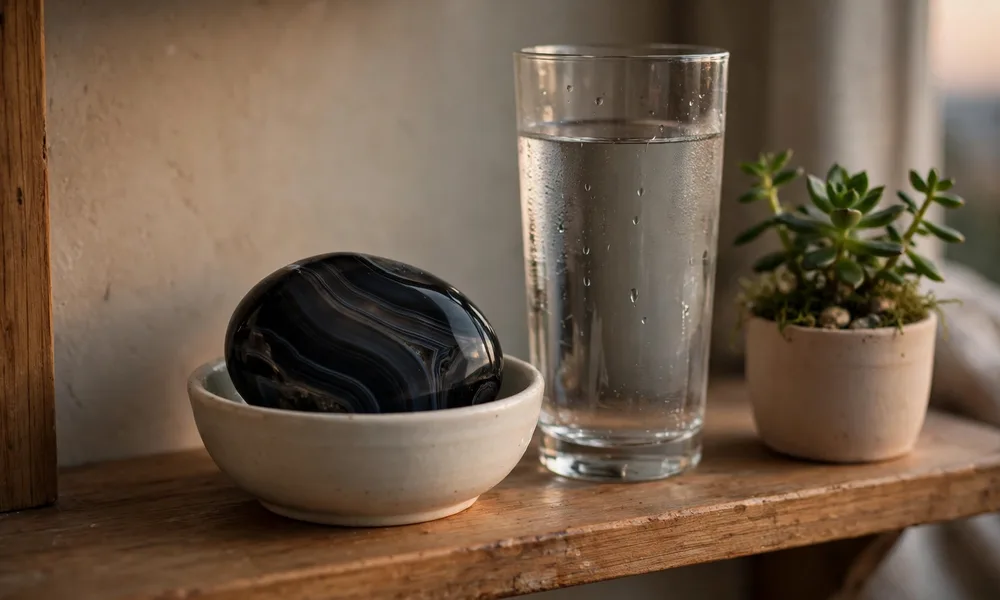
Begin by setting the black agate on a dark wooden tray near the window, with a tall glass of cool water placed well away from it. Drink the water in slow sips and let your eyes rest on the dark stone between sips, without trying to think anything in particular.
The stone itself achieves nothing; the quiet day belongs to you, and the deep black shape stays beside you while it passes. When the light fades, leave the stone where it is and let the evening close around it.
Black Agate Beside Water
Put the black agate at one side of a dark wooden board and a tall glass of water at the far side, with bare board showing between them, and nothing else touching either one. The water stays clean in its glass, the stone stays dry on the wood, and the two sit together only in the sense that one board holds them both beneath the dim evening glow.
Once the stone is placed, clean your hands, and take care it never slips into a glass, a jug, or a bath. Water belongs in the glass, stone belongs on the wood, and the board between them keeps that boundary clear all evening.
Black Agate at a Glance
| Deep black body | Quiet days | Display only |
|---|---|---|
| Faint dark lines | Low light, slow hours | Wash hands after |
| Cool, smooth, weighty | Tray, shelf, windowsill | Never in water |
| Soft shine, no glitter | Book, rest, pause | Dry cloth wipe |

Black Agate and Banded Agate
Banded agate is the closest cousin black agate has, and telling them apart takes a side-by-side look in daylight. Banded agate for slow days covers a pale striped stone in soft grey, cream, and warm brown bands, its lines meandering the way a slow river bends.
The stone in this guide is the dark one. Its black runs from edge to edge, with only the faintest darker lines inside it, while banded agate shows its pale stripes openly. Both are layered chalcedony, yet one hides its layers and the other displays them.
Black Agate and Dendritic Agate
Dendritic agate is the patterned opposite of black agate, and the contrast could hardly be sharper. Dendritic agate for quiet days covers a pale white stone marked with dark branching shapes, like small ferns pressed into the surface.
Where dendritic agate is white stone crossed by dark branches, black agate is dark stone all the way through. One gives the eye branches to follow; the other gives it a single deep surface to rest on. Both suit quiet days, yet they do it in opposite ways.
Black Agate, Grey Agate, Green Agate, Yellow Agate and Orange Agate
Four further agates arrive in this same batch, each one standing a little apart from the deep black stone of this guide. Grey agate, the sibling numbered 758, is a soft grey chalcedony, pale and even. Green agate, the sibling numbered 760, is fresh and leafy in tone. Yellow agate, the sibling numbered 762, is warm and sunny. Orange agate, the sibling numbered 764, glows like late afternoon light.
Black agate is the dark one between them. It is the deep black chalcedony with no colour at all, and that plain darkness is what makes it the quietest member of the whole family.
Black Agate and the Other Agates
Beyond the near relations, the wider agate family holds more colour. Moss agate for plant lovers covers a green stone veined with soft green moss-like marks, happiest on a plant shelf. Tree agate is its paler twin, a white stone patterned with soft green branches.
Pink agate and purple agate hold one soft colour each, while plume agate carries soft white feathers through milky grey. Moroccan and Botswana agate are place-named banded stones in soft grey, cream, and pink. White agate is clean and pale, crazy lace is bright with swirling patterns, fire agate carries a warm spark, and blue lace is soft blue. None is the deep black stone.
Caring for Black Agate
Black agate is a hard stone, so it asks for little, but it still likes a calm home. Keep it somewhere dry and cool, tucked in a padded case that closes, or up on a ledge where jars and books cannot slide down onto it. A quiet corner suits it best, away from bright sun and damp.
Clear dust away with a dry soft cloth, brushing lightly over the curved top without bearing down. Keep soap, sprays, and polishing pastes on their shelf, and never lower the stone into an ultrasonic cleaner. Give it a little room of its own on the shelf every single day.
Stones That Must Never Touch Water
Not every stone belongs anywhere near a glass, so here is the plain rule to carry with you: some minerals must stay dry, full stop. Malachite heads that dry-only group — its green bands look lovely on a shelf, yet the stone itself should never be steeped, stirred, or dropped into anything you might drink. Hematite follows close behind, rich in iron and best kept well away from drinking water, even for one quick dip.
Pyrite, angelite, and amber sit on that same dry list, none of them made for cups or soaking bowls. Apatite stays out of the water too, and lepidolite, whose pale flakes hold lithium, must never go near a drink. Black agate rests dry beside the glass as well.
Your Quiet Days Checklist
- Set the black agate on its tray, with a full glass standing nearby.
- Drink the water unhurried, in the low light of the evening.
- Clean your hands once the stone is back on its tray.
- Buy from a seller who knows the stone's origin.
- Store it somewhere dry and cool, out of children's reach.
- For any health worry that lingers, ask a doctor, not a stone.

Frequently Asked Questions
What is black agate?
Black agate is a deep black chalcedony, a form of quartz that grows in slow layers inside old volcanic rock. It feels cool, smooth, and weighty, with a soft shine.
How is black agate different from banded agate?
Both are layered chalcedony, but banded agate shows fine soft bands of grey, cream, and gentle brown. Black agate is dark from edge to edge, hiding its layers inside one deep black mass.
How is black agate different from dendritic agate?
Dendritic agate is a white stone crossed by dark branching shapes like tiny trees. Black agate is the opposite: dark stone all the way through, with no branches at all.
Is black agate safe to hold?
Yes, for brief handling. Put it down, wash your hands, and keep the stone on its own shelf, far from children and from anything you eat.
Why must black agate never go in water?
Keep the stone beside the glass and the water inside it. Do not drop the stone into a cup, a bath, or any drink, and do not stir it through water.
Where should I keep black agate at home?
Pick a calm, dry place, such as a tray, a shelf, or a windowsill, and keep the glass near the stone without touching it.
The Bottom Line
Black agate lends quiet days a deep black calm: a single small dark stone in dim light, resting on a wooden tray near a glass of water, looked at and held, never swallowed.
A Note for Quiet Days
Keep the room dim and the stone dry. A single black agate, a glass of water, and a few unhurried hours are enough.