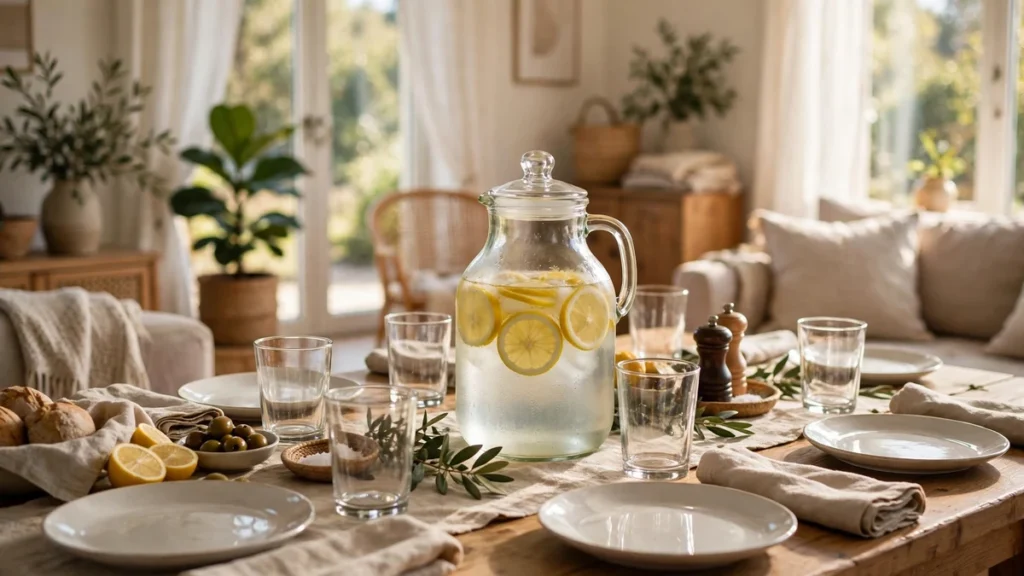
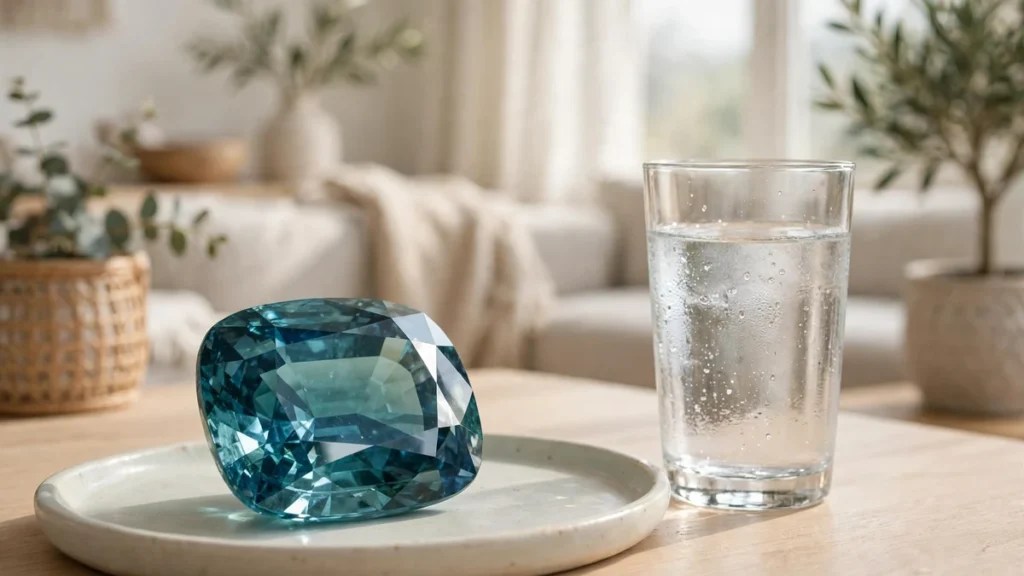
Bright days change colour as they go. The morning starts pale and gold, the middle of the day turns white and sharp,. A stone with only one colour cannot keep up with that, but a stone with two colours inside it can follow the whole day.
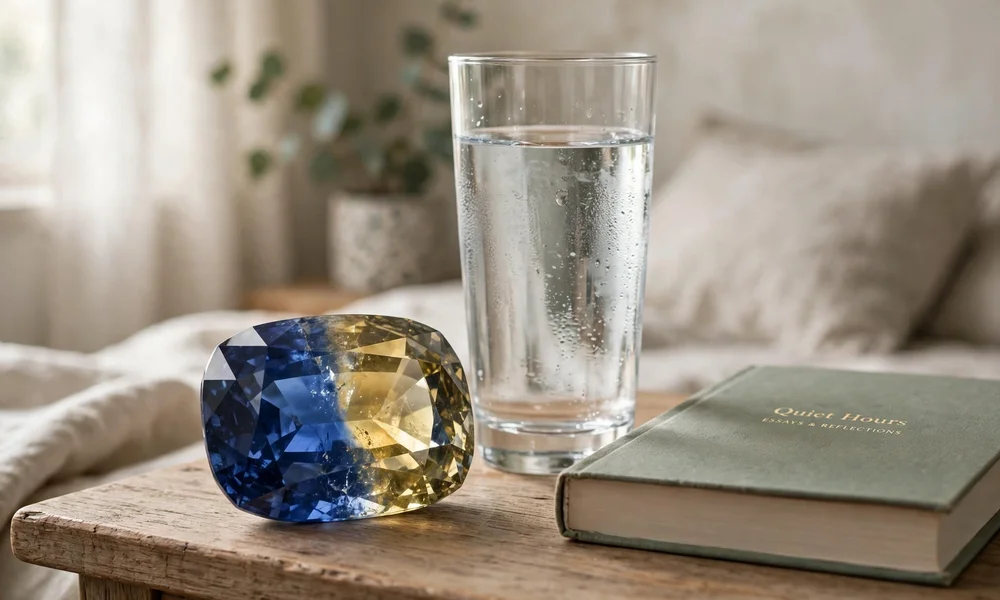
Bi-colour sapphire is that stone. It is one corundum crystal carrying two colours at once, often a deep blue that melts gently into green or gold along the piece. The two halves blend slowly, and turning the stone lets one colour hand over to the other.
Here is a close look at bi-colour sapphire: what the two-colour stone is, how to pick a good piece, and how to spend a bright day with it resting on a tray near a glass of water. It is an object to admire, and it will not heal anything.
Key Takeaways
- Bi-colour sapphire is one corundum stone holding two colours, often blue shading into green or gold.
- The soft shift between colours suits bright days and changing daylight.
- Bi-colour sapphire differs from every single-colour sapphire and from bi-colour tourmaline.
- The stone is for display only; it stays next to water, out of it.
- A single small piece on a dry tray fills a bright day.
What Bi-Colour Sapphire Is
Bi-colour sapphire is sapphire, the blue variety of corundum, with a twist: while the crystal grows, the trace elements inside it change, so one end takes on a different colour. Iron and titanium give the blue half its depth, while a shift in those same traces lets green, gold or pale yellow appear beside it.
A good piece feels cool and smooth, with flat facets that throw back small bright flashes as it turns. Some stones are cut into neat ovals; others keep a softer pebble shape, with the colour change running across the middle like a horizon.
Why Two Colours Suit Bright Days
A bright day is never one light. Sunlight at eight in the morning is thin and gold, at noon it is white and direct, and by evening it turns low and honeyed. A bi-colour stone answers each change: the blue half wakes up in morning light, and the green or gold half glows as the afternoon warms.
That slow handover is the whole pleasure of the stone. You do not need to do anything with it; you only need to leave it where the light can reach it and glance at it as the day moves. Strong light is the stone's best friend, so a bright windowsill shows the shift far better than a shaded shelf ever could.
Choosing a Bi-Colour Piece
Choose bi-colour sapphire with your eyes first, in daylight if you can. Look for a piece where both colours are easy to see, . The blue should be clear and rich, and the second colour, green or gold, should be bright enough to notice without hunting for it.
Keep the piece small: a pebble about the length of your thumb suits a tray well, and a faceted oval the size of a fingernail does the job nicely too. Check that the surface is smooth all over, with no rough pits and no cloudy patches that dull the shine.

A Bright Day with Bi-Colour Sapphire
Begin the morning by setting the bi-colour sapphire on its tray in the sunlight, a tall glass of cool water standing at the other end, well away from the stone. Drink the water slowly, watch the blue half catch the first light.
As the sun climbs, move the tray a little so the light keeps falling on the stone, and notice how the second colour comes forward. By mid-afternoon the gold or green half may be the brighter of the two, and by evening the blue returns as the light thins.
Bi-Colour Sapphire Beside Water
Water and the stone may sit on the same tray, but that is as close as they get. Set the glass on one side and the stone on the other; no stone ever goes into a drink.
This rule keeps the bright day simple and safe. Wash your hands after you hold the stone, keep it far from food and from little hands that might grab it, and never let it drop into a glass, jug or bath.
Bi-Colour Sapphire at a Glance
| Two colours, one stone | Bright days | Display only |
|---|---|---|
| Corundum, hard, glossy | Sunlight, shifting light | Beside water only |
| Blue into green, gold | Tray, sill, bedside | Wash hands after |
| Small piece, clear blend | Morning, noon, evening | Dry cloth wipe |

Bi-Colour Sapphire and Blue Sapphire
Blue sapphire is the classic of the family, and it makes the clearest contrast with a two-colour stone. Blue sapphire for calm days covers a rich blue corundum, bright and clear, whose cut faces throw off tiny blue glints, the stone most people picture first.
Both stones are corundum, yet they ask for different days. Blue sapphire holds one deep blue from edge to edge and suits a calm day, while bi-colour sapphire holds blue beside green or gold and suits a bright day that keeps changing.
Bi-Colour Sapphire and Padparadscha Sapphire
Padparadscha sapphire is the softest member of the family, and it sits gently beside a bi-colour stone. Padparadscha sapphire for tender days covers a soft peach corundum, pink and orange at once, clear and bright.
Padparadscha blends its two warm tones into one peach glow, while bi-colour sapphire keeps its two colours distinct enough to watch them trade places.
Bi-Colour Sapphire and Bi-Colour Tourmaline
Bi-colour tourmaline is the nearest rival in name. Bi-colour tourmaline for bright days covers a single tourmaline crystal whose pink end fades toward green.
Both stones carry two colours and both suit bright days, yet they are different minerals with different pairs. Tourmaline pairs pink with green, while sapphire pairs blue with green or gold, and sapphire is the harder, glossier of the two.
Bi-Colour Sapphire and the Other Sapphires
Beyond the three nearest cousins, the sapphire family holds more colour still. Green sapphire is fresh green all through, and orange sapphire is warm and sunny. Purple sapphire is soft violet, while white sapphire is clear and colourless.
The general sapphire guide, sapphire calm water, builds a whole evening around deep blue sapphire beside a glass of cool water at the bedside, a restful wind-down rather than a bright-day display. None of these is two-coloured: each holds one colour from edge to edge.
Two more sapphires sit beside it in this same batch of guides: 722 Black Sapphire, a deep black stone for quiet evenings, and 724 Teal Sapphire, a soft blue-green stone for calm days.

Caring for Bi-Colour Sapphire
Bi-colour sapphire needs very little looking after. Keep it somewhere dry and cool. Never carry it loose in a pocket alongside keys or coins, since even a hard stone can pick up fine scratches.
Wipe it with a dry, soft cloth only, using no soap or sprays. If the tray gets wet, move the stone aside, dry the tray, and put the stone back.
Stones That Must Never Touch Water
Some minerals and drinking water should never meet, so it is worth knowing which ones to keep well away from any glass. Malachite is the first name to remember: it should never sit in a jug, a cup or a glass, because it can release substances that have no place in anything you drink. Hematite belongs on the same keep-out list, with no dipping and no swirling in water meant for drinking.
Apatite needs the same distance, and so does lepidolite, whose soft grey layers hide lithium within them. Pyrite, angelite and amber also stay dry, out of glasses, jugs and bowls left to soak. Bi-colour sapphire is sturdier, yet the habit stays the same: the stone rests beside the glass.
When a health worry lingers, or a symptom keeps coming back, the right person to ask is a doctor, not a stone and not a guide about one.
Your Bright Days Checklist
- Put the bi-colour sapphire on a dry tray, a full glass of water beside it.
- Drink the water unhurriedly as sunlight crosses the room.
- Rinse your hands with soap once you have put the stone down.
- Buy only from a seller who names the stone as bi-colour sapphire.
- Store the stone somewhere dry, where children cannot reach it and food stays away.
- If a health worry keeps coming back, ask a doctor about it, not a stone.
Frequently Asked Questions
What is bi-colour sapphire?
Bi-colour sapphire is a sapphire, a variety of corundum, that holds two colours in one stone. While the crystal grows, the mix of trace elements inside it changes, so one end turns blue and the other turns green or gold.
Is bi-colour sapphire the same as bi-colour tourmaline?
No, although the two share a name and both suit bright days. Bi-colour sapphire is corundum, usually blue shading into green or gold, while bi-colour tourmaline is a different mineral, usually pink shading into green.
Is bi-colour sapphire safe to hold?
Yes, for a short look. Put it down, rinse your hands with soap, and keep it away from children and food. It is a stone for looking at.
Why must bi-colour sapphire never go in water?
A display stone stays beside the glass, never inside it. Do not drop bi-colour sapphire into a drink, leave it soaking, or stir with it; wipe away any drops right away.
Will bi-colour sapphire brighten my day?
No. It is a two-colour stone made for looking, and any lift you feel comes from the sunlight and the slow day, not from the stone.
Where should I keep bi-colour sapphire at home?
Set it where sunlight falls and air stays dry, a wooden tray, a bright shelf, or a bedside table, with a glass of water nearby.
The Bottom Line
Bi-colour sapphire gives bright days a slow colour change to watch: one stone holding blue beside green or gold, resting on a dry tray next to a glass of water in the sunlight, admired through the day and never dropped into a drink. Watch it change as the sun moves, and let the day stay bright.
A Note for Bright Days
Let the sun do the moving and the stone do the showing. One small two-colour pebble, one glass of water, and a bright day are all you need.