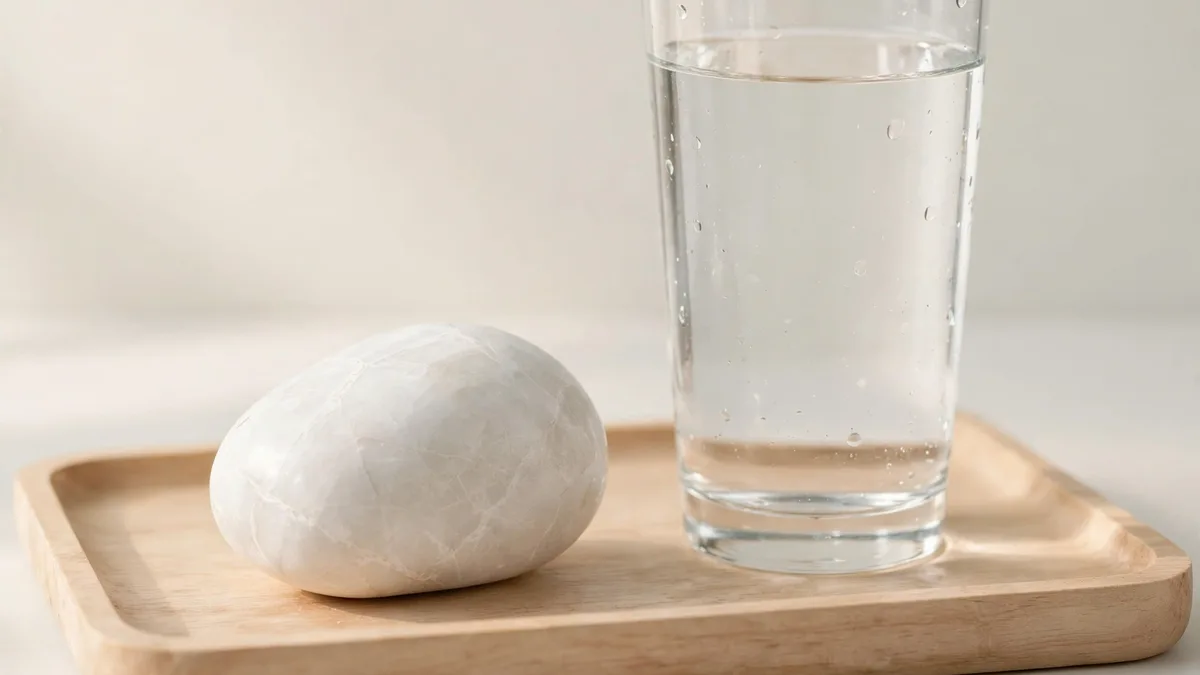
A quiet day has a particular kind of light. It comes in pale and unhurried through the window, settles on the table without fuss, and leaves the room feeling wider. On a day like that, a bright or busy object feels out of place, and the eye looks for something plain instead. A soft white stone fits the hour: it catches the light without throwing it back, and it sits still while the day moves slowly.
Magnesite is that kind of stone: a soft white carbonate mineral, usually a smooth tumbled piece the colour of fresh chalk, sometimes faintly marbled like thin veins in pale marble. It feels light and cool at first touch, then warms quickly as you hold it. Nothing about it shouts, and that is the whole point.
This guide looks at magnesite in plain words: what it is, how to spot an honest piece, how to set it safely near water, and how to shape a short quiet-day habit around it. The stone is a thing to look at and to hold, nothing more, and it will not change your mood, your sleep, or your health. Keep it dry beside the glass, and enjoy the white.
Key Takeaways
- Magnesite is a soft white carbonate stone, smooth and pale, faintly marbled grey.
- Its clear white suits quiet days, pale light, and slow hours at home.
- Much shop magnesite is dyed blue to imitate turquoise, so buy plain white honestly.
- Magnesite is an object to admire and hold briefly; it cures nothing.
- The stone stays dry beside drinking water, never in the glass.
What Magnesite Is
Magnesite is a carbonate mineral, formed from magnesium and carbonate in the earth, often where older rocks were changed by heat and water long ago. Most shop pieces are white or cream, smooth after tumbling, plum-stone sized. The surface is usually matte rather than glassy, like chalk polished by hand.
The white is the stone's whole character: light sits on it softly instead of sparkling, and the faint grey veins show only when you look closely. Magnesite is also a soft stone, softer than quartz and softer than jade, so it scratches easily and needs a gentle hand. That softness is why sellers like it: it shapes smoothly and feels kind in the palm.
Picking a Magnesite Piece
Choose a magnesite piece in plain daylight, away from shop lamps that flatter every white. Hold it flat and turn it slowly: the white should stay even and clean, and any grey marbling should be faint and natural-looking rather than painted on. A bright blue piece is not natural magnesite at all; it has been dyed to look like turquoise, and an honest seller will say so without being asked.
Ask the seller whether the colour is natural and where the stone came from, and check the edges for chips, since this stone bruises easily. Buy the smallest piece that pleases you, keep the receipt, and wash your hands after handling it before you pick up your drink.

A Quiet Day with Magnesite
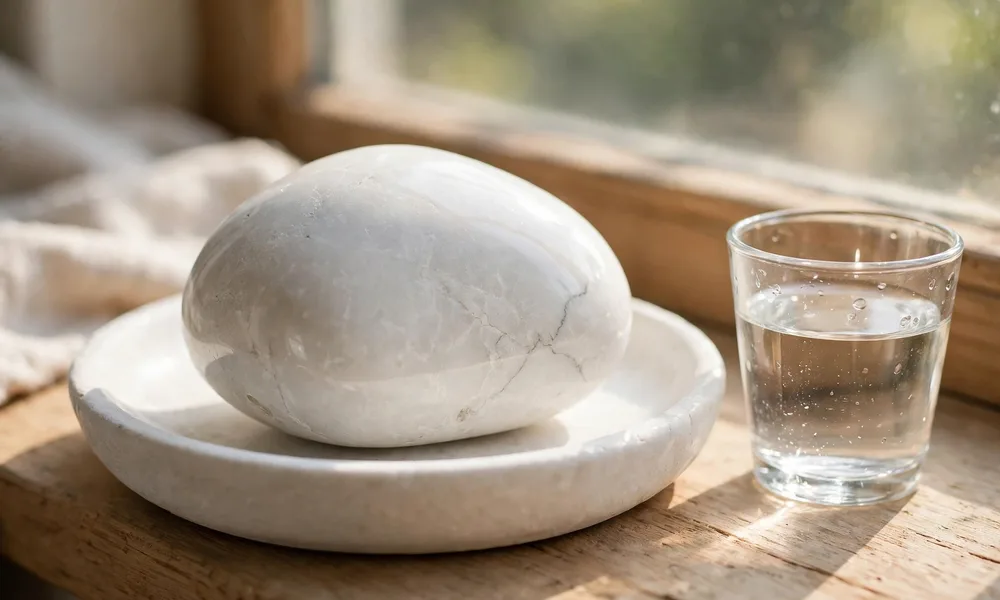
A quiet day with magnesite starts with the stone in easy sight. Spread a pale cloth over the dressing table, place the stone toward the front where the morning light can touch it, and stand a glass of water at the far end, with bare wood between them. Drink the water in slow sips while the light moves across the white.
The stone suits a slow day because it asks for nothing. Leave it where the light falls, glance at it when you pass, and move it to the windowsill for an hour in the afternoon. Nothing is timed, and the day stays quiet.
Magnesite Beside Water
Water and magnesite make a pretty pair on a tray, but the two should stay apart. Put the tumbler at one end and the stone at the other, with a clear gap of bare wood between them. Wash your hands after handling the stone before you lift your drink.
It never belongs inside a glass, a jug, or a bath. Magnesite is soft and porous enough to dull in water, so a dry cloth wipe is its only cleaning. The stone stays on its tray, and the water stays in its cup.
Magnesite at a Glance
| Clear white stone | Pale tray, desk | Dry hands only |
|---|---|---|
| Soft, light, matte | Quiet days, light | Glass kept apart |
| Faint grey veins | One accent, plain | Never in drinks |
| Carbonate mineral | Clear window light | Never soak stone |
| Often dyed blue | Tidy shelf, tray | Dust dry weekly |
Magnesite and White Jade
White jade for calm mornings is a soft creamy white stone, smooth and cool, with a gentle waxy shine. It is tough nephrite jade, dense and hard, holding a polish that stays bright for years.
Magnesite is lighter and softer than white jade, and its white is chalkier and more matte, where white jade glows like pale wax. White jade takes a knock without complaint; magnesite chips if dropped. One is a hard stone for everyday handling, the other a soft white piece for a quiet shelf.
Magnesite and White Onyx
White onyx for bright days is a clear milky white chalcedony with soft pale bands like faint lines drawn in pale grey pencil. It holds a quiet shine in daylight and suits bright rooms.
Magnesite is plainer than white onyx: no clear bands, no milky glow, no shine beyond a soft matte finish. White onyx is layered quartz and much harder, while magnesite is a soft carbonate that stays chalk-white. One shows bands, the other shows almost nothing.
Magnesite and White Jasper
White jasper for bright days is clear white quartz, solid all the way through, with almost no marks at all. It looks like morning light caught and held still on a tray.
Magnesite sits close to white jasper in looks, and the two are easy to mix up at a glance. The difference is in the hand: white jasper is hard quartz, solid and cool for a long while, while magnesite is lighter, softer, and warms up fast. White jasper keeps its polish through years of handling; magnesite needs a gentler touch.
Magnesite and the Other White Stones
The white family in this journal is wide, and each member has its own tell. White agate is a clean white chalcedony with faint soft grey bands, harder and glossier than magnesite. Howlite is soft white with fine grey veins, often dyed to imitate turquoise too, so both stones carry the same honest-buying warning. White moonstone is milky white feldspar with a soft blue glow that drifts as you turn it, a light magnesite never shows. White zircon is clear and bright, almost glassy, where magnesite stays matte. Mesolite grows in fine needle-like sprays, a shape no tumbled magnesite takes. None is a soft white carbonate with chalky matte skin.
Magnesite and the Other Stones in This Batch
Elsewhere in this batch of the journal, four other stones sit beside magnesite, and each one is a different colour entirely. Elestial quartz is clear and light, letting light pass straight through it, where magnesite stops the light at its white surface. Kornerupine is fresh green for calm days, cool and leafy next to magnesite's plain white. Smoky citrine is warm brown for steady days, a deep amber-brown glowing in lamplight, the opposite of pale chalk-white magnesite. Dragon blood jasper is deep green for bold days, dark green flecked with red, a loud stone, while magnesite stays quiet. The batch holds one white stone and four coloured ones, and the white one is the calmest.
Keeping Magnesite at Home
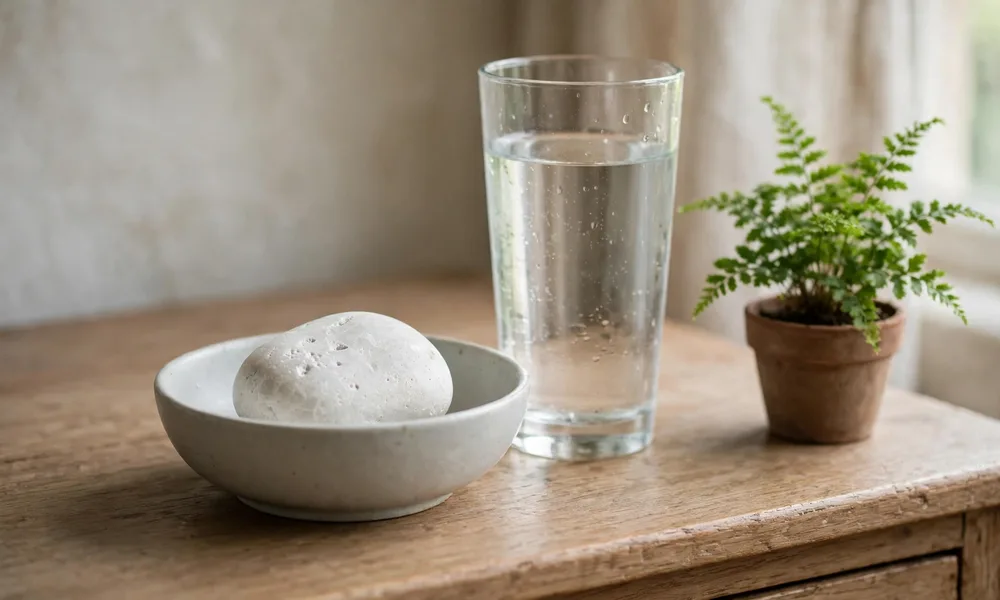
Give magnesite a bright, tidy home: a shelf by the morning window, a clear desk corner, or a little dish on the drawers, somewhere visible and safe from knocks. Keep the tray away from sinks, steam, and small children. Dust it weekly with a soft, dry cloth, and skip soap and sprays, which dull its matte skin. When it is not on show, tuck it away on its own in a small soft pouch, away from keys and harder stones.
Stones That Must Stay Away from Water
Not every stone is as harmless beside a glass as magnesite, and a few carry things inside them that should never reach a drink. Malachite is the clearest warning: its green bands are rich in copper, a metal the body must never swallow, so malachite stays far from water and from anything made to be drunk. Hematite belongs out of drinking water too, as do apatite and pyrite. Lepidolite holds lithium, so it never goes near a drink. Angelite goes dull and loses its shine once it has been wet, and amber — hardened old tree sap — clouds up after soaking and has no place in drinking water either. Magnesite rests dry beside the glass, the only place for any stone.
Your Quiet Days Checklist
- Set the stone on a dry cloth, with the glass apart.
- Drink your water slowly.
- Check the stone is plain white, not dyed blue.
- Put the stone back on its tray before you wash your hands.
- Choose a seller who tells you where the stone came from.
- If a health worry is on your mind, ask a doctor.

Frequently Asked Questions
What is magnesite?
Magnesite is a soft white carbonate mineral, usually a smooth tumbled piece the colour of fresh chalk, sometimes faintly marbled grey.
Why is some magnesite blue?
Much shop magnesite is dyed blue to imitate turquoise, since the soft white stone takes colour easily. An honest seller says so, and the natural stone is white.
How is magnesite different from howlite?
Howlite is soft white marbled with fine grey veins, and it is often dyed blue too. Magnesite is chalkier and plainer, with a matte skin and fainter marbling.
Is magnesite safe to hold?
Holding a small polished piece briefly is fine for nearly everyone, because a dry stone releases nothing into the skin. Set it down when you are done, then wash your hands.
Where should I keep magnesite at home?
A dry, bright corner suits it: shelf, desk edge, or small dish. Keep it clear of the glass, away from knocks, and out of steamy rooms.
Can magnesite go in drinking water?
No, never. Magnesite is soft and porous, and it dulls in water. Keep it dry on its tray; drink from a separate glass.
The Bottom Line
Magnesite fits quiet days: a soft clear-white stone that asks for nothing, a glass of water nearby, the stone kept dry.
A Note for Quiet Days
One white stone, one full glass, a dry tray, and slow light — a quiet day asks for nothing more.


