
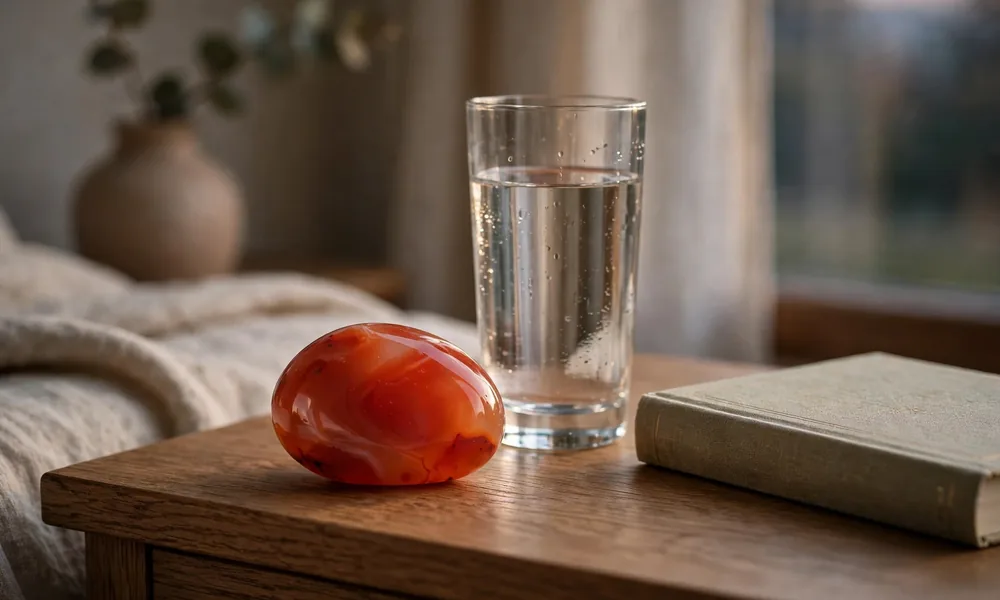
Red walks into a room ahead of everything else. A red coat, a red door, a red stone on a plain tray — the eye finds the warm colour first and lingers there. Red chalcedony carries that same pull in a small, quiet form: a warm red quartz, smooth to the touch, with soft bands drifting through it like clouds at sunset.
The stone belongs to the chalcedony family, a quartz whose crystals are too tiny for any eye to pick out singly. Blue chalcedony is pale sky blue and pink chalcedony is soft rose; this one is the warm red member of the same family, coloured by iron held inside the stone while it formed.
This guide looks at red chalcedony in plain words: what the stone is, how to choose a good piece, and how to enjoy it through a bold day. Be clear about one thing before you buy: the stone is an object to look at and to hold, and nothing beyond that. It cannot shift your luck, lift your mood, or mend your health, and it belongs beside drinking water, never in it.
Key Takeaways
- Red chalcedony is a warm red chalcedony, a form of quartz, smooth and cool in the hand.
- Its warm red colour suits bold days, strong outfits, and rooms with clear daylight.
- Red is the warm red chalcedony; every other live chalcedony is blue, pink, white, purple, lilac, or green.
- The stone is for display and handling only, and it heals nothing.
- The stone rests beside the water glass, never in it, and a dry cloth keeps it bright.
What Red Chalcedony Is
Red chalcedony is the warm red variety of chalcedony, a quartz built from crystals so small that no eye can separate them. The tiny crystals lock into a smooth mass that takes a soft waxy shine when polished, and iron oxide caught inside as it grew gives it the rust-red of autumn leaves and old brick.
The best pieces show one even warm red across the face, sometimes crossed by soft cloudy bands in paler red or cream. The stone is often translucent at the edges, so held toward a window the light sinks a little way inside. You will usually find it as rounded tumbled stones, palm-sized pieces, or beads strung for a necklace, each one cool and weighty when you pick it up.
Picking a Red Chalcedony Piece
Choose a red chalcedony piece in plain daylight, away from shop lamps that flatter every red. Hold it flat and turn it slowly: the red should hold steady from every angle, without washed-out spots or dark muddy edges. A fine piece keeps one rich warm colour across the whole face, feels smooth with no pits under your thumb, and glows gently toward the window.
Ask the seller where the stone came from and whether the red is natural. Dye tends to gather in tiny cracks and hollows, leaving the flat faces paler, while a stone coloured by nature carries its red right through to the centre. A seller who answers plainly is worth trusting. Pick the piece your eye keeps returning to, because you will live with it on your shelf.

A Bold Day with Red Chalcedony
A bold day with red chalcedony starts with the stone where you can see it. Put it on the windowsill beside your morning coffee, or on the hallway table you pass on your way out, and set your glass of water on the far side of the room. Take the water in slow sips while the red catches the early light, and let that be the first quiet minute of the day.
A bold day is not a noisy day. It is a day to wear the strong colour, say what you mean, and finish one job you have been avoiding. The stone does none of that for you; it only sits there, warm and red, while you get on with it.
Red Chalcedony Beside Water
Water and red chalcedony make a handsome pair on a table, and they should stay a pair, never a mixture. Put the stone on a folded cloth at one end of the table and the glass on a coaster at the other, with empty table between them. Wash your hands after handling the stone, before you lift the glass.
The stone never goes into a glass, a jug, or a bath, and water never gets poured across its face. Dust it with a soft dry cloth, and if a splash reaches it, dry it straight away and set it back on its cloth.
Red Chalcedony at a Glance
| Warm red bands | Red scarf, bold coat | Hands dry first |
|---|---|---|
| Rich brick red | Strong daylight, mornings | Glass stays separate |
| Smooth, cool, weighty | Single accent, uncluttered | Keep it dry |
| Rounded palm piece | Windowsill, hallway table | No baths, ever |
| Iron-tinted quartz | Bookcase, dressing table | Wipe dry weekly |

Red Chalcedony and Pink Chalcedony
Pink chalcedony for gentle days is the softest member of the family, a pale rose stone with a milky glow that seems to hold the light inside it. It suits slow hours and quiet rest, and its pink never raises its voice.
Red chalcedony is the same quartz, yet its mood is the opposite. Where pink is pale and hushed, red is warm and forward, a brick red that asks to be noticed. Pink suits a gentle day and red suits a bold one.
Red Chalcedony and Blue Chalcedony
Blue chalcedony for calm conversations is a soft pale blue stone, smooth and cool, with a gentle milky glow that never shouts for attention. It sits on the table before a talk as a small blue reminder to slow down and listen.
Red chalcedony does not slow a room down; it wakes the room up. Blue is the colour of still water and clear sky, while red is the colour of brick, ember, and autumn leaves. A bold day belongs to the red stone.
Red Chalcedony and Red Agate
Red agate for bold days is the closest cousin to red chalcedony, and the two are easy to confuse at a glance. Both are warm red quartz, both are smooth and cool, and both suit bold days. The difference is in the pattern: red agate wears clear bands and stripes, often in layers of red, cream, and brown.
Red chalcedony wears softer bands, cloudy drifts of paler red that melt into the main colour instead of drawing sharp lines. Red onyx is red chalcedony too, but pale cream bands cross it very boldly.
Red Chalcedony and the Other Chalcedonies
The rest of the chalcedony family is easy to tell apart from the red stone, because each member wears its own colour. White chalcedony is clear milky white, with no hint of pink or blue or violet, and it suits bright days and open rooms. Purple chalcedony is deep violet, a rich evening colour for quiet days, while lavender chalcedony is its pale lilac sister, soft and calm.
Chrome chalcedony, the green member of the family, is a full steady green coloured by chromium, the same element that colours emerald. The family now holds blue, pink, white, purple, lilac, and green — and red chalcedony is the only warm red one among them.
Keeping Red Chalcedony at Home
Red chalcedony suits a bright, tidy spot: the top of a bookcase, a corner of the hallway table, or a small bowl on the chest of drawers, somewhere it can be seen and nothing can knock it over. Keep it away from taps, kettles, and steamy bathrooms, and out of reach of small children. Dust it once a week with a soft, dry cloth, and never use soap or sprays.
Between displays, give it its own lined box or soft pouch, away from keys and harder gems that could scratch it. A stone stored on its own keeps its smooth bright face for years.

Stones That Must Stay Away from Water
Some stones hold substances that have no place in a drink, and a careful shelf keeps them well away from any glass. The green bands of malachite contain copper, which must never be swallowed, so malachite never goes near water or any stone drink. Hematite, apatite, and pyrite also stay out of drinking water, and lepidolite, which contains lithium, must never be soaked either.
Angelite dulls and loses its polish in water, while amber, which began as tree sap and hardened over long years, goes cloudy after soaking and must never enter drinking water. Red chalcedony is a hard quartz, yet the same rule covers every stone on the shelf: beside the glass, never inside it.
Your Bold Days Checklist
- Lay the stone on a folded tea towel, away from the tumbler.
- Take your drink in slow sips, with the stone resting untouched.
- Hold the stone a moment, enjoy its red glow, then lay it down.
- Slide the stone back onto its dish before you rinse your fingers.
- Choose a shop that names the mine and the red colour honestly.
- If a health worry comes up, ask your own doctor, never a stone.
Frequently Asked Questions
What is red chalcedony?
Red chalcedony is the warm red variety of chalcedony, a quartz whose tiny crystals lock into a smooth mass, coloured brick red by iron oxide, sometimes crossed by soft cloudy bands.
How is red chalcedony different from red agate?
Red agate wears clear bands and stripes in layers of red, cream, and brown. Red chalcedony wears softer cloudy drifts of paler red that melt into the main colour instead of drawing sharp lines.
How is red chalcedony different from pink chalcedony?
Pink chalcedony is a pale rose stone with a milky glow, made for gentle days and quiet rest. Red chalcedony is warm and forward, a brick red that suits bold days and strong outfits.
Is red chalcedony safe to hold?
Yes, for most people. A polished piece held briefly is harmless for nearly everyone; put it back when you finish and wash your hands afterwards.
Where should I keep red chalcedony at home?
Any bright dry spot suits it: a bookcase top, a hallway table, or a small bowl on the drawers. Keep it away from the glass, safe from knocks, and out of steamy rooms.
Can red chalcedony go into drinking water?
No, never put red chalcedony into drinking water, a jug, or a bath. Keep it beside the glass on a dry cloth.
The Bottom Line
Red chalcedony suits bold days: warm red quartz with soft bands, a full glass close by, and a dry stone on its tray.
A Note for Bold Days
Warm red, a dry stone, a full glass — that is all a bold day needs.


