
Bold days rarely announce themselves the night before. They turn up as a date circled in ink, a talk you agreed to give, a room full of people you have never met.
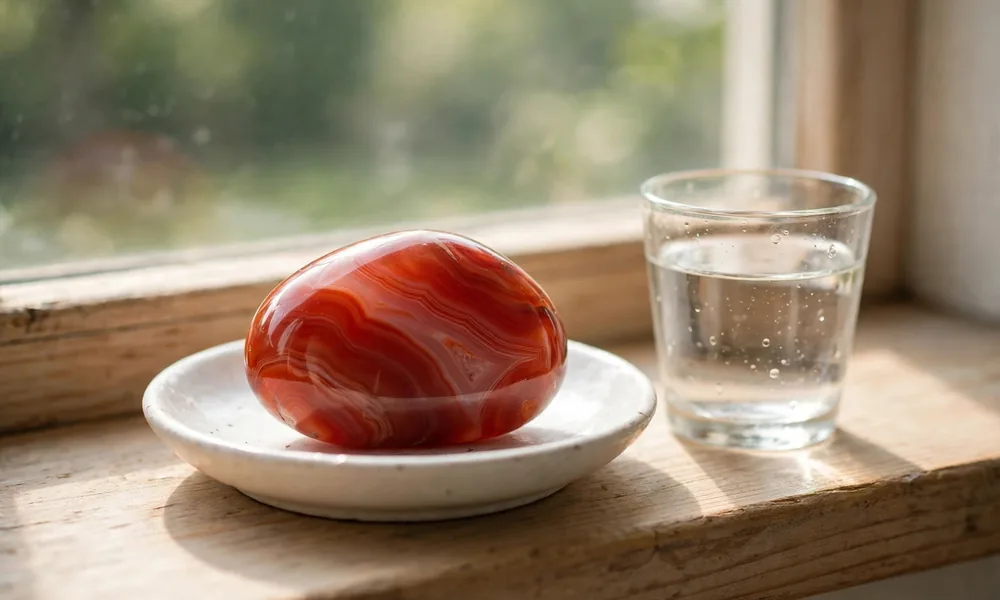
Red agate meets that charge with colour alone. It is a warm red banded stone, deep and glowing, with brick-red stripes running through burgundy and wine-red layers like embers banked under ash. It holds its colour steadily, without sparkle or flash.
What follows looks closely at red agate: how its bands form and what marks a fine piece. The stone is a beautiful object to look at and to hold, and nothing more; it fixes nothing, cures nothing, and lends no courage of its own.
Key Takeaways
- Red agate is a warm red banded chalcedony, deep red with brick-red and burgundy bands.
- Its warm red colour suits bold days, bright rooms, and mornings with one clear task.
- Red agate is for looking at and holding only; it heals nothing at all.
- The stone sits beside a glass of drinking water, never inside it, and stays dry.
- One small red stone is enough for a whole bold day.
What Red Agate Is
Red agate belongs to the agate family, a layered kind of chalcedony, and chalcedony is itself a variety of quartz. It builds slowly inside old volcanic rock, where water carrying minerals settles one thin coat of stone after another across thousands of years. Tiny traces of iron settle into those coats as they form, and the iron is what paints the stone warm red.
A polished piece sits cool and sleek against the palm, with a gentle waxy gleam. The red runs in curved bands, deep wine-red beside brick red, with thin rust lines winding between them. In window light the colour warms further, glowing from inside. No two pieces band in quite the same way.
Banded agate for slow days shows the same layered birth in softer colours, grey, cream, and gentle brown.
Why Warm Red Suits Bold Days
Bold does not mean noisy. It means one clear job on the list, and the resolve to start with it. Warm red wakes the eye the way pale grey soothes it. Red is the colour of ripe fruit, of brick in afternoon sun, of a coat chosen on purpose.
That is why red agate fits a morning with a task in it. It sits on the tray as a small, steady patch of warmth, easy to glance at over your water.
Choosing a Red Agate Piece
Look for red that runs warm and even, with bands that curve rather than clash. Tilt the stone in daylight: the bands should read as deep red, brick red, and burgundy in turn, with no chalky white patches and no dull grey smears across the face. The best pieces show their layers clearly, like rings inside a cut log.
Pick a size that rests easily in your palm. Ask the seller where the stone came from.

A Bold Day with Red Agate
Set the red agate down on a light oak board near the window, with a tall glass of cold water placed well away from it. Drink in unhurried sips and study the red bands while the morning unfolds around you. No rite is called for; board, glass, and stone are all the morning asks.
Glance over your notes once. When the glass runs dry, fill it again.
Red Agate Beside Water
On one tray, a red stone and a tall glass look good together, and the tray is where their friendship ends. Keep the glass on the left side and the stone on the right, with a clear stretch of wood in the middle, so the drink stays clean and the stone stays untouched by water.
Once you have picked the stone up, rinse your hands before you reach for the glass. Keep the stone out of cups, jugs, and baths, and never swirl it through a drink. The same habit holds for blue lace agate in calm evenings.
Red Agate at a Glance
| Warm red bands | Deep, even colour | Display only |
|---|---|---|
| Brick red, burgundy | Tray, shelf, windowsill | Wash hands after |
| Smooth, cool, waxy | Bright light, bold days | Never in water |
| Small stone, warm | One clear task | Dry cloth wipe |
Red Agate and Fire Agate
Fire agate is red agate's nearest bold relative, and telling them apart takes a side-by-side look. Fire agate, live post 990, is a warm brown stone first, banded with flashes of orange, red, and gold that catch the light like embers.
Red agate is red first, through and through, with bands of deep red, brick red, and burgundy and no brown ground beneath them. Fire agate glints and shimmers as it turns; red agate holds one steady warm red, glowing rather than flashing.
Red Agate and Crazy Lace Agate
Crazy lace agate, live post 1398, is the brightest pattern in the whole family, and it could hardly look less like red agate. Its surface swirls bright red, orange, and cream in looping ribbons, like lace caught mid-twirl, and no two pieces ever match.
Red agate keeps its bands in calm, parallel curves, deep red beside burgundy, with no cream ribbons and no orange loops. Crazy lace agate shouts its pattern from across the room; red agate speaks in a lower voice, one warm colour repeated in bands.
Red Agate, Grey Agate, Green Agate, Yellow Agate, Orange Agate and Black Agate
Five further agates arrive in the same recent batch, each carrying a colour red agate avoids. Grey agate, live post 5170, is a soft grey banded stone, quiet in colour and calm in the hand. Green agate, live post 5182, is a fresh leaf green for calm afternoons.
Yellow agate, live post 5194, is a warm sunny yellow striped with honey and cream, for bright days. Orange agate, live post 5206, is a warm orange like marmalade in the sun. Black agate, live post 5218, is a deep black stone for quiet hours. Red agate is the warm red one between them, bold where grey is quiet and black is still.
Red Agate and the Other Agates
The wider family holds plenty of other colours, and none of them matches the warm red described here. Blue agate, article 768 in this batch, is a soft blue banded stone for calm days, while the older blue lace agate, live post 152, is a pale blue stone for calm evenings. White agate for quiet desks is about a plain white stone, smooth and cool to touch, with faint grey lines crossing it now and then.
Tree agate and moss agate are green and garden-like. Dendritic agate shows dark branch shapes on white, like frost on a pane. Plume agate carries soft white feathers in milky grey, and pink agate stays pale pink. Purple agate leans violet and soft. Moroccan agate blends peach with dusty rose, while Botswana agate pairs grey with pink ribbons. Red agate stands apart by being simply red, with no green, no pink, no blue, and no brown ground inside it.
Caring for Red Agate
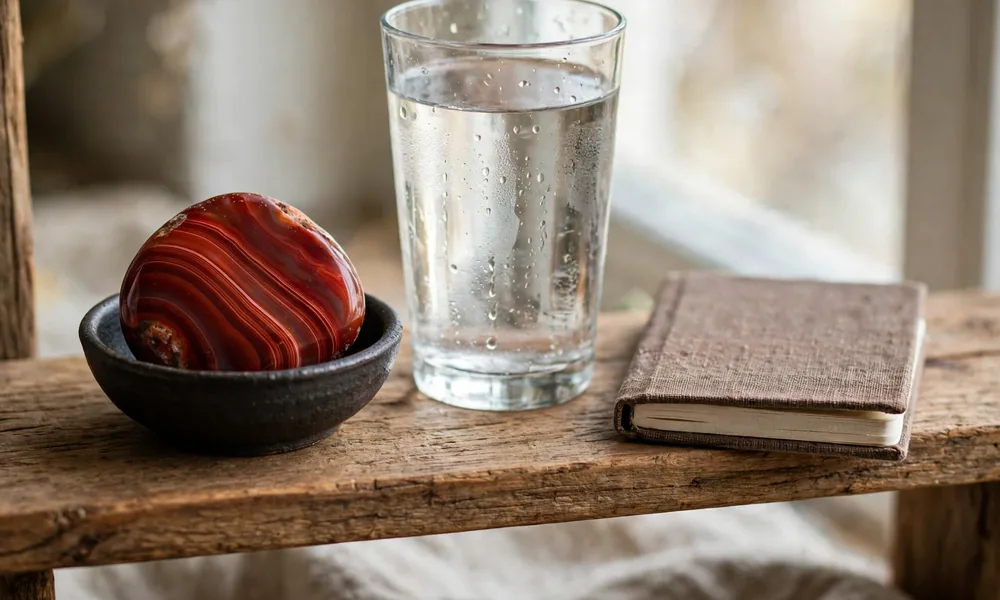
Red agate can take a knock, but it still deserves a gentle home. Give it a dry, cool spot: a lined box with a lid that shuts, or a high shelf where jars cannot fall on it, away from fierce sun and damp air.
Brush dust off with a soft, dry cloth, moving lightly across the rounded top instead of pressing hard. Leave soap, sprays, and polish in the cupboard, and keep the stone out of any ultrasonic cleaner.
Stones That Must Never Touch Water
Some stones must be kept far from every glass, jug, and soak, and the list is worth learning by heart. Malachite leads it: its green bands hide copper compounds that have no place in a cup, so it must never be stirred through drinking water. Hematite follows, because damp turns it rusty and blotchy, so always keep it far from every drinking glass.
Apatite and lepidolite want the same dry treatment, and lepidolite's pale flakes hide lithium inside, so give it a shelf spot far from any cup, jug, or bath you might use. Pyrite, angelite, and amber join them on the dry list. Red agate stays dry beside its glass, on the wooden board, and never in the drink.
Your Bold Days Checklist
- Put the red agate on a dry tray, a full glass close by.
- Sip the water at an easy pace in bright morning light.
- Rinse your hands with soap after setting the stone down.
- Choose a seller who can plainly name the stone's home ground without hesitation.
- Keep it somewhere dry and cool, safely beyond the reach of small hands.
- For any health worry, see a doctor; a stone settles nothing.

Frequently Asked Questions
What is red agate?
Red agate is a warm red banded chalcedony, a form of quartz that builds in thin layers over a very long time. Its bands run deep red, brick red, and burgundy.
How is red agate different from fire agate?
Fire agate is warm brown first, with flashes of orange, red, and gold that glint as it turns. Red agate is red from edge to edge, with steady bands and no brown ground beneath them.
How is red agate different from crazy lace agate?
Crazy lace agate swirls bright red, orange, and cream in looping ribbons like lace. Red agate keeps calm parallel bands of deep red and burgundy, with no cream ribbons at all.
Is red agate safe to hold?
Holding it briefly is fine. Wash your hands with soap as soon as you set it down, and keep the stone far from small children and from food.
Why must red agate never go in water?
Keep the stone on the tray and the water in the cup, each in its own place. Do not dip the stone into a bath or a jug, and do not swirl it through any drink.
Where should I keep red agate at home?
Choose a calm, dry spot — a tray, a shelf, a sill — with the glass close but apart, away from knocks and moisture.
The Bottom Line
Red agate lends bold days a warm red friend: one banded stone in light, set on a light board beside a glass of water, looked at and never drunk.
A Note for Bold Days
Keep the morning bright and the stone dry. One little red agate, one glass of water, and a single clear task are all you need.


