
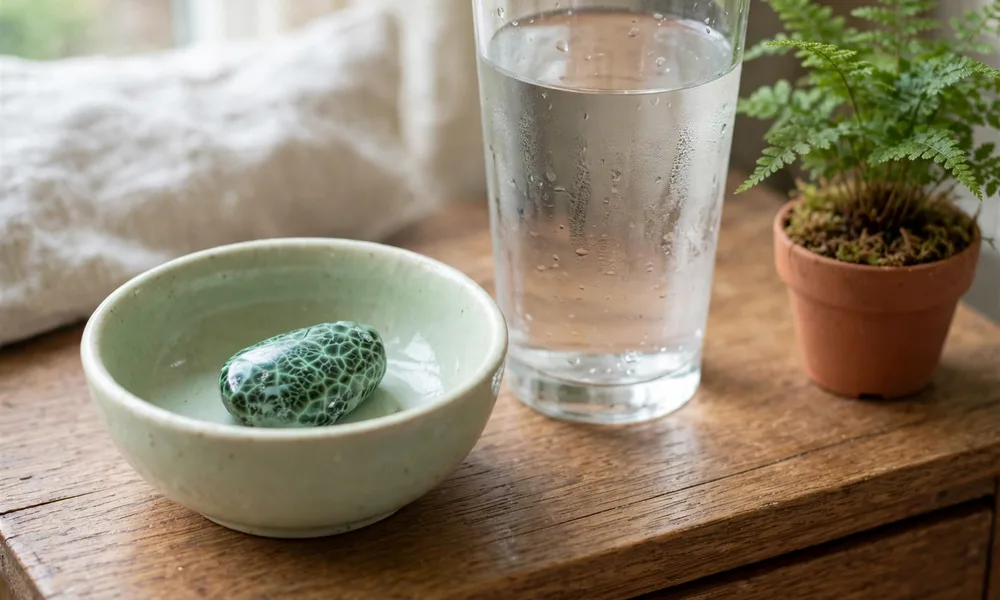
There is a lake in the north of America called Lake Superior, and along its rocky shores people find a green stone that looks like the shell of a small turtle. The pattern is made of little rounded cells, each one outlined in a paler green, and no two stones wear the pattern in quite the same way.
Chlorastrolite is the name of that stone. It is green in the way deep lake water is green, darker at the centre of each cell and lighter along the lines between them, and a polished piece feels cool and smooth when you close your fingers around it.
Keep your drinking water in its own glass, a little way off, and keep the stone dry.
Key Takeaways
- Chlorastrolite is a green stone from Lake Superior with a turtleback pattern of little rounded cells.
- Its deep lake green suits calm days, slow mornings, and rooms that stay tidy.
- It is the only stone in this journal with a turtleback pattern; every other green stone is plain, banded, or glassy.
- The stone is for looking at and holding only.
- Keep drinking water in its own glass, a little way off, and keep the stone dry.
What Chlorastrolite Is
Chlorastrolite is a green variety of pumpellyite, a mineral that formed long ago in the volcanic rocks around Lake Superior in Michigan, in the north of America. As the rock cooled and changed, green minerals grew together in rounded lumps, and the lumps joined into the pattern that gives the stone its nickname: turtleback, because the cells look like the plates on a turtle shell.
A polished piece is usually a smooth oval or a small rounded pebble, cool to the touch, with a soft shine rather than a hard sparkle. The green runs from deep forest green in the middle of each cell to a paler yellow-green along the lines.
Picking a Chlorastrolite Piece
Choose a chlorastrolite piece in plain daylight, turning it slowly in your fingers. Look for a pattern that stays clear as the stone moves, with rounded cells that are easy to see and lines that are pale rather than muddy. A good piece shows deep green at the heart of each cell and a steady shine across the whole face, with no chalky patches and no rough pits.
Ask the seller where the stone came from and whether it is genuine chlorastrolite from the Lake Superior region.

A Calm Day with Chlorastrolite
A calm day with chlorastrolite asks for very little. Spread a pale cloth on the side table, rest the stone at one edge, and stand a glass of water at the far edge, with bare cloth in the middle. Drink the water in slow sips while the stone catches the light from the window, and let the pattern give your eyes somewhere pleasant to rest.
A glass of water, a green stone, and an unhurried hour are enough, and the rest of the day can take care of itself.
Chlorastrolite Beside Water
Water and chlorastrolite look good side by side on a tray, but the two must stay apart. Put your glass at one end of the tray and the stone at the other, with a stretch of dry cloth in the middle, so the drink stays clean and the stone stays dry.
Rinse your hands once you have touched the stone and ahead of raising your own glass for a drink. Never let the stone fall into a glass, a jug, or a bath, and never tip water over its face.
Chlorastrolite at a Glance
| Turtleback cells | Calm tray, desk | Dry hands only |
|---|---|---|
| Deep lake green | Slow mornings, light | Glass kept apart |
| Smooth, cool, solid | Open windows, calm | Never in drinks |
| Palm-sized oval | One tray, one glass | Dust dry weekly |
| Lake Superior stone | Tidy shelf, tray | Never soak stone |

Chlorastrolite and Green Jade
Green jade for slow mornings is the oldest green stone in this journal, and the difference between the two is plain once you hold them side by side. Green jade is a smooth, even green, from pale sage to deep forest, with faint lighter veins or cloudy patches like mist caught inside the stone, and its surface is one steady colour all over.
Chlorastrolite is patterned where green jade is plain. Its turtleback cells break the green into dozens of little rounded shapes, each with its own shade, so the eye keeps moving across the stone instead of resting on one even colour.
Chlorastrolite and Green Pearl
Green pearl is the only other green in this journal that comes from water, but it comes from a very different kind of water. A green pearl grows inside a shelled mollusc in fresh water, its thin coats settling one over another until a round gem takes shape, fresh leaf-green with a soft glow that travels over the bead as it turns.
Chlorastrolite grows in rock, not in a shell, and it is a solid pebble rather than a bead. Its green is deeper and darker than the fresh leaf green of the pearl, and its turtleback pattern is something no pearl can show.
Chlorastrolite and Green Agate
Green agate for calm days is a banded stone, and its bands are the first thing you notice. Faint green stripes cross a darker green heart, like the veins of a leaf seen against bright daylight, and those stripes sweep softly over the piece like small waves on a quiet pond.
Chlorastrolite is patterned in cells, not in bands. Its turtleback shapes are rounded and closed, each one ringed in pale green, while green agate wears long sweeping stripes that run from one edge of the stone to the other.
Chlorastrolite and Green Onyx
Green onyx for calm days is a gentle green chalcedony marked with faint stripes, like still water drifting slowly across a pale bed. Its shade stays paler than moss and softer than emerald, striped with faint bands of cream, white, and pale green that wander through the piece in gentle, even sheets.
Chlorastrolite is darker and busier than green onyx. Where green onyx shows soft even layers, chlorastrolite shows a net of rounded cells, each one a different shade of green, and where green onyx is soft and pale, chlorastrolite is deep and rich.
Chlorastrolite and Green Obsidian, Green Fluorite and Green Tourmaline
Three more live green stones complete the family, and each one is easy to tell apart from chlorastrolite. Green obsidian is a deep green volcanic glass, dark and glassy, with a soft shine rather than a hard glitter.
Green fluorite shows a bright green tone with faint green stripes and patches that cross the piece like gentle sheets of dawn light, and since it is a very tender stone, treat it softly and keep it far from much tougher gems.
Keeping Chlorastrolite at Home
Chlorastrolite likes a spot where the daylight is soft and the room stays tidy. A ledge beside the morning window, a nook on the desk, or a dish atop the drawers all suit it, provided the stone stays plain to see and free of knocks and spilled drinks.
Keep the tray far from taps, kettles, and steamy washrooms, and beyond the reach of young little children. Dust the stone once a week with a soft, dry cloth, and never use soap, polish, or sprays on it, since moisture and chemicals can dull the shine. When the stone is not on display, keep it by itself in its own small cotton drawstring bag, on a shelf of its own, away from keys, coins, and harder gems that could scratch it.
Stones That Must Stay Away from Water
Some stones carry things that should never reach a drink, and it is worth knowing which ones they are. Malachite holds copper in its green bands, and copper is not something to swallow, so malachite must never go into water or into any drink made with stones.
Angelite dissolves little by little in water, while amber is ancient tree sap turned hard, so a soak leaves it hazy and dull. Keep all of them away from food and drink, and keep chlorastrolite the same way: beside the glass, never inside it, with clean dry hands.
Your Calm Days Checklist
- Lay the stone on dry cloth, glass a little apart.
- Drink the water slowly, without rushing.
- Lift the stone, feel its cool cells, and set it down again.
- Return the stone to its tray ahead of washing your hands.
- Choose a seller who speaks openly about where it began.
- When a health worry appears, please ask your own doctor about it, never a stone.

Frequently Asked Questions
What is chlorastrolite?
Chlorastrolite is a green variety of pumpellyite, a mineral from the volcanic rocks around Lake Superior in Michigan. Its pattern of little rounded cells looks like the plates on a turtle shell.
Where does chlorastrolite come from?
Chlorastrolite comes from the Lake Superior region in the north of America, including Isle Royale, an island in the lake. It formed in old volcanic rock, where green minerals grew together in rounded lumps that joined into the turtleback pattern.
How is chlorastrolite different from green jade?
Green jade is a smooth, even green stone with faint veins, from pale sage to deep forest, and its surface is one steady colour all over. Chlorastrolite is patterned, with dozens of little rounded cells in different shades of green.
How is chlorastrolite different from green agate?
Green agate wears long stripes, with faint green threads crossing a darker green heart like the soft pale veins of a leaf. Chlorastrolite holds closed rounded cells instead of stripes.
Is chlorastrolite safe to hold?
Most people can hold a small polished piece briefly with no bother. Put it back in its place once you are done, rinse your hands, and store it somewhere little children cannot get to.
Where should I keep chlorastrolite at home?
A sunny dry ledge, a desk nook, or a dish atop the drawers all suit it. Keep the stone apart from the glass, away from direct sun.
The Bottom Line
Chlorastrolite fits calm days: a deep green turtleback stone in light, your water in its own glass close by, and the stone left dry.
A Note for Calm Days
Deep green cells, a dry stone, a full glass — a calm day asks for nothing more.


