Some mornings ask for nothing at all. The house is quiet, the light comes in low and golden, and there is nowhere to rush to for an hour or two. On a morning like that, a loud colour on the shelf feels like too much noise.
Desert rose fits a morning shaped like that. It is a soft, sand-coloured stone that grows in layered petals, like a rose folded out of pale sand. Put it on a small dish with a glass of fresh water nearby, and the two together lend the room a still, sandy quiet.
This guide walks through desert rose in plain words: what the stone is, how to pick a sound piece, and where it sits best on calm days. One warning runs through the whole guide, and it matters more here than with most stones: desert rose is gypsum, and gypsum melts away in water, so this stone is for dry display only, never soaked, never washed, and never dropped into a drink.
Key Takeaways
- Desert rose is a soft sand-coloured gypsum stone shaped like layered petals.
- Its pale sandy colour suits calm days, quiet rooms and slow mornings.
- Desert rose differs from Libyan desert glass, polychrome jasper and rose quartz.
- Desert rose is only for looking at and holding; it has no healing power.
- Keep it next to your drinking water, never inside it, and always dry.
What Desert Rose Is
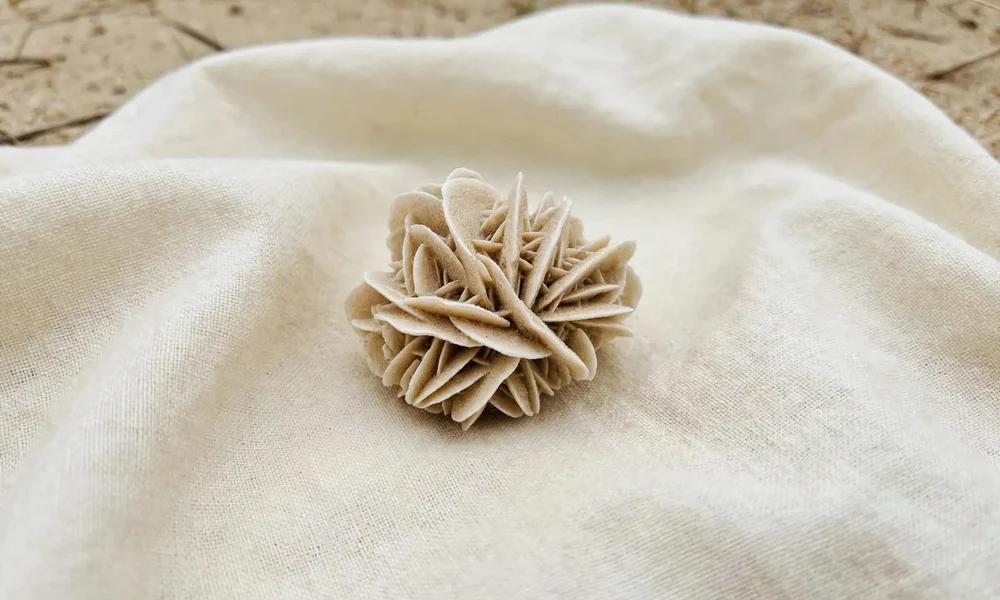
Desert rose is a cluster of gypsum crystals that grows in flat, overlapping blades, each cluster opening out like the petals of a rose. The colour is a soft sand, pale beige with hints of warm tan, and the surface has a gentle, powdery glow rather than a sharp shine. Hold one and it feels light for its size, dry and a little grainy under the fingers, with edges that can flake if handled roughly. It forms in dry desert ground, where mineral-rich water evaporates slowly and leaves gypsum behind, layer upon layer.
Why Soft Sand Suits Calm Days
Soft sand suits calm days because it is the colour of stillness itself. Bright reds and deep blues pull the eye and stir the room, while pale sand asks for nothing and lets the quiet stay quiet. Desert rose brings that feeling indoors without any fuss. Its pale petals soften a corner of a desk or a shelf, and the sandy tone sits easily beside wood, linen and cream walls.
Choosing a Desert Rose Piece
Choosing a desert rose piece comes down to a close look in daylight and your own judgement. Pick one with neat petals in an even sand colour, not a grey, dusty lump with snapped blades, and one that feels firm, not crumbly, when lifted gently.
A small cluster that sits in your palm is plenty for a calm-day tray, easy to hold and easy to move. Buy from a seller with a solid reputation, never one who claims the stone will change your health.
A Calm Day with Desert Rose
Start the morning by placing the desert rose on its tray and pouring a tall glass of water to stand nearby, where the light can touch them both. Drink slowly, rest your hand near the stone, and let the pale petals set the tone before the day begins to move.
Lift the stone once more before the quiet stretch ends, breathe out slowly, and carry on with the day. The stone works no magic on its own: the pause belongs to you, and the sand colour is only a nudge to take it.
Desert Rose Beside Water
Fill a tall glass of cool water and put it on the tray next to the desert rose. They share the tray and nothing else: the stone never goes under the water, never sits in a soak, and never gets splashed on purpose, because gypsum dissolves slowly in water, softening the petals and dulling the shape.
That rule holds on every calm day, without exception. Pick the stone up with clean, dry hands, and if the glass ever tips, move the piece away at once, set it somewhere dry, and bring it back only when the tray is fully dry again.
Desert Rose at a Glance
| Soft sand petals | Calm days | Dry display |
|---|---|---|
| Pale beige, tan | Tray, desk, shelf | Stone apart |
| Light, dry, grainy | Morning, quiet hours | Soft dry dusting |
| Gypsum rosette cluster | Daylight, lamplight, pause | Never soak |

Desert Rose and Libyan Desert Glass
Libyan desert glass and desert rose both come from the desert, and both carry the colour of sand and sun. Libyan desert glass for bright days covers a warm gold natural glass, pale and glowing, formed when a meteorite strike melted desert sand in one sudden moment.
Where Libyan desert glass is smooth, glassy and warm gold, made for bright days, desert rose is a pale sandy gypsum cluster shaped like petals, made for calm days, and it must stay dry because water dissolves it. One is glass born of heat in an instant, the other a flower of sand grown slowly.
Desert Rose and Polychrome Jasper
Polychrome jasper and desert rose both hold desert colours, and both suit a sunny tray. Polychrome jasper for bright days covers a jasper of many colours, with terracotta, sandy ochre, teal and cream swirling together in one stone, warm and bright as a canyon wall.
Desert rose is far quieter. Where polychrome jasper is bold and many-coloured, made for bright days, desert rose is a single soft sand colour in petal layers, made for calm days. One is a canyon in full colour, the other a single dune at dawn.
Desert Rose and Rose Quartz
Rose quartz and desert rose share the shape of a rose in their names, and both are gentle stones for soft hours. Rose quartz for tender evenings covers a soft pink quartz, smooth and cool, kept close in the evening for tender, unhurried time.
Where rose quartz is soft pink and smooth, made for tender evenings, desert rose is pale sand and petalled, made for calm days, and far more fragile, since gypsum dissolves in water while quartz does not. One is a smooth pink stone of the evening, the other a sandy flower of the morning.
Desert Rose and Rhodochrosite
Rhodochrosite and desert rose both carry a rose in their names, and both suit gentle, caring hours. Rhodochrosite is a rose pink banded stone, kept for self-care rituals, with bands of pink and white sweeping through it.
Where rhodochrosite is rose pink with bold bands, desert rose is soft sand with petal layers, and it asks for drier care than almost any stone, since water can melt its gypsum petals away. One is a pink banded stone for rituals, the other a sandy flower for calm days.
Caring for Desert Rose
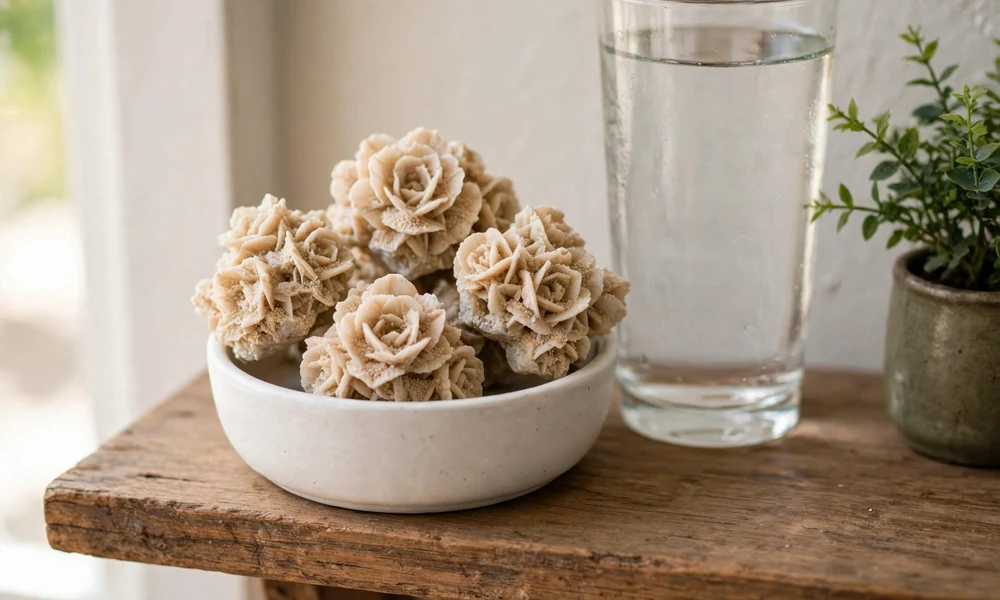
Looking after desert rose takes a gentle hand and a dry shelf. Rest it in a small bowl or on a tray, somewhere dry and out of strong sun, away from radiators and steamy bathrooms, A light dusting with a soft, dry brush now and then is the only cleaning it needs, and soap, water and polish should never touch it.
Gypsum is soft, so a hard knock can snap a petal off, and a fall can shatter a whole cluster, so carry the piece with both hands and never toss it into a bag with hard objects.
Stones to Keep Away from Water
A few stones should stay far from any water, and it helps to know them by name. Malachite leads the list: it has no place in a glass or a jug, because it can give off substances that belong nowhere near a drink.
Hematite belongs on the dry list too, and should never sit in drinking water. Apatite and lepidolite are on it as well, and lepidolite holds lithium inside it. Pyrite, angelite and amber round out the same list: none of them goes into a glass or a soaking bowl. Desert rose heads the list here, because it is gypsum and water melts it, so keep it next to the glass, never in it.
Your Calm Days Checklist
- Put the desert rose on a tray with a full glass of water nearby.
- Drink fresh water slowly while the calm morning unfolds.
- Rest your hand near the stone and breathe out slowly.
- Buy from a seller you trust, and keep the receipt somewhere safe.
- Keep the stone next to drinks, never dropped inside them.
- Stones heal nothing; take health worries to a doctor.
Frequently Asked Questions
What is desert rose?
Desert rose is a gypsum cluster of flat, overlapping blades, opening like the petals of a rose. It is soft sand in colour, pale beige with warm tan hints, and it feels light, dry and a little grainy.
Why must desert rose never be soaked?
Because desert rose is gypsum, and gypsum dissolves slowly in water. Soaking softens the petals and can crumble a cluster, so this stone is for dry display only, beside a glass, never in one.
How is desert rose different from Libyan desert glass?
Libyan desert glass is a warm gold natural glass, smooth and glowing, formed in one sudden moment when a meteorite strike melted desert sand. Desert rose is a pale sandy gypsum cluster grown slowly in petal layers, and far more fragile around water.
How is desert rose different from rose quartz?
Rose quartz is a smooth, cool, soft pink quartz for tender evenings, and quartz stands up well to a splash. Desert rose is pale sand and petalled, for calm days, and it is gypsum, so water can melt it and it must always stay dry.
Will desert rose heal anything?
No. It is a beautiful stone to look at and to hold, and it will not heal anything. If you feel calmer afterwards, that ease comes from the unhurried minutes you gave yourself with it, not from any power inside the stone.
Where should I keep desert rose at home?
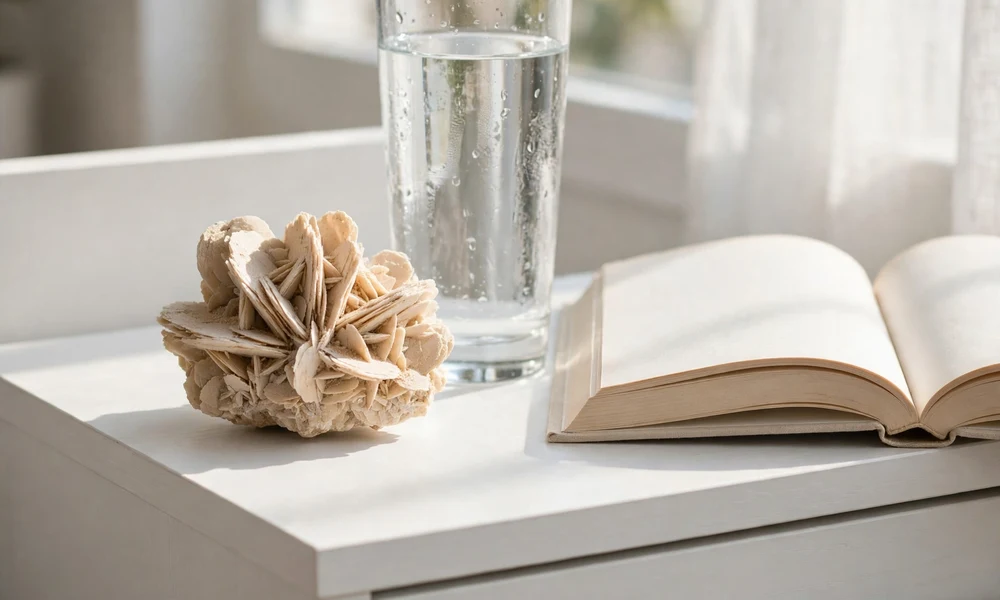
Put it somewhere dry and quiet where you will see it often, a desk tray, a nightstand, or a window shelf, and keep a glass of water nearby without letting it touch the stone.
The Bottom Line
Desert rose brings soft sand calm to quiet days: pale petalled stone on its tray beside a glass of water, always dry, always gentle.
A Note for Calm Days
Keep the sand pale, the stone dry, and the day calm. One petalled cluster, one glass of water, and a few quiet minutes are enough.