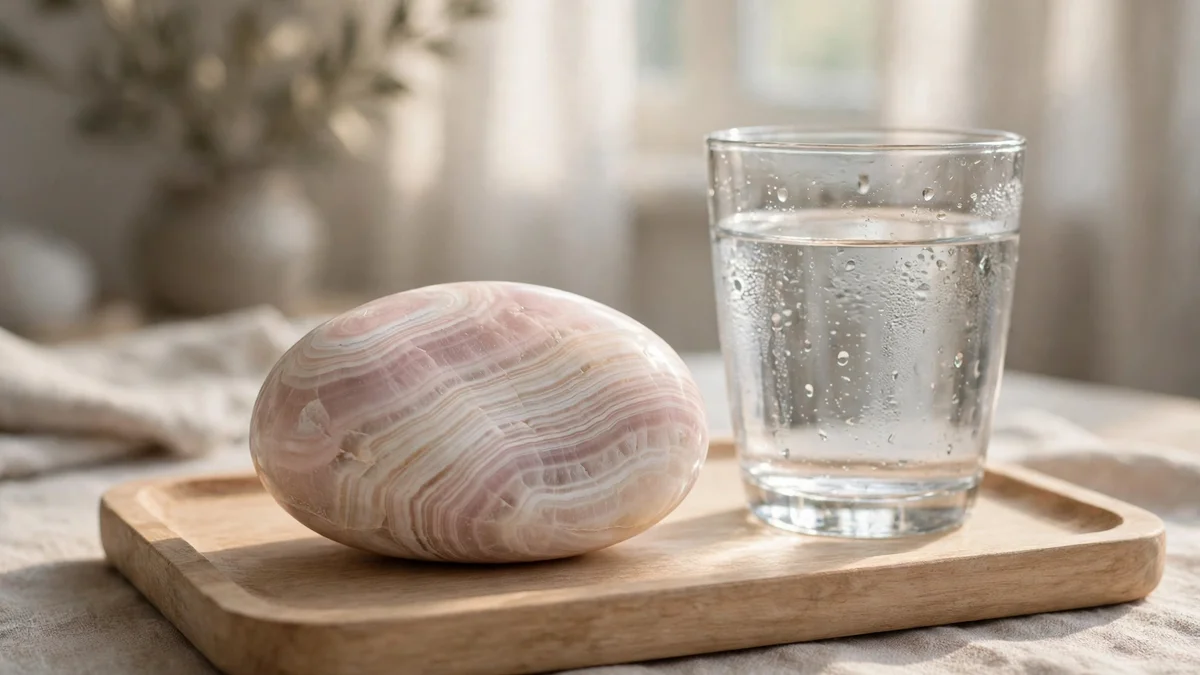
Some days arrive quietly, without any hurry at all. The house is still, the light is soft, and the morning asks for nothing more than a slow start. On a day like that, a bright sparkling stone feels too loud, and a dark heavy stone feels too serious for the mood.
Thomsonite is a stone for days like these: a soft banded zeolite, pale pink, cream and white in gentle curved bands, smooth to the touch and calm to look at.
This guide is a spotlight on thomsonite: what it is, how to choose a piece, how to display it, and how to enjoy it through a quiet day. The stone is for display only, and it will not heal anything.
Key Takeaways
- Thomsonite is a soft banded zeolite, pale pink, cream and white, for quiet days.
- Its gentle curved bands suit quiet days, soft light and slow mornings.
- Thomsonite differs from heulandite, stilbite, natrolite, cavansite and apophyllite.
- Thomsonite is for display and handling only; it will not heal anything.
- The stone stays beside drinking water, never in it, and stays dry and dusted.
What Thomsonite Is
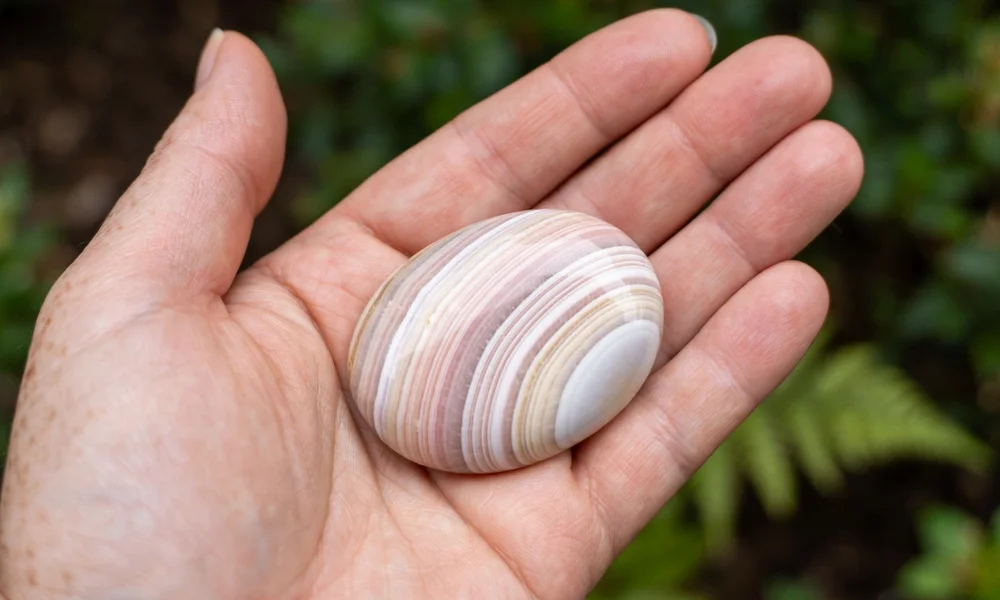
Thomsonite is a zeolite, a family of pale, light minerals that form in volcanic rock, and its banded variety is coloured a soft pale pink, cream and white. The bands curve gently around the stone in smooth, even lines, sometimes in fine rings and sometimes in broader waves, and no two pieces show quite the same pattern.
Hold a polished piece in your palm and it feels cool, smooth and solid, with a soft, silky shine rather than a sharp sparkle. Tumbled stones glow gently as you turn them, while larger polished pieces show the bands more clearly, like the rings of a quiet shell.
At Crystal by Ayesha, we approach thomsonite as a decorative object and a source of visual calm, not as a medical treatment. It will not fix your mood, but it can give your attention a soft, gentle place to rest.
Why Soft Bands Suit Quiet Days
Soft bands suit quiet days because they move the eye slowly, in gentle curves, instead of asking it to jump from one bright point to another. On a quiet day the light is gentle, and a small banded stone gives the eye a restful path to follow, so even a plain tray feels calm.
A quiet day also suits thomsonite because the stone is simple: no preparation, no ceremony, simply there when you sit down, catching the soft light in its pale bands.
Choosing a Thomsonite Stone
Choosing a thomsonite stone is mostly a matter of looking closely and trusting your eye. A good piece shows clear, even bands in pale pink, cream and white, not a muddy grey tone or a washed-out colour, and the bands should curve smoothly around the stone.
Look for a smooth surface with no sharp chips, and a polish that feels silky under your fingers. If a piece feels pleasant in your hand, it is the right one. Buy from a trusted seller, never one who promises it will change your health.
A Quiet Day with Thomsonite
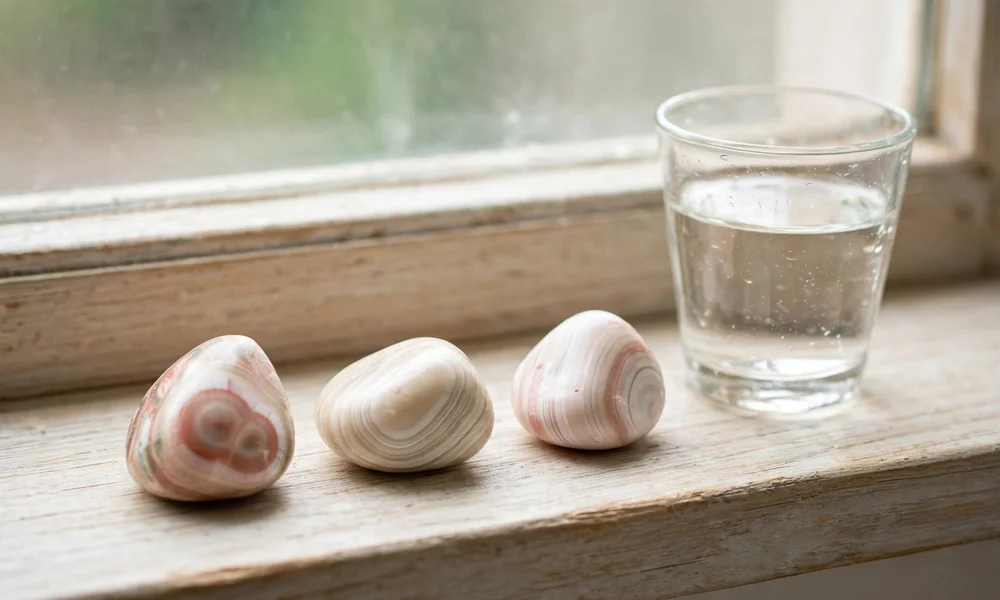
A quiet day with thomsonite takes only a few minutes to begin: place the stone on its tray, fill a clear glass with fresh water, and set it beside the stone. When you sit down, drink the water slowly, in small sips, and then pick up the stone and follow its bands with your eyes for a few breaths.
Put the stone back, and let the day carry on quietly, the tray near a window, where the soft light can reach the stone and the glass.
Thomsonite Beside Water
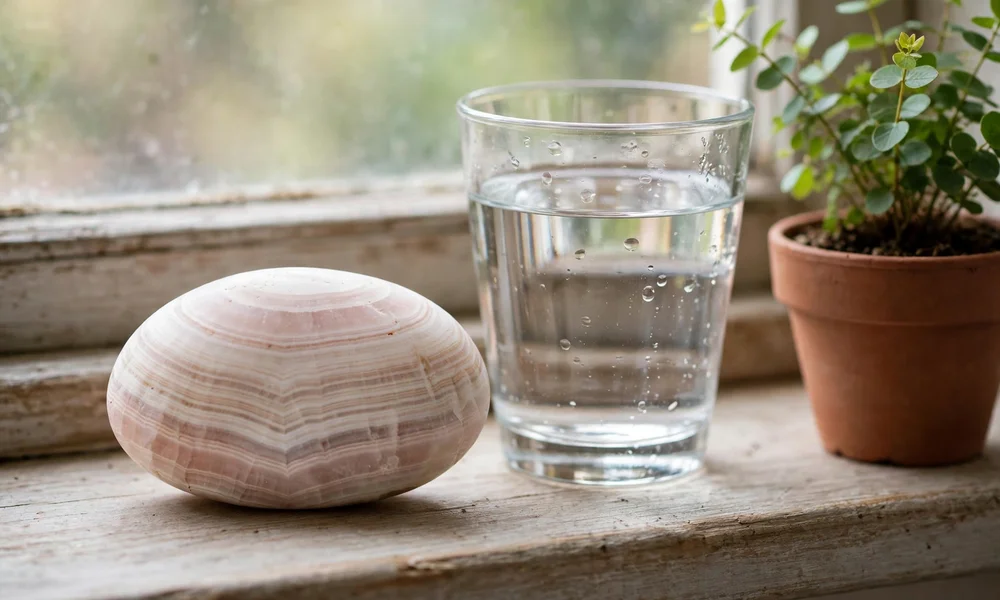
Water belongs beside the stone, never around it: set a clear glass of fresh drinking water next to the stone on the tray. They share a tray, not a glass. Never place the stone inside drinking water, and never soak it, because a stone has no place in a drink.
Thomsonite is a soft, porous zeolite, so soaking can dull the polish and weaken the stone. If the glass spills, lift the stone away and dry it at once. Dust it weekly with a soft, dry cloth, never soap or polish.
Thomsonite at a Glance
| Soft banded stone | Quiet days | Display only |
|---|---|---|
| Pale pink bands | Soft light, mornings | Beside water only |
| Hard, cool feel | Water, light, pause | Dust with dry cloth |
| Cream, white bands | Tray, shelf, desk | Never soak it |

Thomsonite and Heulandite
Thomsonite and heulandite are both zeolites, and both suit quiet hours, yet they look nothing alike. Heulandite is a soft white zeolite that grows in flat pearly plates, stacked in thin layers like the pages of a small book, with a gentle shine that catches the light without flashing it back.
Thomsonite is warmer and rounder, a smooth banded stone in pale pink, cream and white, with curved bands instead of flat plates. Where heulandite soft white for quiet mornings keeps a pale layered stone for quiet mornings, this guide keeps a soft banded stone for quiet days — same family, different shape, different colour, different day.
Thomsonite and Stilbite
Thomsonite and stilbite are both zeolites, and both suit calm rooms, yet they are easy to tell apart. Stilbite is a soft peach zeolite, a pale mineral that grows in gentle fan-like blades and bow-tie shapes, coloured like the inside of a peach held up to the light.
Thomsonite is paler and smoother, a banded stone in pink, cream and white, with no blades and no fans, only gentle curves. Where stilbite soft peach for calm shelves keeps a peach fan of thin blades for calm shelves, this guide keeps a smooth banded stone for quiet days — same family, different shape, different colour, different place.
Thomsonite and Natrolite
Thomsonite and natrolite are both zeolites, and both are pale, yet they could hardly look more different. Natrolite grows as a spray of fine white needles, thin as threads, fanning out from one shared base, like a small frozen firework.
Thomsonite grows in smooth rounded masses, with bands that curve gently around the stone, and it is made to be held, not just looked at. Where natrolite white needles for bright days keeps a delicate needle spray for bright days, this guide keeps a smooth banded stone for quiet days — same family, different form, different day.
Scolecite is another white zeolite worth knowing, and it sits close to natrolite: a white stone with fine needle-like lines running through it, for slow mornings. Thomsonite differs from scolecite too, because its bands are broad, curved and pink, cream and white, not fine white needle lines, and it suits quiet days rather than slow mornings.
Thomsonite and Cavansite
Thomsonite and cavansite are both zeolites, but they are opposites in colour and mood. Cavansite grows as vivid blue bursts, small bright blue rosettes and sprays, scattered across dark grey matrix rock like flowers after rain, and it suits fresh mornings.
Thomsonite is soft and pale, with bands in pink, cream and white, for quiet days. Cavansite wakes the eye; thomsonite rests it.
Thomsonite and Apophyllite
Thomsonite and apophyllite are both pale display stones, yet they are easy to tell apart. Apophyllite is a clear, glassy mineral, often sold as a single point with a neat pyramid tip, and it looks like a piece of frozen water that catches the daylight in soft, clear flashes.
Thomsonite is not clear and not pointed: a smooth, opaque banded stone, pink, cream and white. Apophyllite suits the brightest corner; thomsonite suits a quiet tray in soft light.
Stones That Must Never Touch Water
Not every stone is safe beside water. Malachite must never go in water or in elixirs, because it can release harmful substances. Hematite must never go in drinking water, and apatite, lepidolite — which contains lithium — pyrite, angelite and amber must never go in drinking water or in soaks either.
The rule stays the same for thomsonite: display it on a tray, keep a glass of water beside it, and never let the two meet.
Your Quiet Days Checklist
- Set the stone on a tray beside a clear glass of water.
- Drink a glass of fresh water slowly when the day begins.
- Hold the stone for a few breaths and follow its soft bands.
- Keep the stone beside water, never inside drinking water or soaks.
- Dust the stone dry weekly, and wash your hands after handling it.
- Remember the stone will not heal anything; see a doctor for health problems.
Frequently Asked Questions
What is thomsonite?
Thomsonite is a soft banded zeolite, pale pink, cream and white in gentle curved bands. It is a smooth, cool stone with a soft silky shine, and it suits quiet days.
Is thomsonite the same as heulandite?
No. Heulandite is a soft white zeolite that grows in flat pearly plates, stacked like the pages of a book. Thomsonite is a smooth banded stone in pale pink, cream and white. Same family, different shape and different colour.
Is thomsonite safe beside water?
Yes, it is safe beside a glass of drinking water, on the same tray or shelf. It must never go inside drinking water or be soaked, because it is a soft, porous zeolite and the water should stay plain.
Will thomsonite heal anything?
No. Thomsonite will not heal anything. It is a beautiful object for display and handling, and the calm comes from the pause and the quiet day, not from the stone.
How do I clean thomsonite?
Dust it once a week with a soft, dry cloth, never soap or polish, and never scrub it. If it gets wet, dry it at once.
Where should I keep my thomsonite?
Keep it on a small tray in a dry room, with a clear glass of water beside it — a desk, a shelf or a windowsill in soft light works well.
The Bottom Line
Thomsonite brings soft bands to quiet days: a pale pink, cream and white zeolite with gentle curves, held beside a glass of fresh water in soft light. Keep it beside water, never in it, and dust it dry.
A Note for Quiet Days
Keep it soft, keep it dry, keep it quiet. A small banded stone, a glass of water, and a few slow minutes can carry a quiet day.