There is a blue that does not shout: the blue of a sky washed pale by morning, or of water in a shallow dish, and it asks the eye to rest rather than to stare. Lazulite carries exactly that blue, soft, even, and quiet, for days when nothing needs to be hurried.
A calm day has room for small pleasures, and a stone on a tray is one of them. You set it down, pour a glass of water, and sit for a while with nothing to finish. The stone stays dry, the water stays plain, and the two share a table without ever touching.
This guide looks at the best ways to enjoy lazulite on a calm day: what the stone is, how to pick a good piece, where to put it, and how to tell it apart from lazurite and lapis lazuli. It is gentle general information only, and lazulite, lovely as it is, will not heal anything.
Key Takeaways
- Lazulite is a soft blue phosphate mineral, paler and quieter than lapis lazuli.
- Its gentle blue suits slow hours, soft light, and unhurried rooms.
- Lazulite is an ornament for the eye and the hand; it treats nothing at all.
- The stone rests beside the glass of water, never inside it, and stays dry.
- One small piece on a plain tray or cloth is enough for a calm day.
What Lazulite Is
Lazulite is a blue phosphate mineral, formed where hot, mineral-rich rock cooled slowly deep underground. Its colour comes from its own makeup, not from a coating or a dye: a soft azure blue, sometimes pale as a morning sky, sometimes deeper, with milky white veining where quartz runs through it.
It is softer than quartz, about five and a half to six on the hardness scale, so cutters polish it gently and it keeps a soft, waxy shine rather than a sharp glassy one. Good pieces feel cool and smooth, and the blue stays even from edge to edge. It has been found in Austria, Brazil, Madagascar, and parts of America, usually as small masses rather than large crystals.
Hold a piece up to the window and the blue turns lighter, almost milky at the edges. That softness is the whole charm of the stone: it never glares, and it never competes with the room.
Why Soft Blue Suits Calm Days
Soft blue is the colour of a sky that has nothing to prove. On a calm day, when the chores are few and the voices in the house are low, a pale blue stone fits the mood because it asks for nothing. It sits on the tray, catches the light, and lets the eye wander past it without being pulled back.
Deeper blues can feel grand, almost formal, like evening light or a dark sea. Lazulite is different: its blue is the blue of mid-morning, easy and open, for a day meant to be spent slowly. Put it beside a glass of water and the two blues answer each other, one in stone and one in glass.
A calm day does not need much decoration: one soft blue stone, one glass of water, and a little light through the window are enough to make a corner of the room feel settled.
Choosing a Lazulite Piece
Look for a piece in daylight, by a window or outside, where the blue shows without shop lamps warming it. A good piece shows one soft, even blue across its face, with no grey patches, no chalky streaks, and no crack running through the middle. Turn it over in your hand: it should feel smooth, with a gentle shine, and sit flat without wobbling.
A piece about the size of a walnut, or a little smaller, is plenty for a calm day. Bigger pieces look impressive in a shop, but a small stone is easier to keep on a tray, easier to pick up, and easier to put away. Rough pieces show the stone as it came from the ground, while polished ones feel silkier in the palm.
Ask the seller where the stone was found, and walk away from anyone who promises it will calm your nerves or mend your health.

A Calm Morning with Lazulite and Water
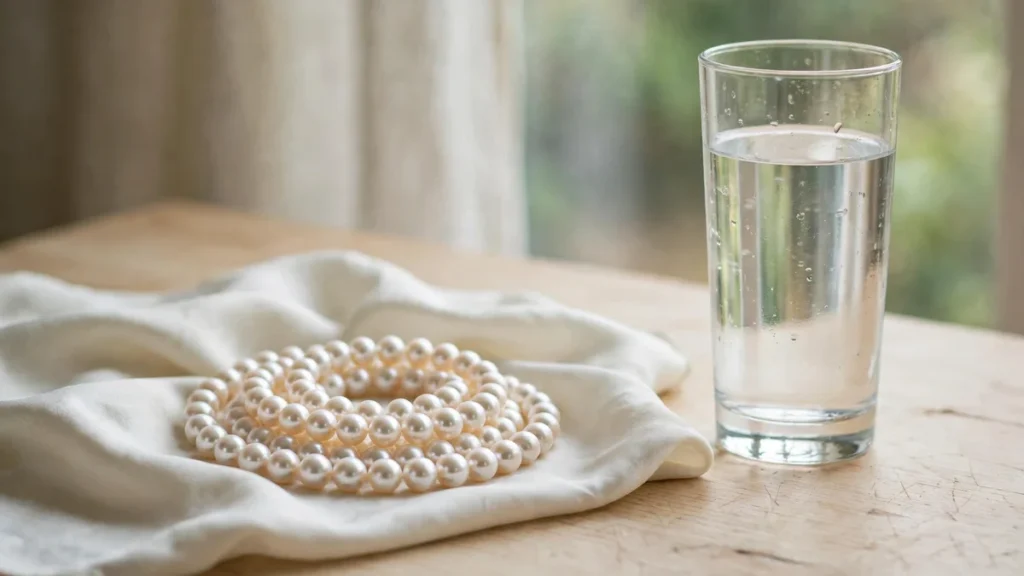
Start by clearing a corner of the table, not the whole table. Lay down a folded pale cloth, set the lazulite at one end of it, and put a tall glass of water at the other, with a strip of bare cloth between them. The gap matters: it keeps every drop off the stone.
Pour the water slowly and drink it in small sips while the room wakes up. Pick the stone up once, feel its cool weight, look at the blue for a few breaths, and set it back down exactly where it was. When the glass is empty, the little ritual is done.
Nothing needs to be repeated or improved. The same cloth, the same glass, the same stone, and the day begins from a quiet place.
Lazulite at a Glance
| Soft blue stone | Tray or cloth | Dry hands only |
|---|---|---|
| Phosphate mineral | Calm days | Glass kept apart |
| Walnut-sized piece | Soft daylight | Wipe dry weekly |
Lazulite and Lazurite
For the deep blue mineral inside lapis lazuli, see the lazurite guide.
Lazurite is a single deep blue mineral, a feldspathoid whose rich colour comes from sulphur in its structure, and it is the part that supplies nearly all the blue in lapis lazuli. Its blue is deep and dusky, like the sky after the sun has gone down, and it sometimes carries a speck or two of gold. Lazulite is a different mineral altogether: a phosphate, not a feldspathoid, and its blue is softer and paler, like a morning sky, with milky veining instead of gold.
Lazulite and Lapis Lazuli
For the famous deep blue rock flecked with gold, see the lapis lazuli guide.
Lapis lazuli is a rock, not one mineral: mostly lazurite, mixed with golden pyrite flecks and small veins of white calcite, polished into beads and ornaments for thousands of years. It is busy to the eye, a night sky held still, and it suits quiet evenings when the light is low. Lazulite has none of that pattern: no gold flecks, no bold white veins, only one soft blue with a little milky veining, for the middle of a calm day rather than the evening.
Lazulite and Dumortierite
For another deep blue stone for quiet days, see the dumortierite guide.
Dumortierite is a deep blue stone too, darker and more solid in colour, often cut into smooth pieces for a quiet shelf. Lazulite sits a shade lighter beside it, softer to the eye in bright daylight. The two can share a tray without crowding each other, so long as each has its own end and the glass keeps its distance from both.

Nine Neighbours in This Batch
In this batch, lazulite keeps company with nine others. A clear white akoya pearl shines softly in its box, a folded map waits beside a bag, and the passport rests in its zipped pocket for the next journey.
Deep blue plancheite waits for calm hours, a suitcase stands shut and light by the wall, and deep black tenorite sits quietly on its shelf. A backpack hangs packed for the morning, warm bronze pyrrhotite rests on its tray, and a tote bag waits by the hook for the day ahead. Among all nine, lazulite alone is the soft blue phosphate that asks for nothing but a little light.
Stones That Must Never Touch Water
Keep the glass on its own end of the tray, because water spoils more stones than most people expect. A few names are worth remembering.
Angelite drinks water in and then cracks along fine lines, until a piece that looked solid splits in two. Pyrite loses its shine the same way: a wet piece dries dark and stained, and no rubbing brings the gold back. Amber, which began as tree resin, goes milky when it soaks. Apatite falls apart in crumbs if it stays damp, and lepidolite holds lithium in its flakes, so it should never go near anything you might drink.
Your Lazulite Checklist
- Pick a piece in daylight, one soft even blue, with no grey patches and no crack.
- Give it a fixed home: a folded cloth, a wooden tray, or one end of a shelf.
- Set the glass of water at the far end of the tray, with bare cloth between them.
- Lift it with clean, dry hands, look at it slowly, and put it back where it was.
- Dust the stone and its cloth with a soft dry cloth once a week.
- If holding a stone leaves your skin sore, or low feelings linger week after week, speak to a doctor, because a stone is a pleasure to look at, not a treatment.

Frequently Asked Questions
Is it safe to hold lazulite in my hands?
Yes, with clean, dry hands. Wash and dry your hands first, lift the stone gently, and set it back on its cloth when you are done.
Where is the best place to keep lazulite at home?
On a dry shelf or a tray out of direct sun, always in the same spot. A folded cloth underneath stops scratches, and shade keeps the blue from fading.
Can lazulite go into drinking water?
No. The stone stays beside the glass, never inside it, and it should never be soaked or rinsed under a tap, because water can dull its surface and seep into fine cracks.
How do I tell lazulite apart from lapis lazuli?
Look for gold. Lapis lazuli is a deep blue rock scattered with golden pyrite flecks and white calcite veins, while lazulite is one soft blue with milky veining and no gold.
How do I clean lazulite?
Wipe it with a soft, dry cloth and leave it at that. Do not use water, soap, or polish, and do not rub hard, since the stone scratches easily.
Can lazulite help me feel calmer on a hard day?
A soft blue stone can be pleasant to look at while you sit quietly with a glass of water. It will not heal anything, and if low feelings stay with you, speak to a doctor.

The Bottom Line
One soft blue stone, one folded cloth, one glass of water kept apart: lazulite needs nothing more to make a calm day feel a little quieter.
A Note for Calm Days
A pale blue stone, a slow glass of water, and an unhurried hour — that is the whole of a calm day with lazulite.