Some days arrive with a crowded mind. There are too many half-finished thoughts, too many small decisions waiting, and no clear sense of what matters first. The day is simply full, and the fullness makes it difficult to think straight.
A clarity ritual is a small pause that gives the mind room to settle. It is not a cure, and it does not promise to clear your mind the way medicine might: it is a calm habit of water, a quiet corner, a few unhurried minutes, and one clear question written down.
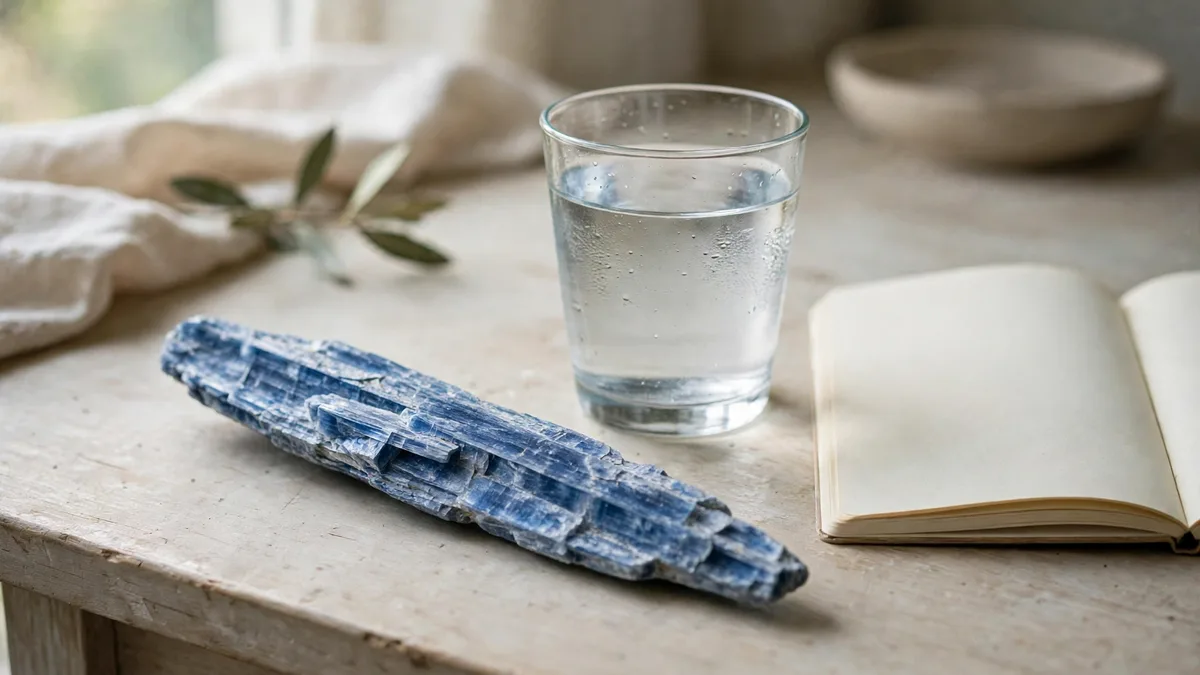
This article explains kyanite clarity rituals: what they are, how to do one in ten minutes, and how to fit one into a morning, a midday break, or an evening. Kyanite, a long blue blade, sits beside your water glass as a visual anchor while you think.
Key Takeaways
- A kyanite clarity ritual is a short, calm pause: water, a quiet corner, one clear question, and kyanite resting beside you.
- Kyanite is a focus aid and a calm ritual companion only; it does not treat, cure, or clear the mind medically.
- Ten quiet minutes done regularly help more than a long ritual you only manage once.
- Writing one question down matters more than the stone: it turns a crowded mind into one thing to think about.
- The stone always stays beside the water, never in the water you drink.
What a Kyanite Clarity Ritual Is
A kyanite clarity ritual is a simple habit built from four things: a piece of kyanite, a glass of fresh water, a notebook, and ten quiet minutes. You sit somewhere calm, place the kyanite where you can see it, pour the water, and write down one question. Then you drink slowly, think, and write down the next small step.
Kyanite is a blue stone that grows in long, flat blades, a deep, clear blue like water seen through glass. That is its job in this ritual: it gives your eyes somewhere calm to rest while your mind works, the way a window gives you somewhere to look while you think.
Nothing here is medical. Kyanite does not clear the mind the way sleep or rest might, and it does not treat anxiety, low mood, or any health condition. If your mind feels persistently crowded or low, please speak to a qualified health professional. A ritual can support a calm day, but it cannot replace care.
Why a Small Ritual Helps You Think Clearly
Clear thinking rarely arrives when you chase it. It arrives when the mind has a little space: a pause between tasks, a quiet room, a glass of water drunk slowly. A ritual creates that space on purpose.
The ritual works because it is small and repeatable. Ten minutes fits into a real day, and a habit that fits is a habit you keep. A long, elaborate routine sounds impressive, but most people abandon it within a week.
A fixed order helps too. When you do the same small steps each time, you stop spending energy deciding what to do next: pour the water, place the stone, write the question. That simple order tells your mind this is thinking time, and it learns to settle into it faster each day.
Choosing Your Kyanite
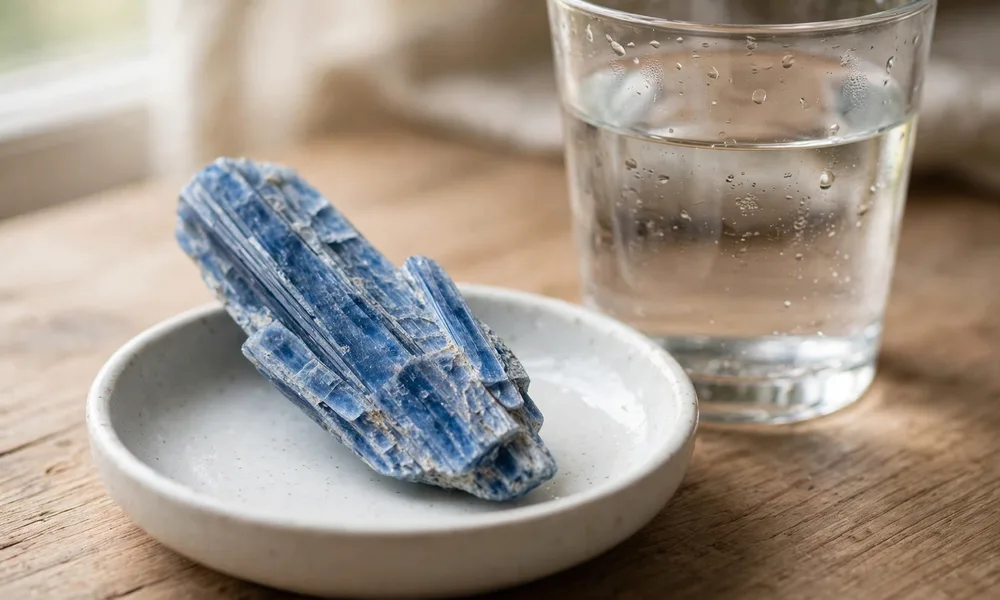
Blue kyanite is the classic choice, and the easiest to find. Look for a blade that feels good in your hand: smooth, solid, and a blue you enjoy looking at. A piece the length of your palm is plenty; it does not need to be large or expensive.
Blue kyanite is quite soft for a stone, so handle it gently: it can scratch and flake if knocked about, and thin blades can snap if dropped. Keep it in a small pouch or a lined box, away from keys and coins.
| Type | Colour | Best for |
|---|---|---|
| Blue blade | Deep clear blue | Desk ritual |
| Blue rough piece | Mottled blue and grey | Holding |
| Green kyanite | Soft green-blue | Calmer look |
| Black kyanite | Dark grey-black | Evening use |
Clean it with a soft, dry cloth; never soak it or scrub it with soap. If you want a morning ritual built around a different stone, a gentle fluorite focus ritual for clear mornings follows the same calm shape, with fluorite resting beside the glass instead.
The Ritual, Step by Step
Set aside ten minutes without interruption. Turn your phone face down or leave it in another room, and sit somewhere comfortable with kyanite, notebook, and pen in front of you.
Pour fresh water and place it beside the kyanite, each in its own place. Look at the stone for a moment, then take a slow sip. The point is not to rush; the point is to arrive.
Open the notebook and write down one question, the one actually on your mind, in ordinary words: what should I decide today, what is making this week feel crowded, or what do I need to finish first? Write it plainly; this is a working note, not a sentence that needs to impress anyone.
Then sit quietly, drinking slowly and letting thoughts come and go without chasing them. When one thought feels useful, write it down. When the ten minutes are over, write one small next step, close the notebook, and return to your day.
A Glass of Water Beside the Stone
Water is the quiet partner in this ritual: a glass of fresh water drunk slowly is a calm pleasure, and it gives your hands something to do while your mind works. Pour it fresh, just before you begin.
The stone stays beside the glass, never in it: kyanite should not sit in drinking water, and a stone in a glass is not a health treatment. The stone is there for its colour and stillness; the water is there to drink.
If the ritual helps, the water habit can grow: a glass with breakfast, one at midday, and one in the evening is a gentle rhythm, easier to keep than any strict schedule. The ritual is simply one of those glasses, drunk with a little more attention.
Writing One Clear Question
Writing does the most work in this ritual: a crowded mind holds many thoughts at once, and they blur together, but writing one question down pulls a single thought out of the crowd and puts it somewhere you can look at it.
Keep the question small and specific: "How do I fix my life" is too large for ten minutes, while "what is the one email I should answer first" is small enough to answer. A clear question makes the next step visible, and a visible step is easier to take.
Sharpen the question by separating what you know from what you are guessing: two short lists, what you know for certain and what you are only assuming. If a fact can be checked, note where. This small distinction, at the heart of five minutes of clearer thinking, often makes the next action easier to see.

A Clearer Desk, a Clearer Mind
A crowded desk makes a crowded mind worse: papers, cups, cables, and half-finished things all ask for attention, and attention is what you are trying to gather. Before the ritual, clear the small space in front of you.
You do not need to tidy the whole room, just one surface: the desk, the table, or the corner where you sit. Put the kyanite where you can see it, the water beside it, and the notebook open in front of you.
Light matters too: sit near a window, or in a corner with soft, natural light. A bright, uncluttered corner changes how a room feels, and a home that catches the light is easier to think in than a dark, crowded one. Fewer things to notice means the mind can notice the one thing that matters.
Morning, Midday, and Evening Versions
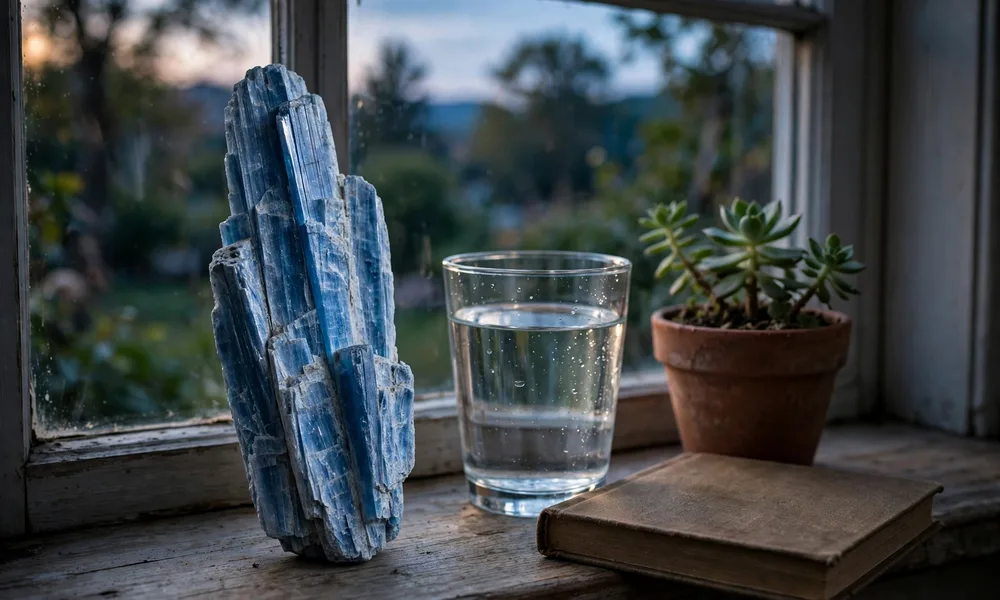
In the morning, the ritual chooses the day before the day chooses you: ten minutes with water, stone, and notebook, before email and messages, sets a calmer tone for what follows.
At midday, the ritual is a reset: step away from the screen, pour fresh water, and ask what the afternoon actually needs. Often the answer is smaller than you feared — one task, one call, one decision — best tried in a different spot from your usual desk.
In the evening, the ritual closes the day: sit somewhere comfortable, light a candle if you like, and ask what is finished and what can wait. Write the next step down, close the notebook, and let the day end — slower and softer, with less writing and more quiet.

Your Kyanite Clarity Checklist
- Choose ten quiet minutes when you will not be interrupted.
- Place your kyanite where you can see it, with fresh water beside it.
- Write down one clear question in ordinary words.
- Drink slowly and let your thoughts settle without chasing them.
- Write down one small next step, then close the notebook.
- Keep the stone beside the water, never in the water you drink.
Frequently Asked Questions
Does kyanite clear the mind? No, not medically. Kyanite is a calm ritual companion and focus aid: a blue stone to look at while you pause, drink water, and think. It does not treat anxiety, low mood, or any health condition.
How long should a kyanite clarity ritual take? Ten minutes is enough; a short ritual done most days helps more than a long one done once. If ten minutes feels long, start with five.
Can I put kyanite in my drinking water? No. Keep kyanite beside the glass, never in the water you drink; it is a soft stone, so keep it dry and handle it gently.
What if I cannot think of a question to write down? Write down whatever is on your mind, even if it is vague — "Why does today feel crowded" is a fine question. The writing is what matters, not finding perfect words.
Morning or evening: which is better for a clarity ritual? Either works. Mornings help you choose the day ahead; evenings help you close it. Try both for a week and keep the one that fits.
Do I need an expensive piece of kyanite? No. A small blue blade the length of your palm is plenty. Choose a piece whose colour you enjoy looking at.
The Bottom Line
A kyanite clarity ritual works because it is small, calm, and repeatable: a blue stone to look at, a glass of water drunk slowly, one question written down, and one small step chosen. It does not promise to clear your mind; it gives your mind ten quiet minutes to settle, and that is often enough to see what comes next.
Begin tomorrow with whatever you already have: a glass of water, a notebook, and ten unhurried minutes, adding a piece of kyanite when you find one you like. The ritual is the pause, not the stone, and the pause is yours to keep.
A Note for Clearer Days
Keep it short, keep it calm, and keep it yours. The clearest days are rarely the busiest: they are the ones where a small pause repeats itself, day after day, until thinking clearly becomes part of how you live. Stay curious. Stay clear. Think well.



