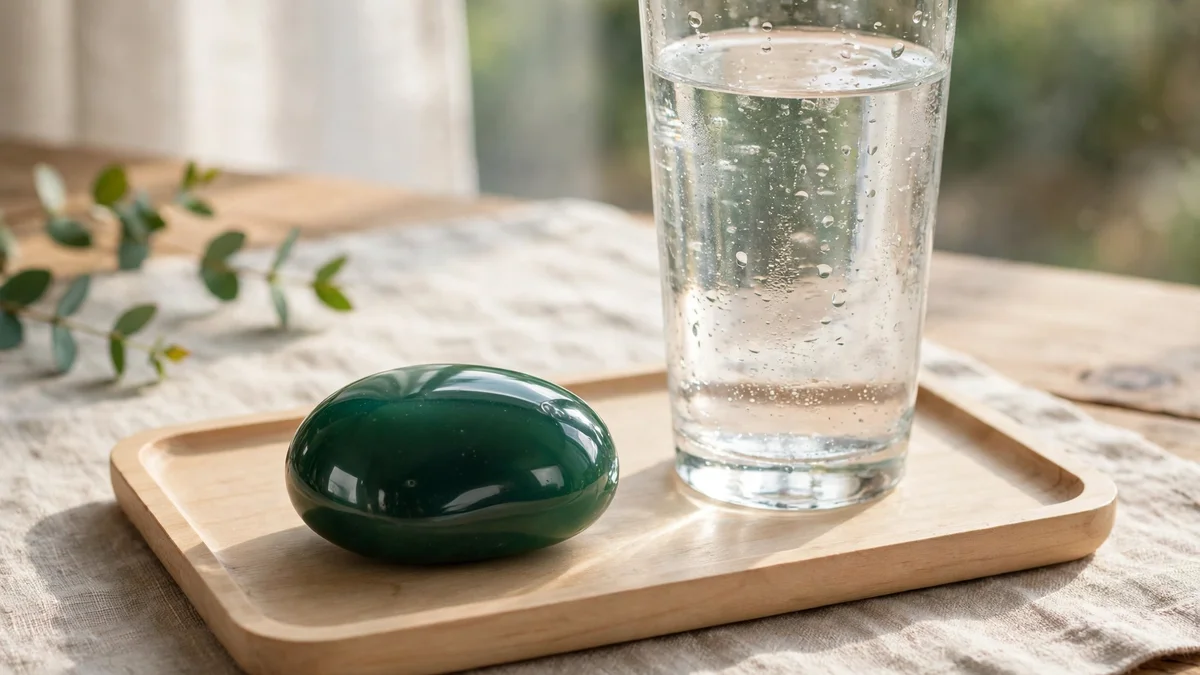
Some greens are pale and washed out, and some are so dark they look almost black in a dim room. Chrome chalcedony sits between those two ends: a full, steady green, deep enough to feel rich and clear enough to catch the light.
The green comes from chromium, a trace element locked inside the stone as it grew. Chromium is the same element that colours emerald. Blue chalcedony is blue, pink is pink, and white is white, so a green chalcedony stands apart the moment you set it down.
The glass stands apart from the tray, and the stone never gets wet.
Key Takeaways
- Chrome chalcedony is a deep green chalcedony, coloured by tiny traces of chromium inside the stone.
- It is the only green chalcedony in this journal; every other live chalcedony is blue, pink, white, purple or lilac.
- Its even green suits calm days, slow mornings, and rooms that stay tidy.
- The stone is for looking at and holding only, and it will not heal anything.
- Your glass of water stands on its own, well clear of the stone, which stays dry.
What Chrome Chalcedony Is
This stone is chalcedony in its green form, a quartz whose crystals are so tiny that no eye can separate them. The crystals lock together into a smooth, even mass, and the stone takes a soft waxy shine when polished. Its green is deep and steady, and the finest pieces hold one even colour right across the face.
Chromium, caught inside the stone as it grew underground, supplies the green. A good piece is translucent, so light sinks a little way into it instead of bouncing straight off the surface.
Picking a Chrome Chalcedony Piece
Choose a chrome chalcedony piece in plain daylight, turning it slowly between your fingers. Look for a green that stays even as the stone moves, with no pale patches and no muddy brown corners. A good piece shows a rich colour all over, a smooth face with no pits, and a gentle glow when you hold it up toward the window.
Ask the seller where the stone came from and whether the green is natural, since some green stones are dyed and show their colour gathered in cracks and dents. A natural piece wears its green evenly, through the whole stone, and a seller who answers plainly is worth trusting.

A Calm Day with Chrome Chalcedony
A calm day with chrome chalcedony asks for very little. Spread a pale cloth over the side table, set the stone down at one end, and place the glass at the far end, leaving dry cloth between them. Sip the water slowly as the stone takes the light from the window.
That is all a calm day needs: water, one green stone, and an unhurried hour.
Chrome Chalcedony Beside Water
Water and chrome chalcedony look good side by side on a tray, but the two must stay apart. Put your glass at one end of the tray and the stone at the other, with dry cloth between them, so the drink stays clean and the stone stays dry. Wash your hands after you have handled the stone and before you lift your glass to drink.
Keep the stone out of every glass, jug and bath, and do not tip water over it. A drink that has held a stone is not one to trust.
Chrome Chalcedony at a Glance
| Rich chromium green | Quiet tray, desk | Hands dry first |
|---|---|---|
| Coloured by chromium | Unhurried mornings | Glass stands apart |
| Smooth, cool, firm | Bright airy rooms | Never dropped in drinks |
| Fits one palm | Single tray, single glass | Wipe dry weekly |
| Zimbabwe find | Neat shelf, tray | No soaking ever |

Chrome Chalcedony and the Other Chalcedonies
Blue chalcedony for calm conversations is the palest cousin in the family, a soft sky blue with a milky glow, and it suits slow talks in a quiet room. Chrome chalcedony is its green opposite: deeper, richer, and warmer in tone, with none of the blue's cool paleness.
Pink chalcedony is soft rose pink, white chalcedony is clean milky white, purple chalcedony is deep violet, and lavender chalcedony is pale lilac. None of them is green. Chrome chalcedony is the only one in the family that wears green at all, and its chromium green is darker and fuller than any of their pastel shades.
Chrome Chalcedony and Green Jade
Green jade for slow mornings joined this journal before any other green stone in the collection. Pick both stones up together and the contrast shows at once. Jade is dense and hard-wearing, in gentle tones that run from pale sage through to deep forest, sometimes marked by faint pale streaks or cloudy patches.
Chalcedony belongs to the quartz family, while jade is a different mineral altogether, and the green on this stone stays steadier from edge to edge. Jade can drift from pale to dark and carry soft streaks; chrome chalcedony keeps a single deep chromium green throughout.
Chrome Chalcedony and Green Agate
Green agate for calm days wears bands, and the bands are what your eye finds first. Thin pale green threads cross a darker green heart, and the stripes sweep over the piece in soft curves.
Chrome chalcedony is banded in no way at all, its green running even and unbroken from edge to edge. The two are close kin, yet the eye tells them apart at once: one is striped, the other is plain.
Chrome Chalcedony and Green Pearl, Green Onyx, Chrome Tourmaline and Chrome Diopside
Four other green stones live in this journal, and none of them looks like this one. A green pearl forms inside a shelled mollusc in fresh water, a round bead whose soft shine moves across it as it turns, and its green is a light leaf green, paler than the deep chromium green here.
Green onyx is a soft green chalcedony with pale bands running through it in gentle layers, so it is banded where chrome chalcedony is plain. Chrome tourmaline is a deep green tourmaline with long grooves down its crystals, and chrome diopside grows in sharp glassy crystals, while chrome chalcedony is a smooth pebble with no grooves and no sharp edges.
Chrome Chalcedony and Trapiche Emerald
Trapiche emerald is the other new green stone in this batch, and the two could hardly look more different. A trapiche emerald carries a dark six-spoked wheel across its face, black lines running from the centre to the edges like the spokes of a cartwheel, with green filling the spaces between them.
Datolite is soft yellow in this batch, and its pale gold is nothing like this even green. Trapiche emerald is a patterned showpiece; chrome chalcedony is a plain, steady green for a quiet tray.
Keeping Chrome Chalcedony at Home
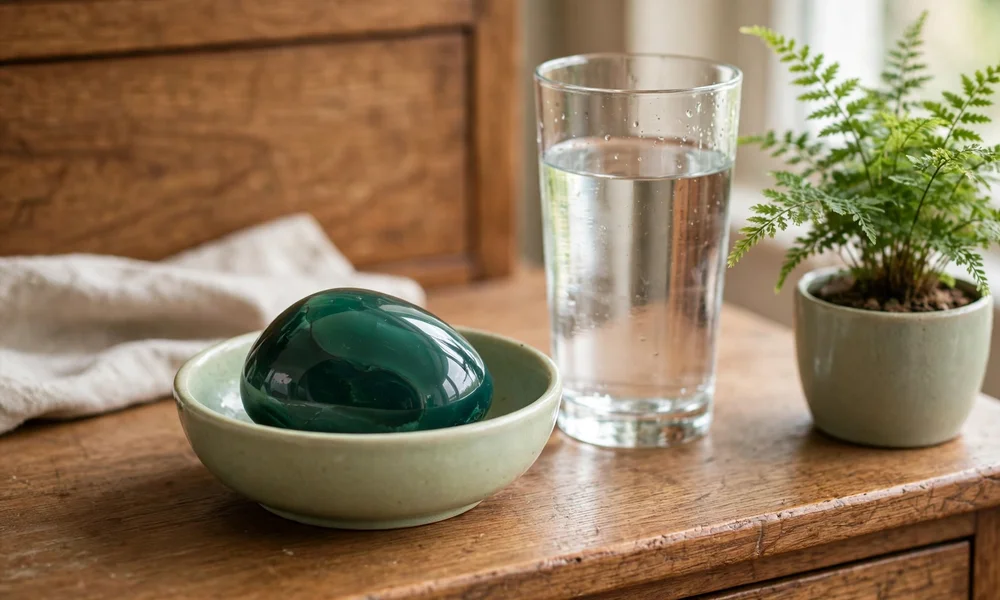
Give this stone a bright, uncluttered corner. The top of a chest of drawers near a window, a clear patch on a work desk, or a shelf in a calm room all work well. Put the tray where splashes cannot reach it, away from sinks and kettles, and where small children cannot grab it.
Once a week, wipe the stone over with a clean dry cloth and nothing else. Soap, polish and sprays stay in the cupboard. Between outings, let it rest alone in a small cotton pouch, kept away from keys, coins and tougher stones that might mark its face.
Stones That Must Stay Away from Water
A few stones hold substances that have no business near a drink, so it helps to know their names. Malachite carries copper in its green bands, and copper should never be swallowed, which means malachite stays out of every glass, jug and bath. Hematite is another one to keep out of drinking water, and pyrite goes rusty and stains when it stays wet.
Angelite slowly dissolves when it sits in water. Apatite and lepidolite prefer to stay dry, and amber clouds over after a soak, so none of them belongs near a drink. Treat chrome chalcedony the same: next to the glass, never inside it.
Your Calm Days Checklist
- Set the stone on a dry cloth, with the glass at a distance.
- Sip the water slowly and take your time.
- Pick the stone up, feel its cool green face, then put it down.
- Put the stone back on its tray, then go and wash your hands.
- Pick a seller who answers plainly when you ask where it came from.
- A health worry goes to your own doctor; a stone cannot answer it.
Frequently Asked Questions
What is chrome chalcedony?
Chrome chalcedony is the green variety of chalcedony, a quartz made of crystals too small to see one by one. Its deep green colour comes from tiny traces of chromium held inside the stone as it formed.
Where does chrome chalcedony come from?
Fine green pieces were first found near Mtoroshanga in Zimbabwe, which is why sellers sometimes call this stone mtorolite. Always ask the seller where a piece began.
How is chrome chalcedony different from blue chalcedony?
Blue chalcedony is a soft pale blue stone with a milky glow, made for calm conversations. Chrome chalcedony is its green cousin, deeper and richer in colour, with the same smooth chalcedony feel.
How is chrome chalcedony different from green agate?
Green agate is a banded chalcedony, with pale green stripes running through a deeper green body. Chrome chalcedony has no bands at all, and its green runs even and unbroken across the whole piece.
Is chrome chalcedony safe to hold?
A short hold of a polished piece is fine for most people. When you have finished, set it down, wash your hands, and put the stone where small children cannot reach it.
Where should I keep chrome chalcedony at home?
Any dry, bright corner works: a shelf, a desk, or a dish on a chest of drawers. Keep it away from the glass, out of damp rooms, and out of harsh sun.
The Bottom Line
Chrome chalcedony suits a calm day: deep chromium green in gentle light, water in a glass of its own nearby, and the stone kept dry.
A Note for Calm Days
An even green, a dry stone, a full glass: that is a calm day, complete.


