Some mornings feel tender from the first minute. The light is thin, yesterday still sits in your chest, and even ordinary jobs feel heavier than they ought to. On a morning like that, softness is not a treat. It is the kindest thing you can give yourself, and one small beautiful object nearby can help the hours feel gentler.
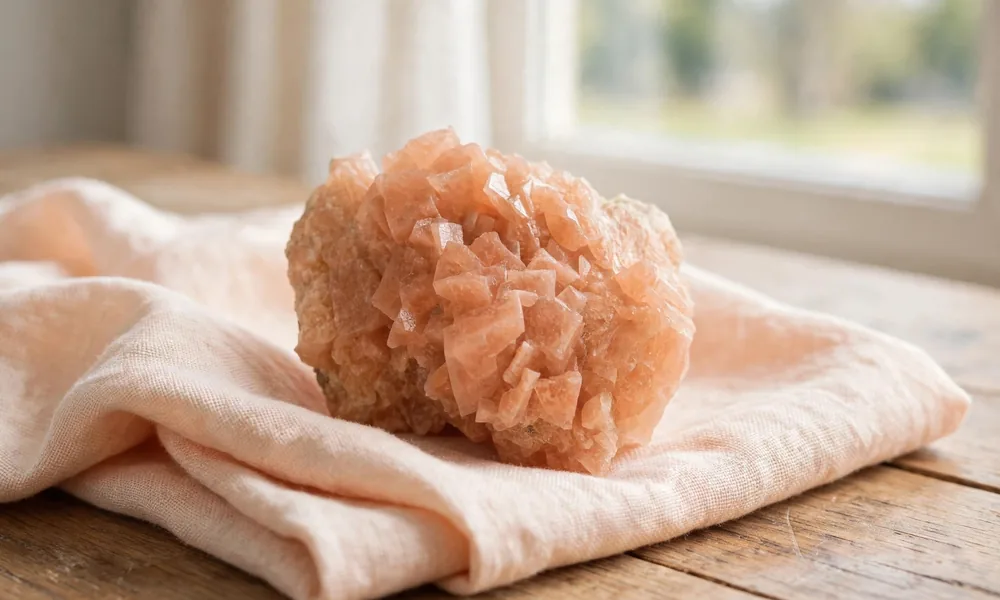
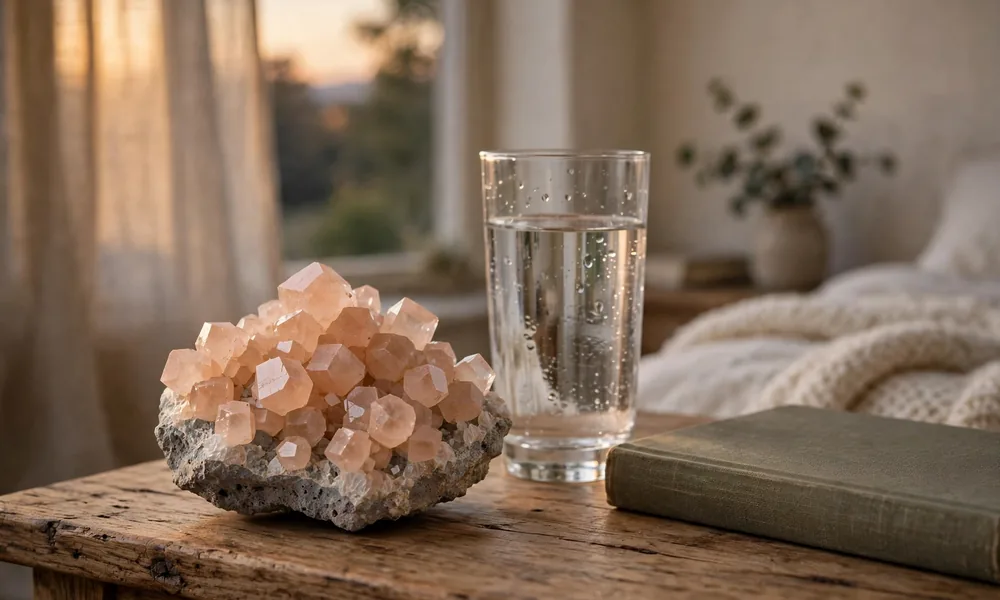
Chabazite is a stone that fits those mornings. It is a soft peach zeolite that grows in neat blocky crystals, the colour of a peach held up to a lamp, and it sits quietly on a tray beside a glass of water.
This guide looks at chabazite on its own terms: what the mineral is, how to pick a good piece, how it stands beside the other zeolites and peach stones on this site, and how to keep it dry. It is a thing to look at and to hold, and nothing more; it will not mend the body or change a day by itself.
Key Takeaways
- A pale zeolite in soft peach: neat blocky crystals, warm and quiet in colour.
- Its gentle peach shade belongs on tender days, in slow hours, in soft light.
- Hold it for a moment, look at it, and set it down — it heals nothing and fixes nothing.
- Keep the water glass next to the stone, never with the stone inside it.
- A single small cluster will do for the entire tender day.
What Chabazite Is
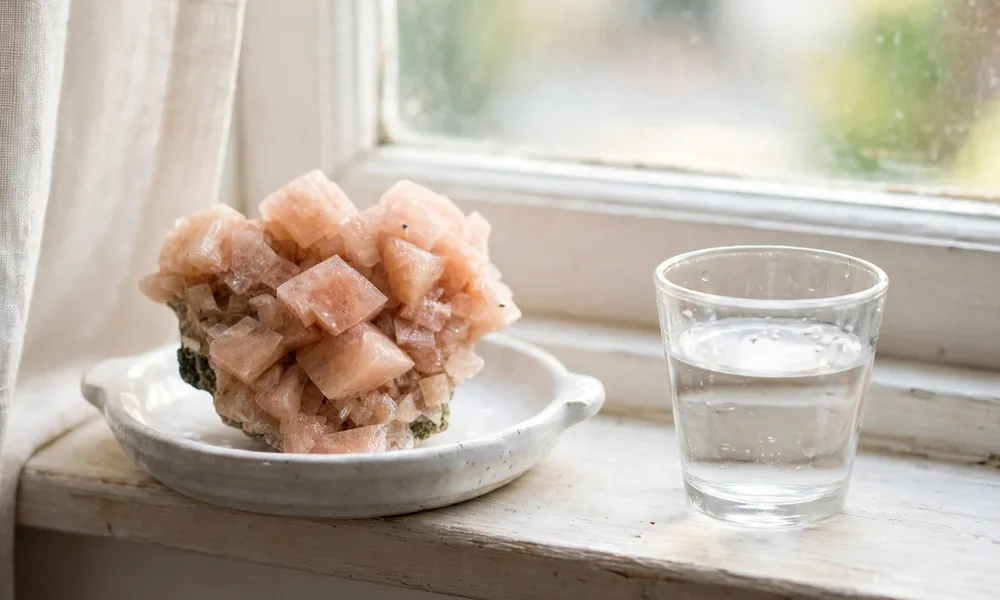
Chabazite belongs to the zeolites, pale minerals born in volcanic rock, and its peach tone comes from faint traces held inside the crystal. It grows in blocky, almost cube-shaped crystals with slanted faces, called rhombohedra, that lock together into clusters like small stacked boxes.
Pick up a polished piece and it sits cool and light in your hand, its flat faces catching a soft glassy shine rather than a hard glitter.
Choosing a Chabazite Piece
Hold the stone up to the nearest window and turn it in the daylight. Good blocky crystals show flat faces, honest edges and an even peach on every side, with no dull grey patches or chipped corners. The peach should look the same in soft light and in bright light, never washed out and never painted on.
Ask the seller where the piece was found and whether it has been dyed or coated. Walk away from any peach that looks brushed on the surface, any price far above what an ordinary zeolite costs, and any seller who promises healing.
A Tender Day with Chabazite
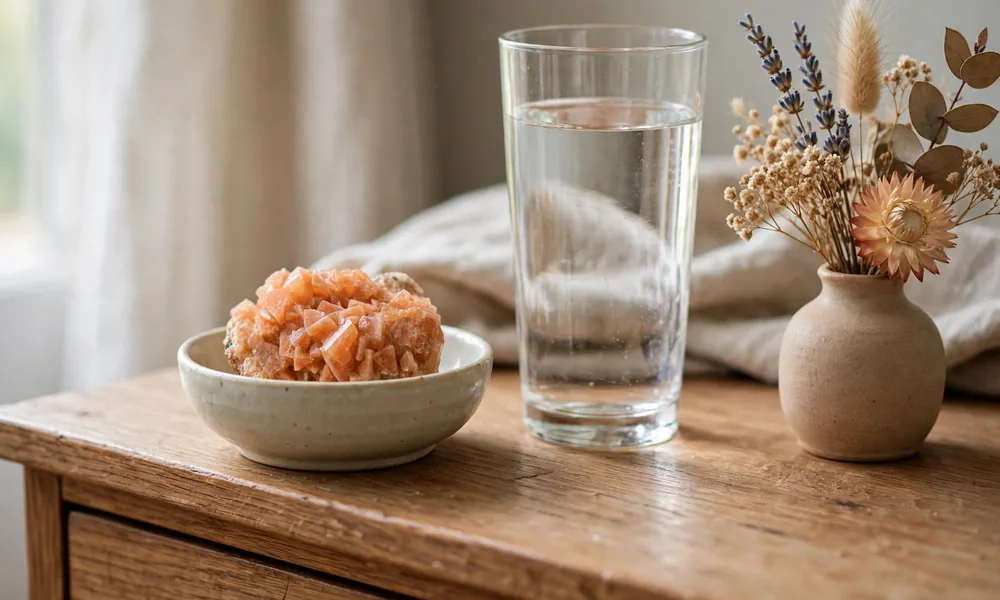
Lay a small wooden tray on the bedside table, the chabazite cluster at one end and a tall glass of water at the other, with bare wood between them. Drink the water slowly and rest your eyes on the blocky peach shapes while the morning wakes up around you.
Nothing else is on the list: tray, glass and stone are the whole plan. Read a few pages, or simply sit with the window light for a while.
Chabazite Beside Water
Chabazite and water look lovely together, yet they must stay apart. Keep the glass at the far end of the tray and the cluster at the near end, so the wood between them keeps your drink clear and the crystals free of damp. A tray holds things side by side; it is not a bath.
Once the stone is placed, wash your hands with soap before you lift the glass. Never drop chabazite into a glass, a jug or a bath.
Chabazite at a Glance
| Peach blocky crystals | Dry tray, soft light | Display only |
|---|---|---|
| Warm, gentle colour | Tender days, quiet rooms | Keep it dry |
| Cool, solid, light | Water stands beside it | Wash hands after |
Chabazite and Mesolite
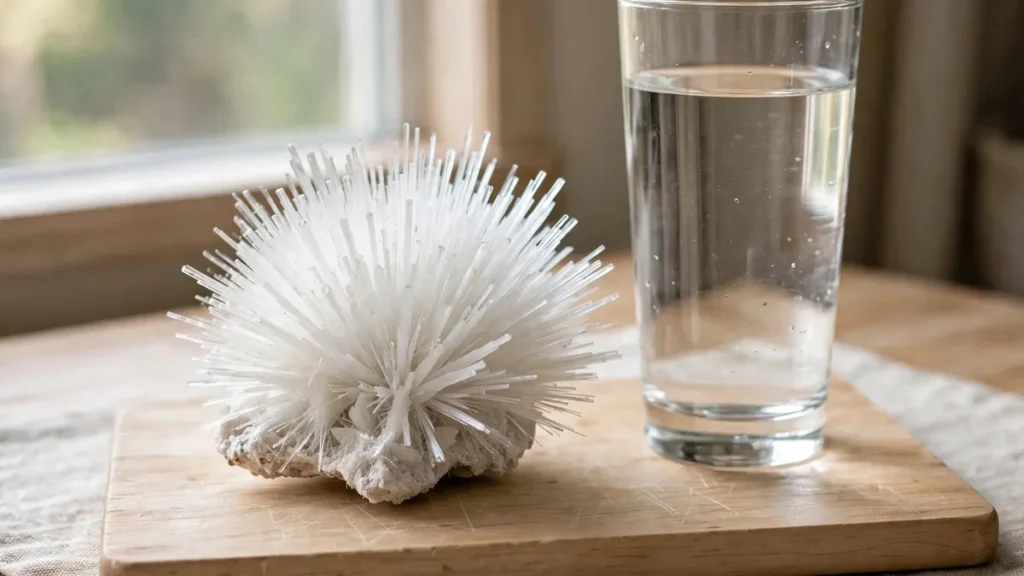
Mesolite is the queued zeolite cousin of chabazite, the next zeolite in this batch, and the two make an easy pair to tell apart. Mesolite grows as fibrous white needles, fine pale threads gathered into soft sprays, while chabazite grows as peachy rhombohedral crystals, neat blocky shapes with flat faces and sharp edges.
The two stones suit different hours. Mesolite, white and feathery, belongs on a quiet day, pale and still. Chabazite, warm and peachy, belongs on a tender day. Same zeolite family, different shape, different colour, different hour.
Chabazite and Stilbite
Stilbite for calm shelves is the nearest live peach zeolite to chabazite: a soft peach stone of thin blades that open like a small fan, warm in tone and quiet in a room. Where stilbite spreads in thin blades, chabazite stacks in blocky crystals, and the shape is the quickest way to tell them apart.
The two stones suit different places. Stilbite belongs on a calm shelf, a fan of peach blades in a quiet room. Chabazite belongs on a tender-day tray, a cluster of peach blocks beside a glass of water.
Chabazite and the Other Zeolites
Beyond stilbite, the zeolite family on this site runs wide, and not one of its other members wears this peach blocky shape. Thomsonite is a pale banded zeolite, pink and cream in soft curving lines. Heulandite is a pale white zeolite of thin pearly sheets, layered like pages in a small book.
Natrolite for bright days forms pale sprays of hair-thin white crystals that open outward from one shared foot, while scolecite is a white zeolite with fine needle-like lines running through the stone like pale threads in silk. Apophyllite is a clear, glassy mineral that usually comes as one upright point with a pointed top. Chabazite stands apart from all of them: soft peach, blocky, and warm, with no bands, no plates, no needles and no clear glassy points.
Chabazite and the Other Peach Stones
Beyond the zeolites, three peach stones already live on this site, and each one is a different mineral altogether. Peach topaz for tender days is a clear soft peach topaz, warm and gentle, with facets that catch the light in small warm flashes. Padparadscha sapphire is a rare soft peach corundum, pink and orange at once, clear and bright.
Peach moonstone is a warm peach feldspar with a pale shimmer that moves across the stone as you turn it. Chabazite is none of these: it is a soft peach zeolite of blocky crystals, and that blocky shape is what makes it easy to recognise.
Where Chabazite Lives at Home
Keep chabazite where your eyes land on an ordinary day: a dressing-table top, a bedside nook, or a calm shelf, where it stays plain to see and clear of elbows. A pale background lets the peach stand out, and soft morning light suits it best.
Choose a spot well away from taps and showers, out of the steam and the splash zone, and high enough that small hands cannot reach it. A cluster left in sight gets looked at daily; one shut in a drawer is soon forgotten.
Looking After Chabazite
Chabazite is a fairly soft stone, so gentle handling keeps its blocky faces clear. Wipe it with a dry soft cloth once a week, as part of the usual housework, and that is all the cleaning it needs. Keep soap, polish and cleaners away; damp and chemicals only dull the shine and loosen the crystals.
Between displays, rest it in a soft pouch of its own, away from keys, coins and harder stones that could chip its edges. Strong sun through glass can fade the peach, so a shaded shelf is kinder than a sunny sill.
Stones That Must Stay Away from Water
Water and some stones are a bad pair, and a few stones carry things inside them that must never reach a drink. Malachite is green with copper, so it must never sit in a glass or a jug. Hematite goes rusty when it stays damp, and the rust can stain whatever it touches.
Some other stones are too soft for a soak, or they hold something best kept dry. Angelite wears away in water, while amber — old tree resin, not rock — goes soft and dull after a long soak. Apatite is too soft for a bath, pyrite goes dull and rusty when it stays wet, and lepidolite holds lithium in its pale flakes. Keep every one of these away from your drink, and chabazite follows the same rule: beside the glass, never in it.
Your Tender Days Checklist
- Set the chabazite on a dry tray, with a full glass of water beside it.
- Sip the water slowly while the morning brightens.
- Hold the cluster in your palm for a moment, then set it down.
- Wash your hands with soap once the stone is back in place.
- Buy from a seller who tells you plainly where the stone came from.
- When health worries linger, ask a doctor first; stones heal nothing.
Frequently Asked Questions
What is chabazite?
Chabazite is a soft peach zeolite, a pale mineral that forms in volcanic rock and grows in blocky rhombohedral crystals. It takes a smooth polish, and it feels cool, light and solid in the hand.
How is chabazite different from mesolite?
Mesolite grows as fibrous white needles, fine pale threads gathered into soft sprays. Chabazite grows as peachy rhombohedral crystals, neat blocky shapes with flat faces.
How is chabazite different from stilbite?
Stilbite is a soft peach zeolite of thin blades that open like a small fan, made for calm shelves. Chabazite is a soft peach zeolite of blocky crystals, made for tender days, so the shape tells them apart.
How is chabazite different from natrolite?
Natrolite forms pale sprays of hair-thin white crystals that open outward from one shared foot. Chabazite grows as peach blocky crystals, so one is a white spray of threads and the other is a peach cluster of blocks.
Is chabazite safe to hold?
Most people can hold it briefly with no trouble at all. Put it down, rinse your hands with plain soap, and keep it far from children and from food or drink.
Where should I keep chabazite at home?
Any dry, still corner works: a dresser top, a window ledge, a quiet shelf. Keep the glass nearby but apart, and put the stone where knocks and damp cannot reach it.
The Bottom Line
Chabazite is a soft peach companion for tender days: one blocky cluster in gentle light, with a glass of water standing beside it.
A Note for Tender Days
Let the hours pass slowly and the stone stay dry. One chabazite cluster, one glass of water, and a gentle morning.