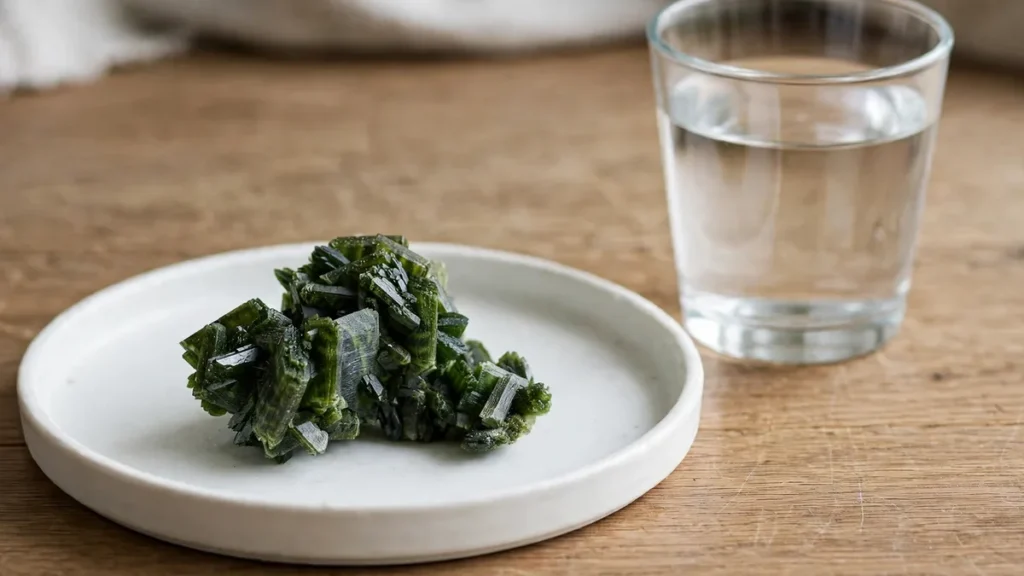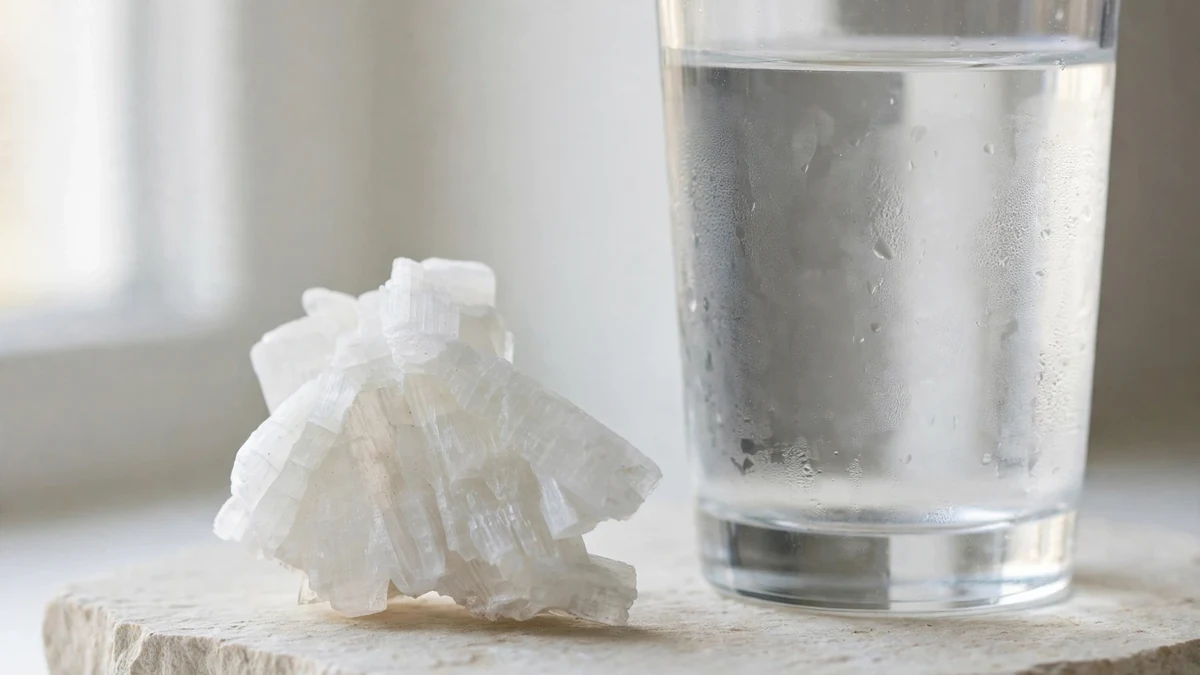
A bright day starts before the clock does. The curtains are thin against the light, and the room looks washed clean. On a day like that, colour feels almost too much, and the eye looks for something plain to rest on. Beryllonite answers that search. It is clear and white, a stone that holds the light without colouring it, like a piece of frozen water left on the sill.
Bright days ask for very little: a glass of water, a clear window, a quiet hour. A colourless stone fits the same mood, because it adds nothing and takes nothing away. It sits there, catching the sun in its flat faces, and lets the day stay bright on its own.
What follows is a plain look at the mineral itself — where it forms, what sets it apart from coloured stones already covered here, how to judge a piece worth keeping, and where to set it down in the house beside a drink. It is a stone to look at and to hold briefly, and nothing more. It will not heal anything, mend any ache, or change any health outcome, and no stone ever could.
Key Takeaways
- Beryllonite is a clear white beryllium phosphate, rare and glassy.
- Its colourless look suits bright days, strong sun and open windows.
- Beryllonite stays dry, so it rests beside water and never inside it.
- One small piece on a stone slab, with the glass kept well apart, is enough.
- Wash your hands after handling it, and store it where children and pets cannot reach.
What Beryllonite Is
Beryllonite is a sodium beryllium phosphate, a mineral built from sodium, beryllium, phosphorus and oxygen, and it forms in granite pegmatites, the coarse-grained veins where rare minerals grow slowly in pockets. It was first described from Stoneham in Maine, in the United States, and fine crystals also come from Pakistan and Afghanistan. Most pieces stay in collections rather than in shops.
The crystals are usually colourless or white, sometimes with a faint yellow or pale pink tint, and they grow as short prisms and flat tabular plates with a glassy shine. Good pieces are clear enough for light to pass through, and the flat faces catch the sun in bright flashes. Beryllonite sits near five and a half to six on the scale that measures how easily minerals scratch, so it is softer than quartz and needs a gentle hand.
Why Clear White Suits Bright Days
White is the colour of light itself, and a clear stone on a bright day behaves like a small window. The sun passes through it, breaks on its flat faces, and throws pale glints across the table. There is no deep colour to study and no pattern to follow, only light moving through glass.
That plainness is the whole point: sun on the floor, a breeze through the window, the garden loud with birds. A colourless crystal does not compete with any of it. It simply sits in the light and returns it, and the room feels brighter for having it there.
Beryllonite and Brazilianite: Clear Beside Yellow-Green
Brazilianite soft yellow for bright days covers a pale yellow mineral touched with green, first found in Brazil, a rare phosphate that lets light through and glows softly instead of flashing. Shops sell it as a bright-day stone, and its yellow-green colour is the first thing anyone notices.
Beryllonite shares the family but not the colour. Both are beryllium phosphates, yet brazilianite carries its yellow-green tint in every crystal, while beryllonite is colourless, a clear white that takes its colour from the light around it. Brazilianite paints the tray yellow; beryllonite lets the tray stay white. One glows, the other sparkles, and the two make a neat pair for phosphate collectors.
Picking a Beryllonite Piece
Stand by a window with the piece in your palm and turn it slowly in the daylight. A good piece shows flat, clean faces with a glassy shine, and the crystal should be clear through, with no chalky white crust and no cracks running across the middle. The edges should feel firm, not crumbly, and the piece should sit flat without rocking when you set it down.
Go for a piece near walnut size, and ask the seller which mine or valley it came from. If the answer turns into promises about health, put the piece down and leave.
A Bright Morning with Beryllonite
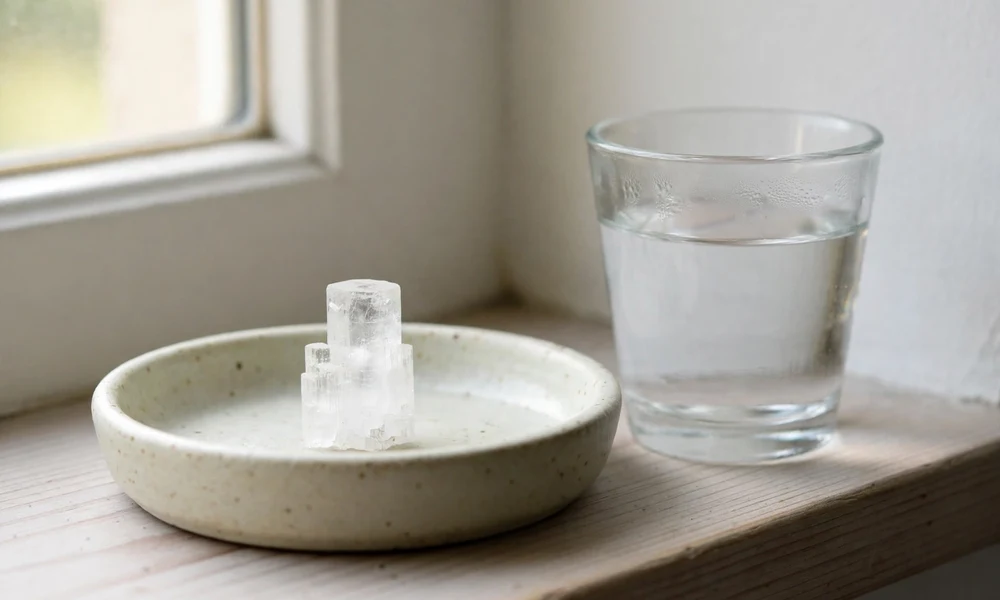
Clear a corner of the sideboard and lay down a pale stone slab. Put the beryllonite where morning sun falls strongest on its tallest crystal, and stand a tall glass of water at the slab's far edge, leaving a wide bare strip of stone between the two.
Pour the water, drink it slowly while the light moves across the slab, and then leave the stone where it sits.
Beryllonite Beside Water
Water and beryllonite can share one slab, provided they never touch. Keep the glass on one side of the slab and the stone on the other, with plenty of bare stone in the middle so splashes cannot reach the crystal faces. Never run the stone under a tap: wet beryllonite dulls. A weekly puff of air clears the dust, and no other care is needed.

Beryllonite at a Glance
| Clear white prisms | Stone slab, sill | Hands washed after |
|---|---|---|
| Beryllium phosphate, glassy | Bright days, strong sun | Glass kept apart |
| Light, clear shine | One small piece | Keep it dry |
| Walnut-sized piece | Stone, cloth, daylight | Wash hands after |
Beryllonite and Datolite: Two Pale Stones
Datolite soft yellow for bright days follows a soft yellow mineral whose colour runs pale and warm, like morning sun on a cream wall. It is a borosilicate, not a phosphate, and its crystals grow in rounded lumps and short prisms with a waxy, gentle glow. The yellow is quiet, but it is always there.
Beryllonite is paler still, and plainer. Where datolite holds a steady yellow, beryllonite holds no colour at all, and where datolite looks waxy and soft, beryllonite looks glassy and sharp. Datolite warms a bright day with a hint of yellow; beryllonite cools it with clear white light.
Beryllonite and Variscite: White Beside Green
Variscite soft green for gentle days covers a pale green phosphate marked by thin brown veins, sold polished as smooth rounded lumps in shades from light mint to dark moss, cool and silky in the hand.
The two could hardly be shaped more differently. Where variscite is smooth, rounded and green, beryllonite is flat-faced, angular and colourless, its crystals standing up in prisms and plates you can see without a lens. Both are phosphates, yet variscite is a veined, rounded green stone, while beryllonite is a clear white crystal.
Beryllonite Among the Other Stones in This Batch
Five other guides share this batch, and each keeps to its own subject. Faden quartz is clear and threaded, a quartz with a white line running through it. Enhydro quartz is clear too, yet it holds tiny pockets of ancient water inside. Vivianite is a deep blue that fades in strong light, so it hides from the sun beryllonite loves. Afghanite is a soft blue, calm and quiet where beryllonite is bright.
The water guides in this batch rest in other ways: one lifts a soup pot onto the stove, one carries a watering can to the plants, one opens a rain barrel under the downpipe, one tends an aquarium of slow fish, and one walks out to a swimming pool for a cool dip.
Where Beryllonite Rests at Home
Give it a spot nobody bumps into on the way past: the end of a sideboard, a shelf well away from the sink, or a high cupboard top. Taps, kettles, steam, small hands and pets all stay clear of it.
For a journey, wrap it in tissue and set it in a padded box of its own.
Stones That Must Never Touch Water
Beryllonite itself stays dry, and a handful of other minerals need the same care for stronger reasons. Apatite flakes apart after a soak, and the pieces it sheds are no good near any cup. Angelite turns cloudy once it has been wet, and the polish never comes back. Pyrite rusts when it stays damp, and the rust stains whatever it touches.
Amber is old tree resin turned hard, and a bath leaves it milky for good, so it never goes near drinking water or a soak. Lepidolite holds lithium in its pale flakes, which is one more reason to keep it far from every jug. Malachite carries copper in its green bands, and copper has no business near a drink. Keep each of them on a dry shelf, and give beryllonite the same treatment.
Your Bright Days Checklist
- Set the beryllonite on a dry stone slab, glass standing a hand-span away.
- Drink the water slowly, a sip at a time, while sunlight moves over the slab.
- Pick the piece up once and look at the flat faces from below.
- Set the piece back on its slab, then wash your hands with soap and water.
- Buy from a seller who says plainly where the stone was dug up.
- If a health worry stays with you, take it to a doctor — a stone has no answer for it.

Frequently Asked Questions
What is beryllonite, in plain words?
Beryllonite is a clear white phosphate mineral, formed in granite pegmatites, and grown as short prisms and flat plates of colourless crystal with a glassy shine.
Why does beryllonite stay out of water?
Once wet, beryllonite can lose its shine and mark easily, so keep it away from drinks, soaks and baths. If it ever drops into a glass, tip the water out and wash the glass with soap.
How can I tell beryllonite from brazilianite?
Brazilianite is soft yellow with a greenish tint, while beryllonite is colourless and white, a clear crystal that takes its colour from the light around it.
How do I pick a good beryllonite piece?
Look for flat clean faces near a window, with a glassy shine, clear crystal through and no chalky crust, on a piece about the size of a walnut.
Can I hold beryllonite in my hand?
An adult can pick up a small dry piece for a moment, then set it back on the slab and wash their hands with soap and water.
Where should beryllonite live at home?
Keep it somewhere dry and bright, away from water, steam, small hands and pets.

The Bottom Line
A clear stone kept dry, a glass standing apart: that is all a bright day needs from beryllonite.
A Note for Bright Days
Clear stone, clear water, and a morning full of sun: beryllonite asks for little, and a bright day gives it gladly.