
Some stones arrive on a shelf like a shout, all deep colour and hard shine. Aurichalcite arrives like a whisper: pale, soft and crusty, a wash of green-blue over dark rock, easy to walk past until the quiet colour holds the eye.
The question is fair: is such a fragile, powdery mineral worth a place on display at all? It cannot be polished like quartz, it must never be washed, and a careless touch can crumble its crust. Yet collectors keep it for that delicacy, and because no two crusts match.
This guide answers plainly: what aurichalcite is, how to pick a piece worth keeping, how to set it out safely beside water, and what it will never do.
Key Takeaways
- Aurichalcite is a pale green-blue copper-zinc carbonate that grows in crusts.
- It is soft, fragile and for display only; it must stay dry.
- A small piece on a clear shelf suits it best.
- It sits beside a glass of water, never inside one.
- It will not heal anything; no stone here is a treatment.
What Aurichalcite Is
Aurichalcite is a secondary copper-zinc carbonate mineral, which means it forms when water and air slowly change copper and zinc ores near the surface of the earth. It grows as thin crusts, soft velvety patches and tiny needle sprays, usually pale green, blue-green or sky blue, over a darker rock base.
The colour comes from the copper inside it, softened by the zinc beside it, so it never reaches the deep green of malachite or the midnight blue of azurite.
It is a soft mineral, about two on the Mohs scale. A fingernail can mark it, and a damp cloth can dull it, so it asks for a gentle shelf and a dry room.
Why Its Pale Green-Blue Colour Catches the Eye
Pale colours are easy to miss in a bright room, which is why aurichalcite rewards a quiet shelf. Against plain wood or a pale wall, its green-blue crust seems to glow from within.
Choosing an Aurichalcite Piece
Pick a piece you can see in daylight before you pay for it. A good piece shows its pale green-blue colour evenly across the crust, with no large bare patches of dark rock.
Look at the surface with your eyes, not your fingers. The crust should look settled and complete, not powdery at the edges. Turn it slowly: the colour should stay steady, and any needle sprays should stand clear.
A palm-sized piece is enough for a shelf. Buy from a seller who names the stone plainly and makes no health promises, and walk away from anyone who claims it can change your body or your luck.

Setting Up a Calm Display Corner
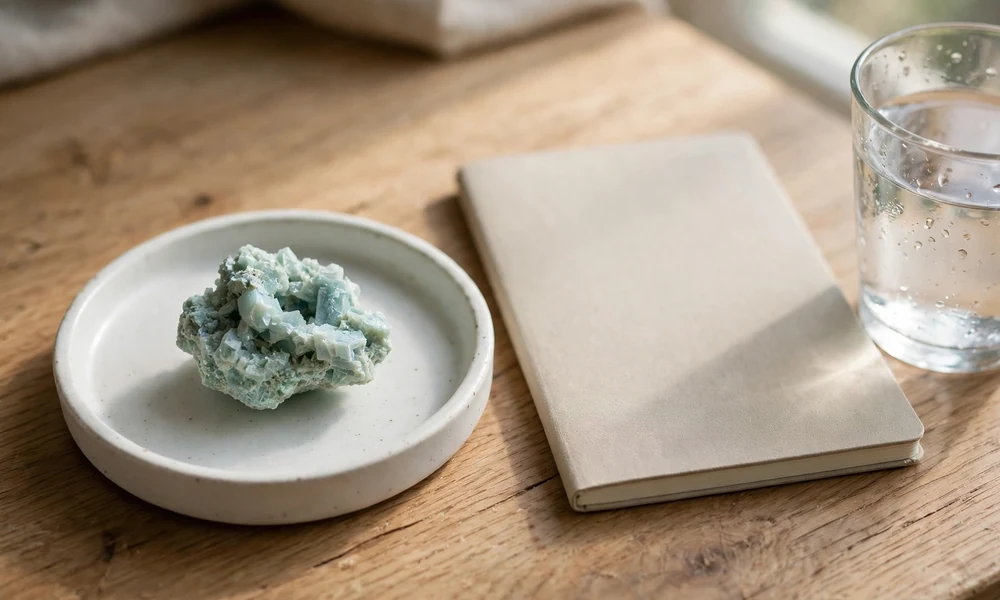
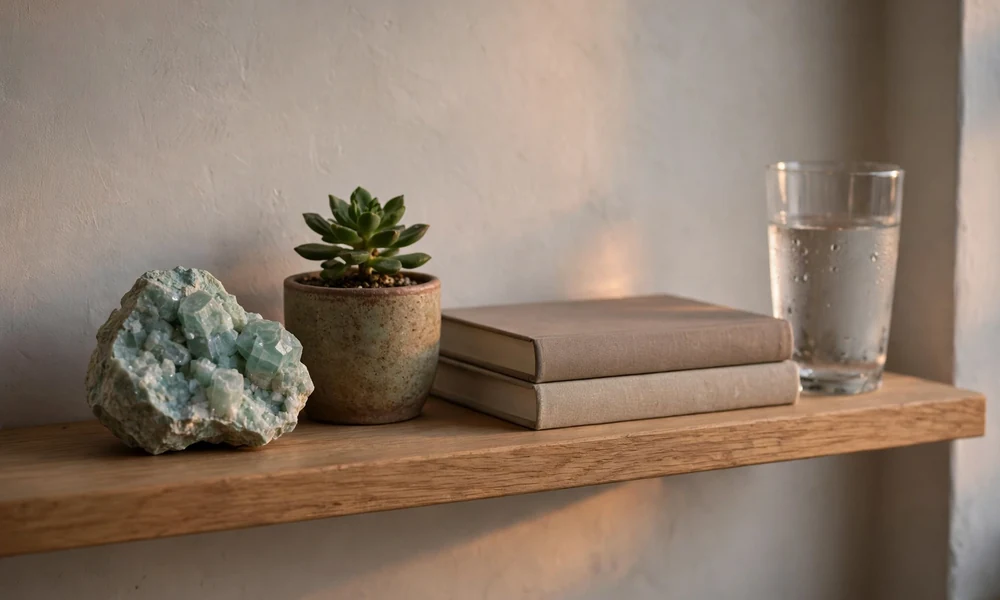
A calm display takes ten minutes and starts with an empty shelf. Take everything off, wipe the wood with a dry cloth, and put back only what earns its place: the aurichalcite on a small white dish, a glass of fresh water beside it, and perhaps a small plant or plain books nearby.
Set the stone where daylight finds it but the sun never falls on it for long. Give it space on every side, and place the glass a handspan away, far enough that a spill cannot reach it.
Each morning, the corner can hold a small ritual: fill the glass, set it down, and let the pale colour mark the start of a quiet day. The water is for drinking; the stone is for looking at.
Aurichalcite Beside Water, Never in It
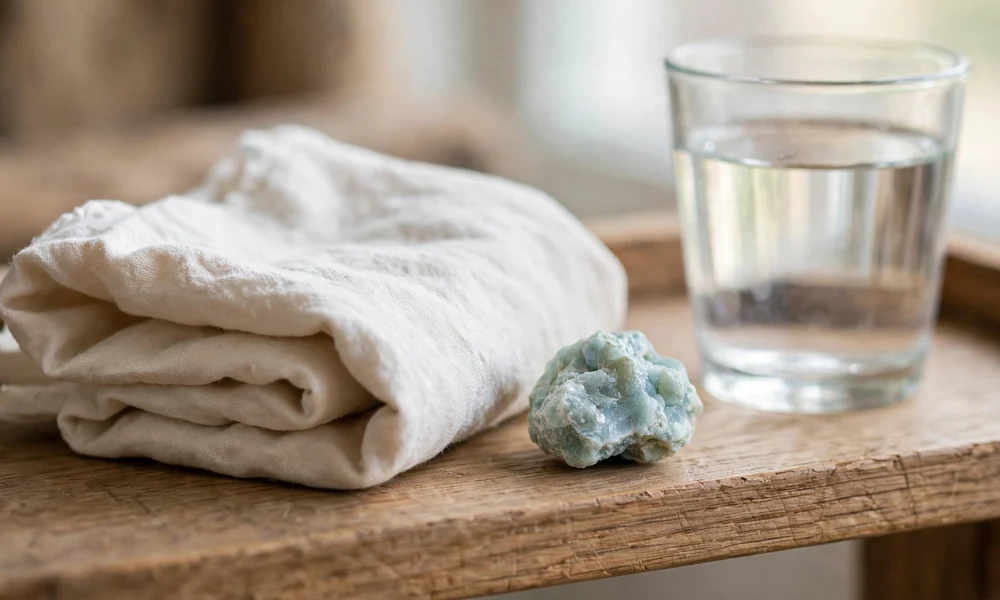
Before the display, the rule: aurichalcite stays dry, always. It is a copper-zinc carbonate, and like other copper carbonates it must never be placed in drinking water, never soaked, and never used to make any kind of elixir. The stone rests on its dish beside the glass, and that is as close as the two ever come.
If a glass spills, lift the stone away at once and leave the shelf to dry before it goes back. One wetting can dull the crust and loosen its needles. Wash your hands after handling it, and keep the stone away from food and small children.
This rule is the first thing to know about aurichalcite, and the stone is worth displaying because it can be enjoyed safely from a handspan away, dry and untouched by the water beside it.
Aurichalcite at a Glance
| Pale green-blue crusts | Display only, dry | Beside water |
|---|---|---|
| Copper-zinc carbonate | Soft, handle gently | Wash hands after |
| Small piece suits shelf | Dust dry, weekly | Keep from sun |
| Crusts, not crystals | No soaking ever | One stone, clear space |
Aurichalcite and Malachite
Malachite deep green for bold shelves puts one richly green stone on a shelf and lets that single colour do all the work. Its bands are the whole display.
Aurichalcite is a different mineral with a different manner. Malachite is deep green, banded, polished smooth and fairly hard, a stone that fills a shelf with colour. Aurichalcite is pale green-blue, crusty rather than banded, soft enough for a fingernail to mark, and happiest where its faint colour can be noticed slowly. Both are copper carbonates, and both must stay dry, but malachite shouts and aurichalcite whispers.
Aurichalcite and Azurite
Azurite deep blue for focused work builds a desk around one dark blue stone, a notebook and a glass of water, as a way to begin work calmly.
Aurichalcite does not do that job. Its colour is pale where azurite is deep, its surface is a soft crust where azurite is smooth and velvety, and it suits a shelf for calm days rather than a desk for hard focus. Azurite is a deep blue copper carbonate; aurichalcite is a pale green-blue copper-zinc carbonate. Different minerals, different colours, and neither one belongs in water.
Aurichalcite and Azurite Malachite
Azurite malachite deep green blue for focused days keeps one stone that holds two minerals at once, blue patches and green bands marbled together, so no two pieces look the same.
Aurichalcite is not a combination stone at all. It is one mineral, one pale wash of green-blue, with no bands and no second colour hiding inside it. Where the combined stone is bold enough to lead a day, aurichalcite is quiet enough to sit at the edge of one, noticed in passing. The three share a copper family, and all three stay beside water only, but aurichalcite is the palest and the softest.
Nine Neighbours in This Batch
Who else arrived with this stone? Nine guides, none doing quite the same job. In the kitchen, the rosemary guide waters a fragrant herb, the orchid guide tends a flowering plant, and the jigsaw guide fits water into a quiet puzzle evening. On the shelf, the limonite, ilmenite, adamite and blue john guides study four stones: warm brown, dark metallic, yellow-green and banded purple.
Between them sit two more household guides. The placemat guide lays one flat mat under one plate, a job of cloth and wood, while the candle holder guide stands a candle upright to frame its light — a flat mat under a plate is not a holder for a flame, and the two are different objects with different care. Aurichalcite, pale and crusty on its dish, belongs with the shelf stones.
Stones That Must Never Touch Water
Pyrite, once wet for a while, loses its bright shine and turns dark, and the dullness stays. Angelite takes water into itself and splits along its grain, so a piece left damp comes apart in flakes. Amber is hardened tree resin, not rock at all, and a soak leaves it cloudy, a milkiness that never clears. Apatite loses its clear shine after time in damp soil, and the dullness does not lift. Lepidolite holds lithium among its pale flakes, so keep it far from anything anyone might drink. None of these belong in a glass, a soak or a bath.
Keeping Aurichalcite Clean and Dry
Dust the piece once a week with a soft, dry brush or cloth, using light strokes. Never use water, soap, polish or sprays, and never scrub, because scrubbing breaks the fine needles. A dry cloth is the whole cleaning kit.
Store the stone on its dish or in a soft pouch when it is not on display, away from harder stones and damp rooms. Keep it out of long direct sun, and do not carry it loose with keys and coins. If it ever gets wet, pat it dry at once and leave it in open air for an hour.
Your Aurichalcite Checklist
- Choose a piece with even pale colour and settled crust.
- Set it on a small dish, a handspan from a glass.
- Dust it weekly with a soft, dry cloth, never water.
- Store it alone, away from harder stones and damp rooms.
- Wash your hands after handling it, before eating or drinking.
- If a stone ever drops into a drink, pour the drink away, scrub the glass, and wash your hands well — a display stone is an ornament, not a remedy.
Frequently Asked Questions
Is aurichalcite safe to hold in my hand?
Yes, you can hold aurichalcite gently with clean, dry hands; it feels light and a little chalky. Wash your hands afterwards, and keep children from handling it alone.
Where should aurichalcite sit in my home?
Aurichalcite sits best on a clear shelf or desk in a dry room, on a small dish in daylight. Keep it out of bathrooms and kitchens, away from long sun, and a handspan from any glass.
Why does my aurichalcite look paler than the shop photo?
Shop lights are brighter than home light, and the pale colour changes with the room. Judge it in daylight, and expect a softer colour at home.
Can aurichalcite go in water to clean it?
No, aurichalcite must never go in water, not for cleaning and not for any other reason. Dust it dry only, and if it ever gets wet, dry it at once.
How is aurichalcite different from malachite?
Malachite is deep green, banded, polished smooth and fairly hard, while aurichalcite is pale green-blue, crusty and very soft. Both must stay dry, but they are different minerals.
Is aurichalcite worth displaying if it is so fragile?
Yes, if you like quiet colour and do not mind gentle care. A small piece on a clear shelf, kept dry and dusted weekly, shows a pale green-blue no harder stone quite matches.
The Bottom Line
Aurichalcite is worth displaying for one reason: its pale green-blue crust brings a quiet colour louder stones cannot, as long as it stays dry, dusted and a handspan from the water.
A Note for Quiet Corners
A pale crust on a white dish, a glass of water a handspan away, and a shelf with room to breathe — that is the whole quiet habit, and it asks for nothing more than dry hands and a soft cloth.


