Some days arrive bright and ask you to shine with them. A clear morning, a day out in the sun, a day when you want to feel awake and golden: on those days, pale colours feel too quiet, and you want something warm beside you.
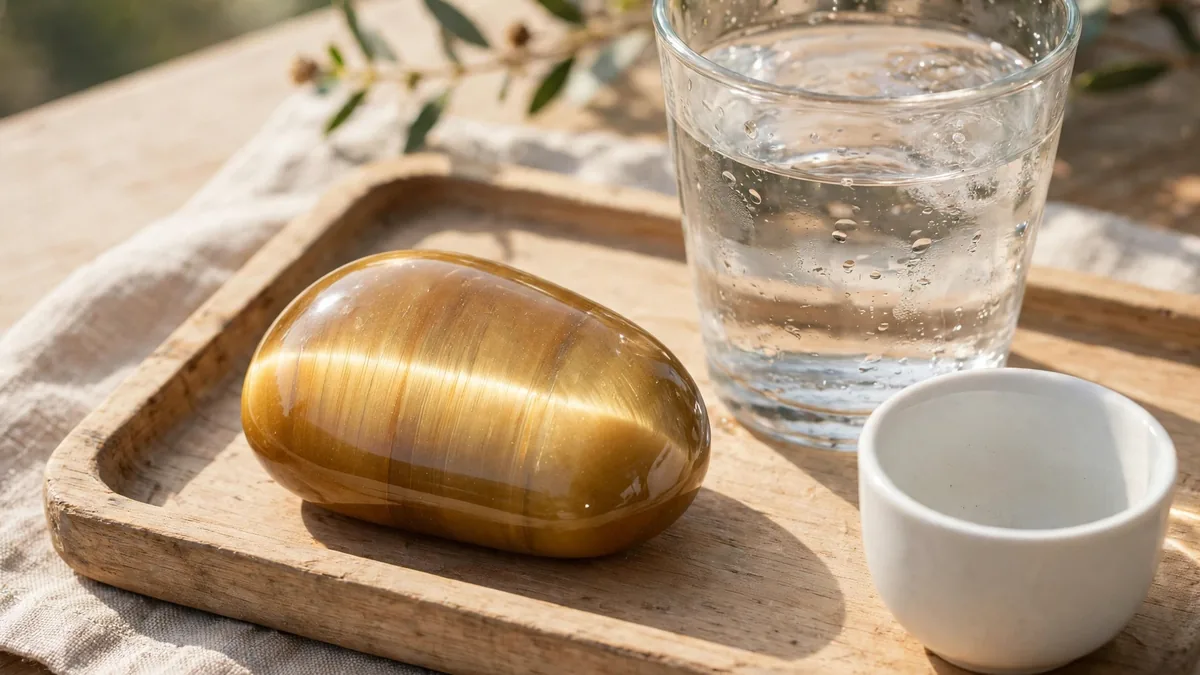
Cats eye is a stone for days like these: a golden quartz with one bright band of light that moves across its surface like a cat's eye in sunlight. Set it on a tray beside a glass of fresh water, and it looks like a small piece of captured sunshine.
This guide explains what cats eye is, how to choose a piece, how to keep it safely beside water, and how to build a short, bright-day routine around it. The stone is for display and handling only, never a treatment, and it will not heal anything.
Key Takeaways
- Cats eye is a golden quartz with one bright band of light that moves as you turn it.
- Its golden shine suits bright days, clear mornings and days out in the sun.
- Cats eye differs from tigers eye, heliodor, imperial topaz and citrine.
- The stone is for display and handling only; it will not heal anything.
- The stone stays beside drinking water, never in it, and stays dry and dusted.
What Cats Eye Is
Cats eye is the name for a quartz stone that shows chatoyancy, a single bright band of light that slides across its surface as you turn it in the light. The band comes from fine, parallel fibres inside the stone, which catch the light together and throw it back as one clear line.
The golden variety is the best known: warm honey gold, sometimes with a hint of bronze, glowing in daylight and warm in lamplight. Hold a polished piece and it feels cool, smooth and solid, with a bright, glassy shine. A stone that shows a sharp band in daylight is a good sign the piece is true.
Why Golden Shine Suits Bright Days
Golden shine suits bright days because it matches the light of the day itself. A bright day is full of sun, warm air and clear colours, and a golden stone catches that same light and gives it back. Honey gold is warm and cheerful at once: the colour of morning sun on a windowsill and a confident step into the day.
A bright day also suits cats eye because the stone is simple: no preparation, simply there when you sit down, catching the light from the window. The golden band stays bright while the day grows busy, a small reminder to look up and enjoy the light.
Choosing a Cats Eye Stone
Choosing a cats eye is mostly a matter of looking closely and trusting your eye. A good piece shows a clear, sharp band of light that moves smoothly as you turn the stone. Look for a warm, even gold colour, not a muddy brown or a pale washed-out yellow, and a smooth polish with no sharp chips.
A palm-sized tumbled stone is enough for a bright-day tray, and it is easy to hold, dust and move. Hold it in daylight and turn it slowly to see how the golden band slides across the surface. If a piece feels pleasant in your hand and its golden shine makes the morning feel brighter, it is the right one. Buy from a trusted seller, never one who promises it will change your health.

A Bright Day Routine
A bright day routine takes only a few minutes, and it starts the night before: place the stone on a small tray beside a clear glass, where the morning sun will find it. When you wake, fill the glass with fresh water and drink it slowly, in small sips. Then pick up the stone and turn it slowly, watching the golden band move across its surface for a few breaths.
Put the stone back on the tray, open the curtains, and let the bright day begin. The routine is simply water, light, one golden stone, and a short pause.
Cats Eye Beside Water
Water belongs beside the stone, never around it: set a clear glass of fresh drinking water next to the stone on the tray. They share a tray, not a glass. Never place the stone inside drinking water, and never soak it, because a stone in water can chip, dull or carry dust into the glass.
If the glass spills, lift the stone away, dry it with a soft cloth, and set it back once the tray is dry.
Keeping the Stone Dry and Clean
Cats eye is a fairly hard stone, so it is easy to care for, but it still deserves gentle, dry care. Quartz sits at hardness 7 on the Mohs scale, so it resists scratches well, yet it can still chip if dropped on a hard floor. Dust it weekly with a soft, dry cloth, never soap or polish.
Keep the stone away from damp windowsills, steamy bathrooms and kitchen sinks. If it ever gets wet, dry it at once and leave it in open air for an hour. Handle it with clean, dry hands, and store it alone so harder stones cannot scratch it.

Cats Eye at a Glance
| Golden honey band | Bright days | Keep it dry |
|---|---|---|
| One bright line | Clear mornings, sun | Beside water only |
| Smooth cool feel | Water, light, pause | Dust with dry cloth |
| Hard, glassy shine | One stone, one tray | Never soak it |
A Bright Corner for the Stone
A bright corner gives the stone a home, and a home makes the bright-day routine easier to keep. Choose a small, clear surface near a window: a bedside table, a shelf, or a corner of a desk. Set down a small tray, the stone on it, a clear glass beside it, and little else.
Keep the corner the same from day to day, so the morning pause becomes a habit instead of a decision.
Cats Eye and Tigers Eye
Cats eye and tigers eye are close cousins, and it is easy to mix them up. Tigers eye is a fibrous quartz too, but its gold comes in many wavy bands of honey, bronze and brown, like the coat of a tiger. Cats eye is different: it shows one single bright band, a clear line of light that moves as you turn the stone, like one cat's eye in the sun.
Where tigers eye stone care beauty keeps a banded golden stone and teaches how to clean, charge and wear it, this guide keeps a single-banded golden stone for bright days — same quartz family, different light, different day.
Cats Eye and Other Golden Stones
Cats eye is not the only golden stone, and each golden stone suits a different kind of day. Heliodor is golden beryl, a warm honey gold that glows like early sunshine, for bright mornings. Citrine is sunny yellow quartz, cheerful and warm, for bright mornings and light, sunny rooms.
Where heliodor golden beryl warm gold mornings keeps a honey-gold beryl for bright mornings, this guide keeps a golden stone with one moving band of light for bright days. Where citrine sunny yellow bright mornings keeps a sunny yellow quartz for bright mornings, this guide keeps a honey-gold stone whose shine moves as you turn it.
Stones That Must Never Touch Water
Not every stone is safe beside water, and some must never touch water at all. Malachite must never go in water or in elixirs, because it can release harmful substances. Hematite must never go in drinking water, and apatite, lepidolite — which contains lithium — pyrite, angelite and amber must never go in drinking water or in soaks either.
Cats eye is different: a hard, stable quartz, safe to hold and display. Even so, it stays beside water, never in it.
When a Stone Is Not the Answer
A stone is not the answer to a health problem, and cats eye is no exception: it will not heal anything, and it will not replace rest, food, water or a doctor. If you feel unwell or worried about your health, please see a doctor, and enjoy the stone for what it is: golden quartz with a bright band of light.

Your Bright Days Checklist
- Place the stone on a small tray beside a clear glass of water.
- Drink a glass of fresh water slowly when you wake.
- Hold the stone for a few breaths and watch its golden band move.
- Keep the stone beside water, never inside drinking water.
- Dust the stone weekly with a soft, dry cloth, never soap.
- Remember the stone will not heal anything; see a doctor for health problems.

Frequently Asked Questions
What is cats eye?
Cats eye is a golden quartz stone that shows chatoyancy, a single bright band of light that moves across its surface as you turn it.
Is cats eye safe beside water?
Yes, it is safe to keep beside a glass of drinking water, on the same tray. It must never be placed inside drinking water.
Will cats eye heal anything?
No. Cats eye will not heal anything. It is a beautiful object for display and handling, and the brightness comes from the pause, the water and the sunny start.
How do I clean cats eye?
Dust it once a week with a soft, dry cloth, never soap or polish. If it gets wet, dry it at once.
How is cats eye different from tigers eye?
Cats eye shows one single bright band of light that moves as you turn it. Tigers eye shows many wavy bands of honey, bronze and brown, like a tiger's coat.
Where should I keep my cats eye?
Keep it on a small tray in a dry room, with a clear glass of water beside it — a bedside table or a quiet shelf near a window works well, as long as the spot stays dry.
The Bottom Line
Cats eye brings golden shine to bright days: a warm stone with one bright band of light, held beside a glass of fresh water in strong morning light. Keep it beside water, never in it, and dust it dry.
A Note for Bright Days
Keep it golden, keep it dry, keep it bright. A small honey-gold stone, a glass of water, and a few quiet minutes can begin a bright day well.