A quiet day has a colour, and for many people it is white. Not the stark white of a blank wall, but the soft, glassy white of a stone that catches the morning light and gives it back. Analcime is that kind of stone. It grows as small, clear, many-faced crystals in the pockets of old volcanic rock, and a polished piece looks like a drop of frozen water that never melts.
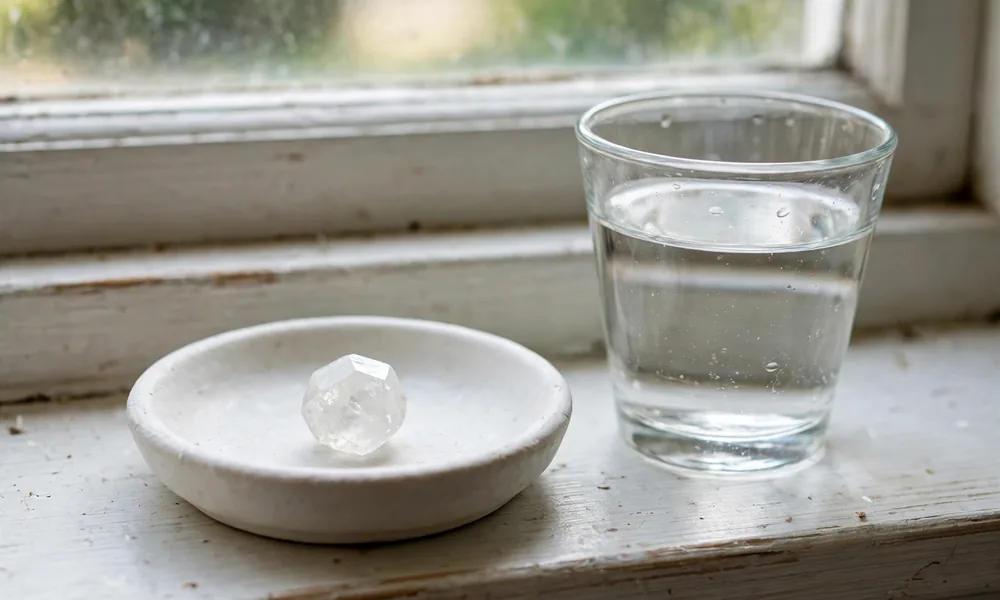
There is nothing loud about analcime. It does not flash, it does not change colour as you turn it, and it asks for no ceremony at all. A small white crystal on a plain tray, a tall glass of fresh water standing a little way off, and a morning with nowhere urgent to be: that is the whole scene.
Analcime will not change your day, and this guide will not claim otherwise. It is a pretty mineral to look at and hold for a short while, never a remedy and never a treatment, and it will never go into a drink.
Key Takeaways
- Analcime is a clear white zeolite, a mineral that forms many-faced crystals inside old volcanic rock.
- Its glassy white fits slow mornings, pale rooms, and days with nothing urgent on them.
- Look at it, hold it for a short while, and expect nothing more from it: it mends nothing.
- Keep it dry on its tray, away from the glass, and rinse your hands once you have put it down.
- One small polished piece and a plain tray are all this stone needs.
What Analcime Is
Analcime is a zeolite, a family of minerals that form inside the air pockets of basalt and other volcanic rocks. Its chemistry is a hydrated sodium aluminium silicate, and it grows as small crystals with twenty-four faces, a shape called a trapezohedron, so a good piece looks like a tiny glass ball that has been cut with many flat panels. Most pieces are colourless or white, sometimes faintly grey or pale pink, with a soft glassy shine.
The name comes from a Greek word meaning weak, because early collectors found that the crystal gave only a faint electric charge when rubbed or warmed. It is not very hard, around five to five and a half on the Mohs scale, so a polished piece needs a little care. Fine crystals have been found in the basalt of Sicily, Iceland, India, and New Jersey.
Picking an Analcime Piece
Choosing an analcime piece starts with looking at it in plain daylight, away from shop lamps. A good piece is clear white or colourless all the way through, with a glassy shine and faces you can see clearly, while a piece that looks chalky or painted white belongs to another stone. Hold it up to a window and look for a quiet glow inside, not a flat milky surface. Ask the seller where the piece was found and whether it is natural and untreated.

A Quiet Day with Analcime
A quiet day with analcime starts at the kitchen table. Set a small white dish in the middle of the table, lay the stone inside it, and put your glass of water to one side, where it cannot be knocked over. Sip the water while you read the paper or write a few lines in a notebook, and pick the stone up now and then to feel its cool faces. In the afternoon, carry the dish to the bookshelf by the window, where the light is softer, and leave it there until evening, when the room goes dim and the stone goes back into its box.
Analcime Beside Water
Analcime and water sit well together on a table, as long as they stay apart. Keep the glass on one side and the stone on the other, with empty wood between them, and never let the two meet. Wash your hands after handling the stone and before you pick up your glass. The stone never goes into a glass, a jug, or a bath, and you should never wash it under the tap. Wipe it with a soft dry cloth instead: a zeolite soaks up water through its tiny pores, and a wet stone soon loses its shine.
Analcime at a Glance
| Clear white zeolite | Pale tray, daylight | Hands washed after |
|---|---|---|
| Volcanic rock find | Slow days, calm | Glass kept apart |
| Twenty-four flat faces | Single accent, plain | Never in drinks |
| Glassy white shine | Gentle morning light | Never soak stone |
| Small pieces common | Neat shelf, tray | Dust with dry cloth |
Analcime and White Jade
White jade for calm mornings is a creamy white stone that feels smooth and cool when you pick it up, with a soft shine more like wax than glass. It is a hard, dense jade, and its pale colour comes from having almost no iron in it, the mineral that turns other jade green.
Analcime is a different kind of white altogether. White jade is dense, waxy, and opaque, while analcime is glassy, clear, and cut by many flat faces that catch the light. White jade feels heavy and solid for its size, and analcime feels light and bright, like a small piece of frozen water.
Analcime and White Onyx
White onyx for bright days is a clear milky white chalcedony with soft pale bands running through it, like faint lines drawn in pale grey pencil. It is a quartz stone that grows in thin layers, and no two pieces carry exactly the same pattern.
Analcime carries no bands at all. Its white is plain and glassy, shaped by crystal faces rather than by layers, and where white onyx looks like skimmed milk held up to a window, analcime looks like a drop of clear water that has turned to stone.
Analcime and Magnesite
Magnesite for quiet days is a soft white stone made of magnesium carbonate, sold mostly as smooth, rounded pieces in a chalky white. A piece can show faint grey streaks through the white, and it feels cool and light in the palm before it warms up.
Analcime shares the quiet-day mood and little else. Magnesite is matte and chalky, while analcime is glassy and clear, and magnesite is often dyed blue in shops to imitate turquoise.
Analcime and the Other White Stones
White comes in many textures on these shelves, and analcime still keeps its own place among them. White sapphire is a clear white corundum, bright and faceted, hard enough to keep its polish for years, while analcime is softer. White calcite is a clean bright white calcium carbonate, smooth and cool, sometimes crossed with faint pale grey veins. A freshwater pearl is a soft white gem grown slowly in lakes and rivers, milky and calm, with a glow from inside. None of them grows as a many-faced zeolite crystal in volcanic rock the way analcime does.
Analcime and the Other Stones in This Batch
This batch holds four more stones beside analcime, and each one takes a different road. Black amber is dark and warm where analcime is clear and pale, a deep piece for evenings rather than for bright mornings. White amber is pale like analcime, yet it is old tree resin hardened over ages, soft and warm to the touch, where analcime is a cool mineral crystal. Scapolite is a silky stone that can show a soft cat-like shimmer, unlike the flat glassy faces of analcime. Scheelite is warm and glowing, golden where analcime is white.
Keeping Analcime at Home
Find analcime a bright, uncluttered spot where it can be seen without being bumped: the corner of a work desk, a ledge near the morning window, or a tiny dish on the chest of drawers. Put it somewhere dry, well away from the sink, the kettle, and the steam of the bathroom, and up high enough that little hands cannot reach it. Once a week, wipe the dust off with a soft, dry cloth. When the stone is not on display, rest it alone in a small padded case, away from keys and harder stones.

Stones That Must Stay Away from Water
Not every stone is harmless near a drink, and a few are best kept well away from water altogether. Malachite is a green banded stone that holds copper inside it, and copper has no business in anything you drink, so malachite stays on its shelf and never near a glass. Hematite should also stay out of drinking water, and the same goes for apatite and pyrite, which do not belong in a jug or a tumbler either. Lepidolite holds lithium, so it is a dry-shelf stone too. Angelite turns dull and cloudy after it gets wet, and amber, which is ancient tree resin, goes milky when it soaks, so both of them stay far from every drink. The simplest rule is the safest one: stones sit beside the water, never in it.
Your Quiet Days Checklist
- Set the stone in its dish, with the glass a good distance away.
- Sip your water slowly, and take your time over it.
- Lift the piece gently and watch the light move across its faces.
- Put the stone back in its dish, then rinse your hands clean.
- Buy from a seller who says plainly where the stone came from.
- If a health question worries you, ask your doctor — a stone cannot answer it.

Frequently Asked Questions
What is analcime?
Analcime is a clear white zeolite mineral that grows as many-faced crystals inside the air pockets of volcanic rock.
Where does analcime come from?
Fine crystals have been found in the basalt of Sicily, Iceland, India, and New Jersey, usually as small white crystals lining a cavity.
Why is analcime called weak?
Its name comes from a Greek word meaning weak, because the crystal gives only a faint electric charge when it is rubbed or warmed.
How is analcime different from white jade?
White jade is a dense, waxy, opaque stone, while analcime is a glassy, clear zeolite cut by many flat crystal faces.
Is analcime safe to hold?
Yes, holding a small polished piece for a short while is fine for most people, as a dry stone leaves nothing on the skin.
Where should I keep analcime at home?
Pick a dry, bright spot, such as the corner of a work desk, a ledge near the window, or a tiny dish on the chest of drawers, well away from water and steam.
The Bottom Line
Analcime suits quiet days: a clear white zeolite on a dry tray, with a glass of water standing close by and never touching it.
A Note for Quiet Days
One clear white crystal, a full glass, a dry tray — that is all a quiet day needs.