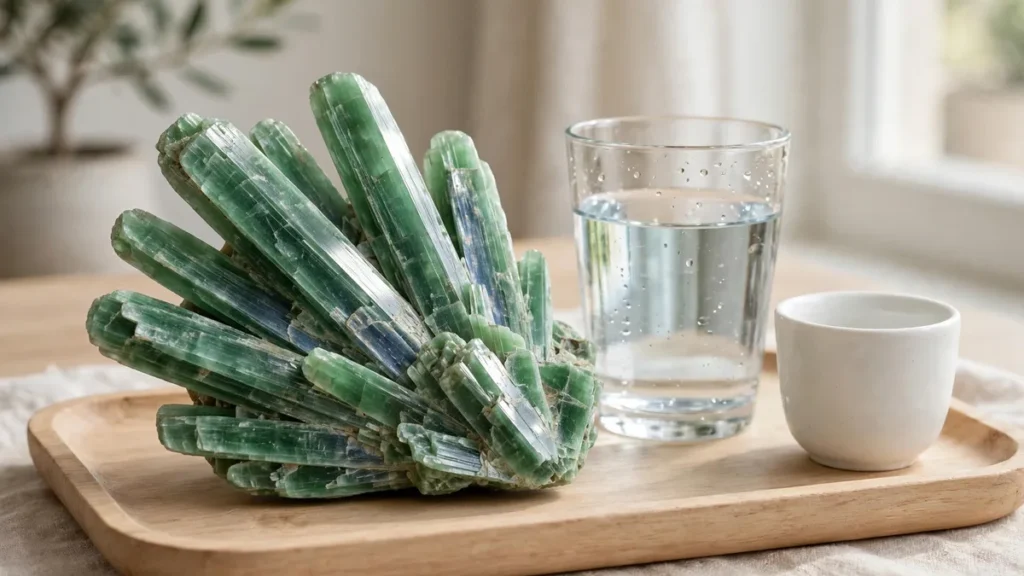
Some nights ask for very little. The day is done, the lights are low, and the house has gone quiet in the way that only evening can manage. Those are the nights when a small, calm habit matters most, and when one quiet object on the bedside table can make the whole room feel slower and softer.
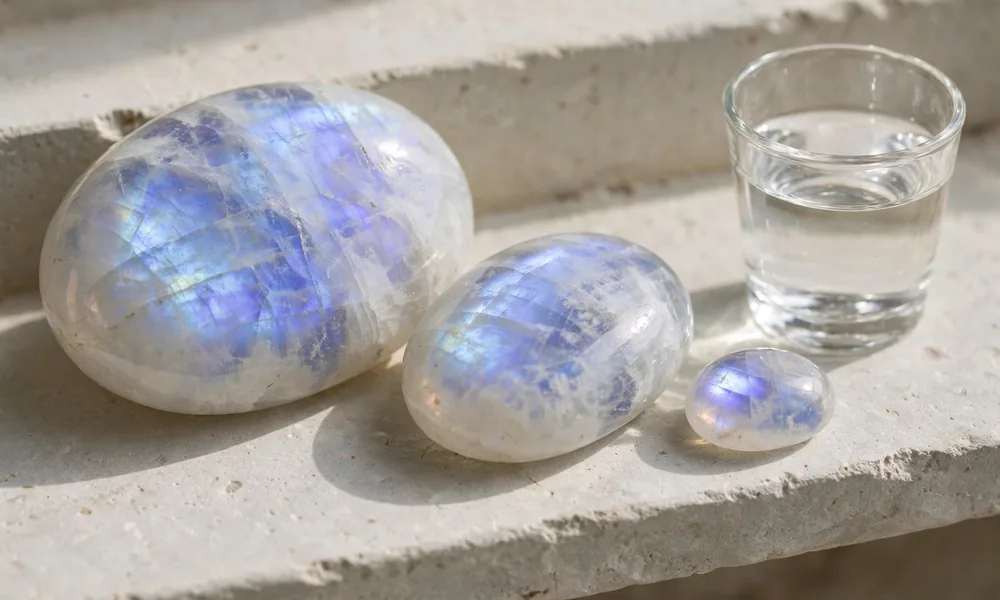
Rainbow moonstone is a stone that suits those quiet nights. It is a milky white feldspar, pale and soft, with a gentle flash of blue and violet that moves across it like light on still water. Set it beside a glass of water, and it sits there like a small piece of moonlight.
This guide explains what rainbow moonstone is, how to choose a piece, how to keep it safely beside water, and how to build a short quiet-night habit around it. The stone is for display and handling only, never a treatment. It will not heal anything. It is simply a beautiful object that helps a night feel slower and calmer.
Key Takeaways
- Rainbow moonstone is a milky white feldspar with a soft blue and violet flash.
- Its gentle glow suits quiet nights, dim rooms and the slow hour before sleep.
- Rainbow moonstone is for display and handling only; it will not heal anything.
- The stone stays beside drinking water, never in it, and it should be kept dry and dusted.
- A quiet night needs very little: soft light, plain water, one stone, and time.
What Rainbow Moonstone Is
Rainbow moonstone is a variety of feldspar, a common mineral family that also gives us peach and black moonstone. Its body is milky white, sometimes almost clear, and its surface carries a soft flash of blue, violet and pale gold. That flash is called adularescence, and it drifts across the stone as you turn it, bright in one angle and gone in the next.
Hold a polished piece in your palm and it feels cool, smooth and solid. The surface is glassy, and the flash seems to float just below it, like light caught under thin ice. No two pieces are quite the same.
Why Quiet Nights Feel Different
A quiet night feels different because it asks nothing of you. The work is done, the messages can wait, and the room grows dim. A quiet night is a night given a little shape on purpose, and that shape can be very small indeed.
A soft stone helps because it gives the eye somewhere to rest. When the evening feels scattered, a single pale object on a tray can pull the attention back to one place. The blue flash of rainbow moonstone suits this mood especially well, because it appears and fades gently, like the last light of the day. Where peach moonstone warm peach mornings offers warm peach for soft mornings, this guide offers a cool blue flash for nights that need to feel quiet instead.
The Soft Flash Explained
The soft flash of rainbow moonstone comes from thin layers inside the feldspar. Light enters the stone, bounces between those layers, and returns as a soft blue glow, sometimes with violet or pale gold at the edges. The effect is gentle, never bright, and it moves as the stone moves.
Look for a flash that drifts smoothly. The best pieces show a broad, even glow across a milky white body, with no dull patches. Turn the stone slowly under a lamp and watch the light travel.
Choosing a Rainbow Moonstone
Choosing a rainbow moonstone is mostly a matter of looking closely and trusting your eye. A good piece shows a clear milky white body with a soft blue flash, not a grey or cloudy stone with no light at all. The flash should be blue and violet, gentle rather than garish, and it should move when you turn the stone.
Size matters less than feel. A palm-sized tumbled stone is enough for a bedside tray. Look for a smooth polish with no sharp chips, and check that the stone sits flat. If its flash makes you pause, it is the right one. Hold the stone under a warm lamp and then under cool daylight, because a good flash should show in both, soft and steady rather than bright in only one light.

A Quiet Night Routine
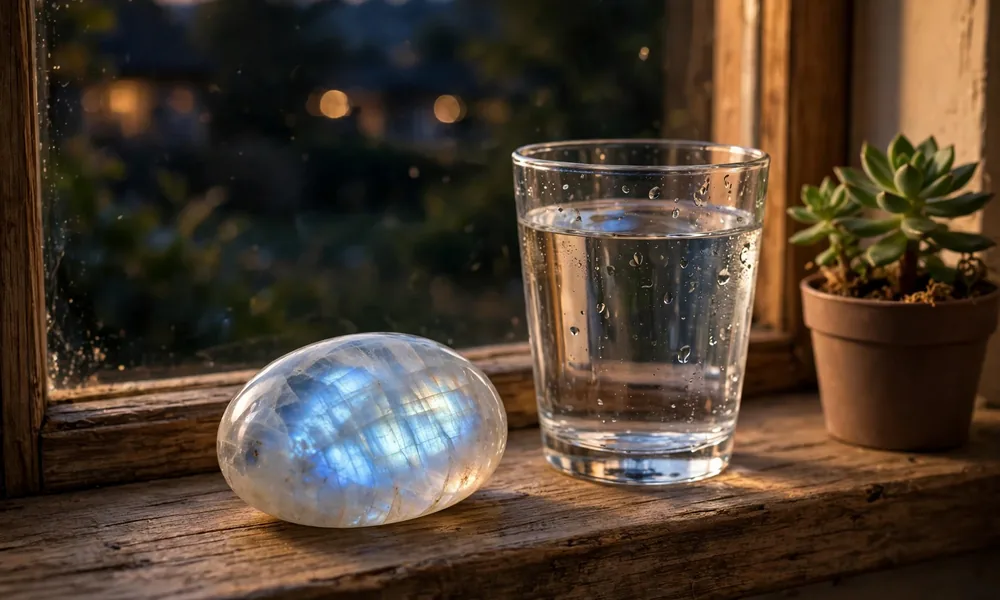
A quiet night routine takes only a few minutes, and it starts before the lamp goes out. Place the stone on a small tray beside a clear glass, and set the tray where the lamplight will find it. When the evening winds down, fill the glass with fresh water and drink it slowly. Then pick up the stone and look at the flash for a few breaths.
Put the stone back on the tray, and let the night begin. The routine is simply water, soft light, one pale stone, and a short pause before sleep.
Rainbow Moonstone Beside Water
Water belongs beside the stone, never around it. Set a clear glass of fresh drinking water next to the stone on the tray. They share a tray, not a glass, and that is the only safe way to pair them. Never place the stone inside drinking water, and never soak it, because a stone in water can chip, dull or carry dust into the glass.
If the glass spills, lift the stone away, dry it with a soft cloth, and set it back once the tray is dry. Where black moonstone soft grey quiet nights keeps a dark grey stone beside water on quiet nights, this guide keeps a milky white stone with a blue flash beside water, with the same dry rule.
Keeping the Stone Dry and Clean
Rainbow moonstone is fairly hard, but it still deserves gentle, dry care. Dust it once a week with a soft, dry cloth. Do not use soap, polish or cleaners, and never scrub it. A dry cloth is enough.
Keep the stone away from damp windowsills, steamy bathrooms and kitchen sinks. Store it on its tray in a dry room, out of direct sun. If it ever gets wet, dry it at once and leave it in open air for an hour.

Rainbow Moonstone at a Glance
| Milky white body | Soft blue flash | Keep it dry |
|---|---|---|
| Pale, cool tones | Drifts with light | Beside water only |
| Smooth, glassy polish | Blue and violet | Dust with dry cloth |
| Quiet night stone | Slow, gentle glow | Never soak it |
A Quiet Corner for the Stone
A quiet corner gives the stone a home, and a home makes the night routine easier to keep. Choose a small, clear surface near a lamp: a bedside table, a shelf, or a corner of a desk. Set down a small tray, place the stone on it, a clear glass beside it, and little else.
Keep the corner the same from night to night. When the stone always sits in the same place, the evening pause becomes a habit instead of a decision. A small lamp nearby is enough, and the corner should stay free of clutter so the stone is the first thing your eye finds.
Stones That Must Never Touch Water
Not every stone is safe beside water, and some must never touch water at all. Malachite must never go in water or in elixirs, because it can release harmful substances. Hematite must never go in drinking water. Apatite, lepidolite — which contains lithium — pyrite, angelite and amber must never go in drinking water or in soaks either. These stones belong on a dry shelf, far from any glass you drink from.
Rainbow moonstone is different: it is a fairly hard feldspar stone, safe to hold and display. Even so, it still stays beside water, never in it.
When a Stone Is Not the Answer
A stone is not the answer to a health problem, and rainbow moonstone is no exception. It will not heal anything, it will not calm a medical condition, and it will not replace rest, food, water or a doctor. The stone is a beautiful object, and that is enough.
If you feel unwell, please see a doctor. Enjoy the stone for what it is, a piece of pale moonlight. Where labradorite shimmer evening beauty uses a grey stone with green and gold flashes for evening beauty, rainbow moonstone offers a milky white stone with a blue flash for quiet nights instead.
Your Quiet Nights Checklist
- Place the stone on a small tray beside a clear glass of water.
- Drink a glass of fresh water slowly when the evening winds down.
- Hold the stone for a few breaths and watch its soft blue flash.
- Keep the stone beside water, never inside drinking water.
- Dust the stone weekly with a soft, dry cloth, never soap.
- Remember the stone will not heal anything; see a doctor for health problems.
Frequently Asked Questions
What is rainbow moonstone?
Rainbow moonstone is a milky white feldspar with a soft blue and violet flash that drifts across the stone as you turn it in the light. Its glow comes from fine layers inside the stone, and it suits quiet nights and dim rooms.
Is rainbow moonstone safe beside water?
Yes, it is safe to keep beside a glass of drinking water, on the same tray. It must never be placed inside drinking water or soaked.
Will rainbow moonstone heal anything?
No. Rainbow moonstone will not heal anything. It is a beautiful object for display and handling, and the calm comes from the pause, the water and the slow evening.
How do I clean rainbow moonstone?
Dust it once a week with a soft, dry cloth. Do not use soap, polish or cleaners, and never scrub it.
How is rainbow moonstone different from black moonstone?
Black moonstone is dark grey with a pale silvery blue sheen, while rainbow moonstone is milky white with a soft blue and violet flash.
Where should I keep my rainbow moonstone?
Keep it on a small tray in a dry room, with a clear glass of water beside it. A bedside table works well, as long as the spot stays dry.
The Bottom Line
Rainbow moonstone brings a soft flash to quiet nights: a milky white stone with blue and violet light, gentle in a dim room. Keep it beside water, never in it, dust it dry, and let a short evening pause do the rest.
A Note for Quiet Nights
Keep it pale, keep it dry, keep it slow. A soft flash, seen quietly, can still end a day well.